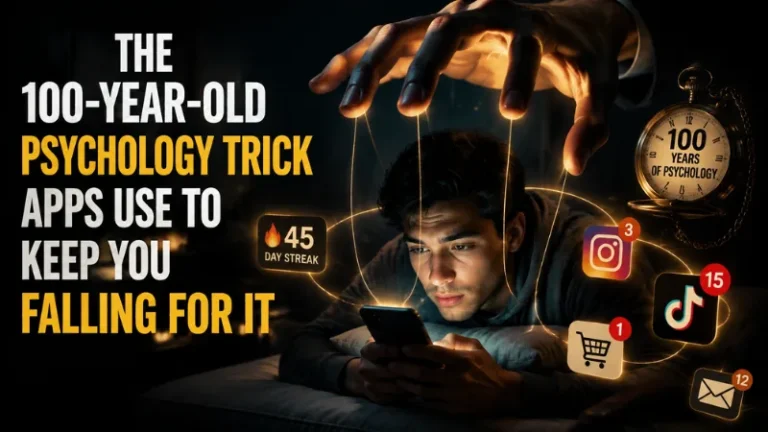
The 100-Year-Old Psychology Trick Apps Use to Keep You Falling For It
10 major brands using the Zeigarnik Effect to keep you clicking, drain your wallet, steal your screen time, and keep you coming back for more. It is midnight. You are exhausted, trying to sleep, and somehow your brain has chosen this exact moment to obsess over one thing: A $65 linen shirt still sitting in your shopping cart. You do not even need it. You added it while waiting for coffee and moved on with your day. Your brain, apparently, did not. You went through a full day of tasks, meetings, and things you actually finished. But that unfinished cart is still hanging around. Why does the stuff we don’t finish stay with us longer than the things we actually complete? That is the psychological trap of open loops, and nearly 100 years after psychologists first noticed it, app developers and growth marketers have become very good at using it to pull you back in and nudge you toward “Complete Order.” The 1920s Berlin Waiter Who Started It All Long before product managers in Silicon Valley were running A/B tests to optimize your screen time, a Russian psychologist named Bluma Zeigarnik was hanging out at a bustling café in Berlin. It was 1927, and Zeigarnik noticed something deeply bizarre about the café’s serving staff. The waiter taking their table’s order possessed what appeared to be a superhuman memory. He managed complex, multi-course drink and food orders for massive groups entirely in his head. No notepad, no digital tablet, zero written notes. He knew exactly who ordered the extra espresso shot, who wanted oat milk, and who had a split bill running. Except there was a glaring catch. The moment a table paid their bill and walked out the front door, Zeigarnik stopped the waiter and asked a quick question about what those customers had eaten. The waiter looked at her with total, unblinking blankness. He couldn’t recall a single dish from the order he had served just three minutes prior. Once the transaction was settled, his brain executed a hard factory reset on that data. Fascinated, Zeigarnik headed straight to her psychology laboratory to run controlled experiments. She assigned subjects a series of small tasks like solving puzzles, stringing beads, or folding paper. Midway through half of the tasks, she deliberately interrupted them. When she tested their recall later, participants remembered the interrupted, unfinished tasks far better than the tasks they had finished undisturbed. This phenomenon became known as the Zeigarnik Effect. Shortly after, her colleague Maria Ovsiankina uncovered the second piece of the puzzle: the Ovsiankina Effect. Her experiments showed that when a task is interrupted, people feel a strong urge to return and complete it. Together, they explain two parts of the same pull: The Zeigarnik Effect: unfinished tasks can stay more mentally active than completed ones. The Ovsiankina Effect: once a task is started or interrupted, you feel a pull to return and finish it. 10 Brands Weaponizing Your Unfinished Business If your phone currently feels like an inescapable trap of red notification badges and abandoned shopping carts, it isn’t an accident. Modern UX designers know all about Zeigarnik and Ovsiankina. They purposefully engineer interfaces that open psychological loops, ensuring your brain remains in a state of subtle tension until you open the app to close them. Here are 10 major brands using 100-year-old brain science to dominate your digital life: 1. Nike & ASOS: The Abandoned Cart Ping You add a coat on ASOS or sneakers on Nike, hit the checkout screen, see a surprise $15 shipping fee, close your browser tab, and try to walk away. Two hours later, your phone buzzes: “Your items miss you! Finish checking out before stock runs out!” Because you started the checkout, your mind logged it as an active project. The notification acts as a deliberate interruption, poking that open loop and triggering enough psychological discomfort that you re-open the app just to make the feeling go away. 2. LinkedIn: The “Profile Strength” Trap Ever signed up for LinkedIn and been hit with a progress bar claiming your profile is “64% Complete”? That incomplete bar is visual friction designed to trigger the Ovsiankina Effect. If LinkedIn demanded you fill out 15 tedious form fields on day one, you would delete the app immediately. But by showing a bar that is already partially filled, your brain gets tricked into believing the task has already commenced. The unfilled space acts as an open loop, driving you to spend twenty minutes adding skills, bios, and headshots just to experience the relief of a 100% status bar. 3. Duolingo: The Daily Streak Ultimatum The infamous Duolingo owl doesn’t just remind you to practice Spanish; it threatens to break your 45-day streak. An active streak is the ultimate open loop. Letting a streak die feels like abandoning a project halfway through, which drives tens of millions of users to open the app daily just to keep the loop intact. 4. Sephora: The Visual Preview Nudge Sephora takes cart abandonment a step further. They don’t just send a generic email; they trigger push notifications featuring a high-res visual preview of the exact lipstick or moisturizer shade you left sitting in your cart. Seeing the specific product reignites the original goal-directed tension, making it almost impossible to ignore. 5. Slack & Apple iOS: The Red Badge Friction That tiny red dot sitting on your Slack, Gmail, or Instagram icon? It exists solely to exploit task interruption. Your brain interprets that red badge as an incomplete conversation or unresolved task, creating a low-level itch that forces you to tap the app just to clear the screen. 6. TikTok: The Infinite “For You” Loop TikTok’s algorithm doesn’t just serve hyper-personalized content; it structures video edits so that transitions feel seamless. Because videos loop endlessly and auto-play the next clip before your brain can process the end of the previous one, you never experience a natural stopping point. Without a closed loop, your brain stays locked in a
The 100-Year-Old Psychology Trick Apps Use to Keep You Falling For It Read More »