
Our take on Chicago Mayoral Elections 2023
0
0


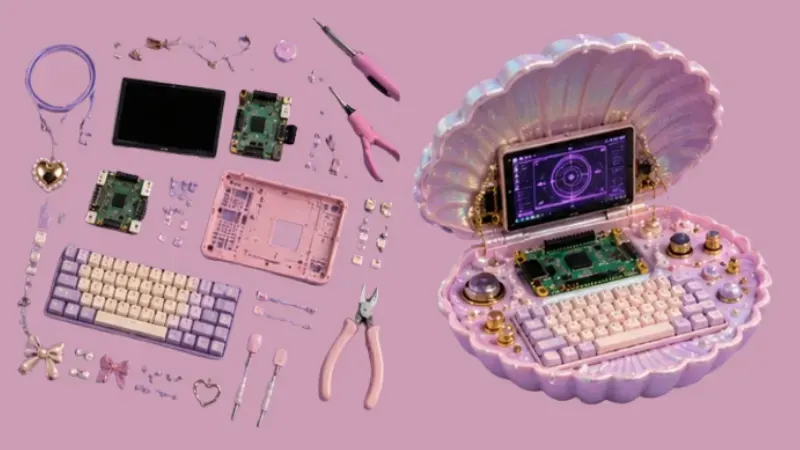
Tiny screen? Check. Mechanical keyboard? Check. Mysterious switches nobody else understands? Absolutely.
Open the case and you might find a miniature screen glowing beside a mechanical keyboard, a Raspberry Pi tucked beneath a web of wires and a collection of switches whose purpose only the builder fully understands. The outside may be covered in stickers, pearls, translucent plastic or hardware-store bolts. Nothing looks factory-made, and that is exactly the point.
A cyberdeck is a custom-built portable computer assembled around the needs, imagination and aesthetic of its maker. Some live inside rugged equipment cases. Others appear in purses, makeup boxes, seashell-inspired shells or repurposed packaging. They are part computer, part craft project and part personal statement.
Once associated mainly with cyberpunk fiction, hacker culture and post-apocalyptic design, cyberdecks are now being reinvented by a wider generation of makers who want technology to feel personal again. We have faster and more polished machines than ever, yet many are anonymous, sealed, difficult to repair and almost impossible to make truly our own. Cyberdecks offer the opposite experience: visible mechanisms, creative control and the satisfaction of building something by hand.
The fascination is not really about replacing a laptop. It is about recovering something consumer technology has gradually taken away: the pleasure of understanding a machine, changing it and leaving evidence of yourself in the final object.
So what exactly makes a computer a cyberdeck? Where did the idea come from, what do people use these machines for, and how difficult is it to build one yourself?
A cyberdeck is a portable computer designed and assembled by its owner rather than purchased as a finished device. There is no formal engineering standard, but most cyberdecks share four qualities: they are portable, personally assembled, visibly customised and created around a particular purpose or fantasy.
A typical build combines a small computer board with a compact display, keyboard or custom controls, storage, a power source and a handmade or repurposed enclosure. Some also include software-defined radio, environmental sensors, offline maps, local archives, retro games or cybersecurity tools.
That makes a cyberdeck different from a laptop. A laptop is a finished general-purpose product whose shape, components and assumptions were chosen by a manufacturer. A cyberdeck is closer to a working prototype, an art object and a personal tool at the same time. A laptop asks, “What might the average customer need?” A cyberdeck asks, “What do I want this machine to do?”
One clarification is useful: the device is generally called a cyberdeck, not a “cybertech”. The term has fictional roots going back more than 40 years, although the recognisable real-world hardware movement developed much later.
Cyberdecks did not begin as Raspberry Pi projects. Their history runs through personal computing, cyberpunk fiction and the modern maker movement.
In the 1970s, microprocessors helped move computing away from institutional mainframes and towards hobbyist machines that individuals could programme and modify. The Smithsonian notes that early personal computers gave individuals access to tools previously controlled by businesses and corporations, although those machines often demanded considerable technical effort.
Historian Fred Turner connects this period to countercultural ideas about decentralisation, information sharing and personal empowerment. The computer was imagined not only as a product, but as a tool through which individuals could resist bureaucracy and expand their own capacities.
The word itself comes from William Gibson’s 1984 novel Neuromancer, where a custom “cyberspace deck” allows a hacker to enter a networked virtual realm. Gibson’s machine belonged to cyberpunk’s larger suspicion of corporations, concentrated power and technology that alters the human nervous system.
Real-world cyberdecks emerged gradually from maker, hacker and science-fiction communities. The r/cyberDeck community dates to 2016, and Hackaday was documenting Raspberry Pi cyberdeck builds by 2019. So the claim that cyberdecks “have been around since the 80s” is only partly accurate: the fictional concept dates to 1984, while the recognisable online hardware movement developed decades later.
By 2026, brightly decorated and highly individual cyberdecks were attracting wider attention online. Builds by creators such as Annike Tan reached millions of viewers, while Raspberry Pi highlighted the growing number of women bringing new styles and ideas into the maker community.
Cyberdecks look wonderfully chaotic from the outside, but most are built from a recognisable set of parts.
The brain is often a Raspberry Pi or another single-board computer, although builders may also use a mini PC, an old smartphone, a microcontroller or salvaged laptop hardware. The choice depends on the deck’s size, power needs and intended job.
The Raspberry Pi is popular because it compresses a capable computer into a small board while leaving ports and hardware interfaces accessible. Current Raspberry Pi 5 models provide a quad-core Arm processor, external display support and general-purpose input/output connections, giving builders enough power for ordinary Linux tasks as well as specialised hardware projects.
Most decks use a compact HDMI, USB-C or touchscreen display. Some builders choose a wide screen for writing or terminal work; others deliberately use a tiny screen because it fits the object’s fantasy, even if it is less practical.
Input may come from a mechanical keyboard, miniature keyboard, trackball, joystick, rotary knobs, toggle switches or programmable buttons. A mysterious switch is sometimes practical and sometimes there because mysterious switches are fun.
A portable deck needs a battery or external power source. Beginner builds commonly use a ready-made USB power bank. More advanced makers may design custom battery and charging systems, but power management and heat are among the parts of a build that require the most care.
The enclosure gives a cyberdeck its identity. It may be a rugged case, toolbox, handbag, makeup case, vintage electronics shell, 3D-printed body or something rescued from the recycling bin. Inside, brackets, panels, screws and adhesive mounts keep the components from becoming an expensive maraca.
Depending on its purpose, a deck may include speakers, antennas, cameras, sensors, GPS, cooling fans, radio hardware, storage drives, lights or decorative elements. These additions are what turn a basic portable computer into a machine designed for one person’s particular mission.
Most cyberdecks are not intended to become everyday laptop replacements. They are usually designed around a narrower task, an aesthetic experiment or the pleasure of learning how computers work.
Function varies widely because each machine is designed around its owner’s priorities rather than a manufacturer’s product roadmap. A deck does not need to be the most efficient solution to justify its existence. Sometimes the point is to build a computer that feels as though it belongs in an imagined world – and then make that world actually boot.
A cyberdeck is not usually assembled from one universal kit. The builder makes a chain of decisions, and each decision changes the next one.
A writing deck needs a comfortable keyboard and long battery life. A radio deck needs antennas and specialised hardware. A field computer may need weather resistance. A decorative build may prioritise appearance and interaction. Purpose prevents the project from becoming a box full of unrelated cool parts.
The board determines processing power, operating system options, ports, cooling requirements and battery life. A lightweight Linux terminal can use modest hardware; a local AI or media project may need a more powerful board or mini PC.
The screen and keyboard usually determine the deck’s basic dimensions, so builders often choose them before designing the enclosure. This stage also includes deciding where ports, switches, knobs and pointing devices will sit.
The computer, display and accessories must receive stable power. The builder also needs to plan cable paths, charging access, ventilation and heat. A deck can look perfect and still fail if a connector is inaccessible or the processor cooks inside a sealed jewellery box.
Builders measure the components, make a layout and create openings for the screen, keyboard, ports and ventilation. Parts may be secured with screws, brackets, laser-cut panels, 3D-printed supports or removable adhesive mounts. Prototypes are often made from cardboard before anyone attacks the final case with a drill.
Most Raspberry Pi cyberdecks run a Linux-based operating system. The builder then installs the tools required for the deck’s purpose, configures controls and may create a custom interface that launches automatically.
Building rarely happens in a perfect straight line. A cable may be too short, a hinge may block the screen, a keyboard may draw more power than expected or the case may trap heat. Revision is not evidence that the project has failed. Revision is the project.
Your first cyberdeck does not need custom circuitry, soldering or a 3D printer. A simple version can be built from ready-made parts, tested on a desk and placed into an enclosure only after everything works.
Safety note: beginners should avoid constructing lithium battery packs from loose cells unless they understand charging, protection and thermal safety. A reputable, ready-made USB power bank is usually the simpler starting point.
There is no single price. A deck built from reused parts can be relatively inexpensive, while a powerful mini PC, premium display, custom keyboard and fabricated enclosure can cost more than an ordinary laptop. The computer, screen, battery and enclosure usually account for most of the expense. Reusing an old case, keyboard or display can reduce both cost and waste.
One explanation comes from self-determination theory. Ryan and Deci argue that people are more deeply motivated when an activity supports autonomy, competence and relatedness.
Building a cyberdeck can satisfy all three. The maker chooses the form and function, learns enough electronics or code to make it work, and shares the result with a community that swaps instructions, files, mistakes and encouragement.
There is also a measurable attachment to self-made objects. Norton, Mochon and Ariely called this the ‘IKEA effect’: people often value successfully assembled objects more highly because their own labour has become part of the object’s meaning.
A cyberdeck intensifies that effect because the builder is not merely following one set of instructions. She is solving dozens of small problems involving dimensions, heat, power, wiring, software and appearance. Each decision makes the machine less interchangeable.
Material engagement theory adds another layer. Malafouris argues that thinking does not occur only inside the head; tools and materials can actively organise thought. A loose wire, awkward hinge or badly positioned screen creates a concrete problem that invites experimentation. The device teaches through resistance. This is very different from tapping a sealed phone whose difficult decisions have been hidden behind glass.
Nostalgia matters too, even for people who did not personally experience the 1980s or early 2000s. Research distinguishes personal nostalgia from historical nostalgia, a longing for a period known through stories, media and objects. Recent psychological work suggests nostalgia can produce both curiosity about technology and uncertainty about new systems, including AI. A cyberdeck lets its maker borrow the visual optimism of an imagined past while using current components.
The “girlies” part of the trend is not trivial decoration added to serious technology. It challenges an old cultural rule about what technical competence is supposed to look like.
Cyberdeck culture previously favoured rugged cases, dark colours, exposed bolts and military or hacker imagery. Recent makers have kept the wiring and programming but expanded the visual code. Pearls, pink plastic, shells, miniature charms, bows and makeup cases now sit beside Linux terminals and circuit boards.
The point is not that women naturally prefer one aesthetic. It is that technical legitimacy no longer has to be performed through masculine design conventions.
Research on feminist hackerspaces helps explain why this matters. Fox, Ulgado and Rosner found that women-centred making spaces did more than provide access to equipment. They altered the social conditions under which technical work was recognised, taught and valued.
Later research similarly describes feminist makerspaces as places where care, mutual aid and shared governance support alternative cultures of technology production.
A highly feminine cyberdeck therefore performs two acts at once. It demonstrates technical skill, and it refuses the idea that seriousness requires visual neutrality. The decoration is part of the argument.
The cyberdeck revival arrives at a moment when many people feel that digital technology is powerful but increasingly difficult to inspect, refuse or control.
In a representative 2025 Pew survey, 50% of US adults said they were more concerned than excited about the increased use of AI, and about six in ten wanted more control over how AI was used in their lives. A majority also expected AI to weaken creative thinking.
A cyberdeck offers a symbolic reversal. Instead of asking an opaque service to produce something instantly, the builder spends hours measuring, configuring, soldering where necessary and correcting errors. The friction is not a flaw. It is the source of authorship.
Repairability adds a political dimension. The US Federal Trade Commission’s Nixing the Fix report documented concerns about manufacturer restrictions on independent repair and recommended expanding repair options.
A cyberdeck is rarely effortless to repair, but its architecture is usually legible. Components can often be identified, removed and replaced without asking the original manufacturer for permission.
This does not make cyberdecks inherently anti-AI. Some builders may run local AI software on them. The deeper contrast is between technology controlled by distant systems and technology the owner can inspect, configure and alter.
Cyberdecks can be configured for offline use and local storage, but a homemade computer is not automatically private or secure. Privacy depends on its operating system, software, network settings and the builder’s knowledge.
They are not automatically environmentally friendly either. New boards, batteries, screens and 3D-printed plastic carry material costs. A build becomes meaningfully less wasteful when it reuses existing components, remains repairable and serves a lasting purpose rather than becoming disposable content.
Cyberdecks also inherit a contradiction from hobbyist computing. Personal tools can empower their owners, but a hobby built around specialised components, spare time and fabrication equipment is not automatically accessible to everyone. Beginner-friendly kits, shared workshops and repair communities can lower the barrier, but they do not erase it.
The most evidence-based prediction is that cyberdecks will remain a niche practice while influencing wider expectations about personal technology. Their strongest contribution is cultural: they make modularity, offline capability, visible construction and unconventional design desirable again.
Future builds are likely to use lower-power boards, local AI models, solar charging, software-defined radio and offline knowledge libraries. That does not make them automatically private or secure; those qualities will still depend on software choices, configuration and the builder’s knowledge.
The more speculative possibility is that commercial brands will imitate the aesthetic while removing the freedom that made it attractive. A mass-produced “cyberdeck-style” gadget could reproduce the knobs, translucent shell and retro screen while remaining sealed, tracked and difficult to repair.
The real test is not whether a device looks homemade. It is whether its owner can understand it, alter it and keep it working.
Cyberdecks are popular because they convert technology from a service delivered by distant companies into a material relationship. You can touch the parts, make the wrong choice, revise it and leave evidence of yourself in the final object.
That is not nostalgia for primitive computing. It is a demand for technology with authorship.
No. A Raspberry Pi is a single-board computer. A cyberdeck is the complete custom device built around a computer board, display, controls, power source and enclosure.
Usually not. Most are built for a narrow purpose, aesthetic experiment or learning project. Their value lies in customisation rather than efficiency.
Recent female creators have made the hobby more visible and expanded its visual language. Their builds show that electronics can be feminine, playful and technically serious at the same time. Current evidence comes mainly from creator audiences and media observation, not a comprehensive gender survey.
Not inherently. Some builders frame them as resistance to automated, standardised culture, while others may run local AI software on them. The deeper theme is user control.
They can be configured for offline use and local storage, but a homemade computer is not automatically secure. Privacy depends on its software, connectivity and configuration.
They can reduce waste when they reuse old cases, screens or keyboards and remain repairable. A build made entirely from new parts may have no environmental advantage over an ordinary device.
In practice, most cyberdecks aren’t daily laptops. Builders use them for portable Linux terminals, cybersecurity labs, amateur radio, writing devices, retro gaming, field research, offline knowledge libraries, or simply as creative engineering projects. Function varies widely because each machine is designed around its owner’s priorities rather than a manufacturer’s product roadmap.

Log in to support this story.
New here? Create an account


Discussion · 0 Comments
No comments yet — be the first to share your thoughts.