
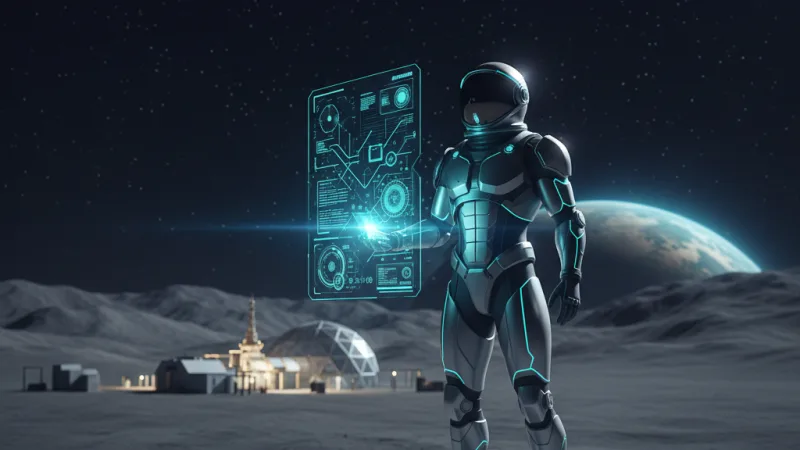
The Moon Calls Again
Humanity has always been fascinated by the night sky. Peering into the seemingly endless expanse, almost everyone has dreamed of soaring among the stars and touching the galaxies. In 1969, humanity made a giant leap when man took a small step on the moon. That step gave new life to the already kindling passion for space exploration and astronomy. It pushed satellites to the edge of our solar system and fueled the hope that we would one day go further.
But then the momentum stopped. For over half a century, no human has left Earth’s orbit. The moon, our closest source of wonder, became a distant memory. Now that is about to change. Project Artemis is preparing to carry astronauts back to the lunar surface, this time with the intention to stay.
The Space Age and Beyond
In 1957 Sputnik orbited Earth. A decade later Apollo astronauts walked the lunar surface. Humanity reached beyond its cradle, if only briefly. The moon landings ended in 1972, but space telescopes, robotic probes, and planetary rovers carried exploration further. The digital era followed, with data streams from instruments so powerful they needed algorithms to keep up.
Project Artemis: A Return with Purpose
The Mission
Artemis carries a symbolic name. In Greek mythology, Artemis is the twin sister of Apollo, the goddess of the hunt and the protector of new frontiers. The Apollo missions placed humanity on the moon for the first time. Artemis intends to build on that legacy by making the moon a place we can return to, study deeply, and eventually live on for extended periods. This program is not just about a few landings. It is about establishing the groundwork for a sustained human presence beyond Earth.
Key Components
- Space Launch System (SLS): At the heart of Artemis is the SLS, the largest and most powerful rocket ever developed. Its engines generate millions of pounds of thrust, enough to lift both astronauts and the heavy cargo required for lunar missions. Unlike Apollo’s Saturn V, the SLS is designed with modern systems and flexibility to support not just moon landings but future missions to Mars.
- Orion spacecraft: Once launched, astronauts will travel inside Orion, a deep-space capsule built for weeks of travel far beyond low Earth orbit. Orion includes life-support systems, advanced heat shielding to survive re-entry, and room for four astronauts. It can dock with other spacecraft in lunar orbit, such as Gateway, and act as the safe return vehicle to Earth.
- Human landing systems: To reach the surface itself, Artemis will use specialized landing vehicles built in partnership with private industry companies like SpaceX and Blue Origin. These landers are being designed to handle multiple trips, carry crews safely down to the lunar terrain, and return them to orbit. They mark a shift toward reusable systems that reduce costs and expand mission possibilities.
- Gateway: In orbit around the moon will be Gateway, a small but vital space station. It will act as a staging ground for landings, a research lab, and a logistics hub. Unlike the International Space Station, which circles Earth, Gateway will orbit the moon in a special near-rectilinear halo orbit, providing consistent access to the lunar surface. It will also be a testing platform for technologies needed on long voyages to Mars.
The Vision
Artemis is designed with more than short-term exploration in mind. NASA and its partners aim to build a sustainable presence on the moon by the end of this decade. That means deploying habitats where astronauts can live for weeks or months, creating reliable power systems such as solar grids, and testing resource use on the lunar surface. One of the biggest goals is to locate and use water ice, which could supply both drinking water and fuel.
The program is also a training ground for the challenges of Mars. Operating on the moon allows teams to practice long-duration missions, radiation protection, autonomous operations, and deep-space logistics. The moon becomes a stepping-stone, both scientifically and strategically.
In essence, Artemis is not a repeat of Apollo. It is a new chapter that transforms the moon from a destination into a proving ground for the next great era of human exploration.
Artificial Intelligence: A Steady Companion
From Computation to Autonomy
Astronomy and space exploration have always leaned on computational help. Early on, tables of star positions were hand-calculated, then transferred to mechanical and digital computers. Automated telescopes now scan the skies and feed images into software that can classify stars faster than teams of humans.
AI in Modern Astronomy
Machine learning sorts through petabytes of sky surveys to identify faint galaxies or distant exoplanets. Image processing algorithms sharpen data from telescopes like Hubble, rescuing blurred pictures and revealing cosmic details.
AI in Artemis
- Rovers and robotic scouts use autonomous navigation.
- Algorithms select safe landing zones by analyzing terrain.
- Machine vision identifies resources such as water ice.
- AI-assisted simulations reduce mission risks.
- Onboard AI helps spacecraft diagnose problems and conserve energy.
The Human Story and Its Responsibilities
Behind the machinery lies the human story. The return to the moon reflects our need to explore, to test boundaries, and to seek knowledge that reshapes who we are. International collaboration is central to Artemis, with partners across Europe, Japan, Canada, and beyond.
Yet ethical questions remain. How will we use lunar resources responsibly? How do we balance exploration with preservation? These questions matter as much as the rockets.
Closing and Future View
The arc of astronomy runs from stone circles aligned with stars to AI-guided spacecraft tracing orbits around the moon. Project Artemis represents both a return and a beginning. The partnership between human imagination and artificial intelligence is not temporary. It grows deeper with each mission, shaping how we see the universe and how we survive in it.
The moon once marked time for farmers and poets. Soon it will mark the next leap for explorers. Humanity’s oldest companion in the sky is about to become its newest home.
Future View: Artemis is the trial run to establish a base on the moon for the long run. From mining explorations, space tourism and venturing into deep space, Artemis will be the key to setting up a pitstop at the lunar surface. The most important aspect of Artemis however, remains the exploration of the sea of tranquility, water ice as they call it, at the South pole of the lunar surface, a key ingredient for future deep space missions. The water ice is theorized to be a key ingredient for life support and rocket fuel.