RethinkTrends

Mansi Hake

10 AI-Ready Skills Every Content Marketer Should Know

10 AI-Ready Skills Every Content Marketer Should Know

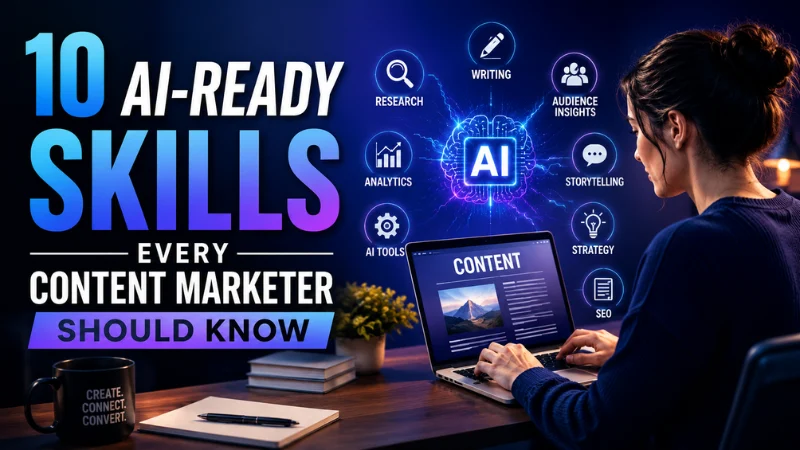
Nobody warned us about this part. You signed up to write blogs, build content calendars, manage editorial pipelines, maybe craft a few email sequences and LinkedIn posts along the way. And then AI arrived and everyone in your industry started saying things like “workflow automation,” “agent oversight,” and “signal-based personalisation” in meetings, in job descriptions, in performance reviews as if these were words that had always existed. They were not words that had always existed. But here’s the thing. The shift is real, it’s already happened, and panicking about it is not a skill listed anywhere on this list.  What is on this list: ten things that will make you genuinely more valuable in a market where AI handles the generic and humans are expected to handle everything else. None of these require a computer science degree. All of them require paying attention. 1. AI Workflow Design: Because One Good Prompt Is Not a Strategy Writing a prompt that produces a decent output is a starting point, not a skill. The real skill is building a repeatable system around that prompt. Instead of asking AI to “write a content campaign,” an AI-ready content marketer breaks the task into something the machine can actually work through: Analyse audience research and past content performance Pull out the topics and angles that consistently drive engagement Suggest content formats based on funnel stage Generate draft variations for different channels and personas Check the copy against brand voice and editorial guidelines Flag it for human review before anything goes live That’s a workflow. That’s a system that produces consistent, useful output instead of one good draft followed by three confusing ones. The goal is not to generate content faster. It’s to make better editorial decisions, more reliably. Speed is a side effect. 2. Prompting With Context: Stop Asking Vague Questions If you prompt an AI, “Write a LinkedIn post about content marketing.” You will get a LinkedIn post about content marketing. It will be perfectly fine. It will also sound like every other LinkedIn post about content marketing written by someone who knows nothing about your audience, your editorial angle, or your brand’s point of view. AI produces what you give it. If you give it nothing, it produces the average of everything it has ever seen on the topic. Strong prompts include: Who the reader is and what they care about What the brand’s content position is What objections or content fatigue the audience typically has What the brand voice actually sounds like Where in the buyer journey this content sits What evidence or data is available What the reader should think, feel, or do next Prompting is less about cleverness and more about context. The more specific you are about the situation, the more useful the output becomes. 3. Human Editing and AI Quality Control: The Most Underrated Skill on This List  AI can write a paragraph that sounds completely authoritative and is factually wrong.  It can sound like your brand without actually sounding like your brand. It can produce content that is polished, confident, and entirely pointless. This is why editing is becoming more valuable, not less. Someone still has to ask the uncomfortable questions: Is this claim accurate? Is this message specific enough to mean anything? Does this actually reflect how the company thinks? Is there any real evidence here, or just confident sentences? Is this genuinely useful to a content marketer reading this, or does it just exist? AI may write the draft. But a content marketer still decides whether the draft deserves to go anywhere. The most valuable people on content teams will not be the ones who produce the most. They will be the ones who recognise what is actually worth publishing. 4. Audience Intelligence: The Thing AI Cannot Research for You AI can summarise audience data beautifully. But it cannot replace the actual understanding that comes from reading through six months of blog comments, sitting in on a content debrief, or going through reader feedback and noticing the same gap appearing over and over. Real audience intelligence for content marketers comes from: Content performance data (especially the pieces that underperformed despite strong effort) Reader surveys and direct feedback Comments, replies, and social responses to published work Search queries your audience is actually using Topics your sales team hears repeatedly but your blog has never addressed Newsletter unsubscribe reasons Here’s what this can produce: AI analyses thirty underperforming blog posts and surfaces a pattern. It found a reason that readers weren’t disengaged because of the topics. They were bouncing off because the intros spent too long framing the problem before getting to anything useful. That one insight will change how every article on the site gets structured going forward. AI found the pattern. The content marketer knew what to do with it. 5. Answer-Engine Optimisation (AEO): SEO Is Not Dead, But It Has a New Roommate Business buyers don’t just use search engines the way they used to in 2019. They ask questions through AI-powered experiences, conversational tools, and platforms that may return an answer without sending the user anywhere at all. No click required. No website visit. Just an answer, and then they move on. This creates a new challenge for content marketers specifically. You now need to create content that AI systems can understand, trust, and cite not just pages that rank for a keyword. Content that performs in this environment tends to have: Clear, direct answers to specific questions Strong headings that signal what each section covers Original data that isn’t available anywhere else Expert perspectives, not just explanations Comparison sections Real reader evidence Consistent brand information across every channel FAQs that actually answer what buyers ask The objective has shifted. It’s not just about ranking. It’s about becoming part of the answer and ideally, becoming the answer itself. 6. Original Point-of-View Creation: Generic Content Has Nowhere to Hide Anymore AI can explain anything in seconds. This means content that simply explains common knowledge

10 AI-Ready Skills Every Content Marketer Should Know Read More »
Why FIFA Mascots Stay Memorable Years After the World Cup

Why Do We Still Remember FIFA Mascots Years Later? The Answer Has Nothing to Do With Football

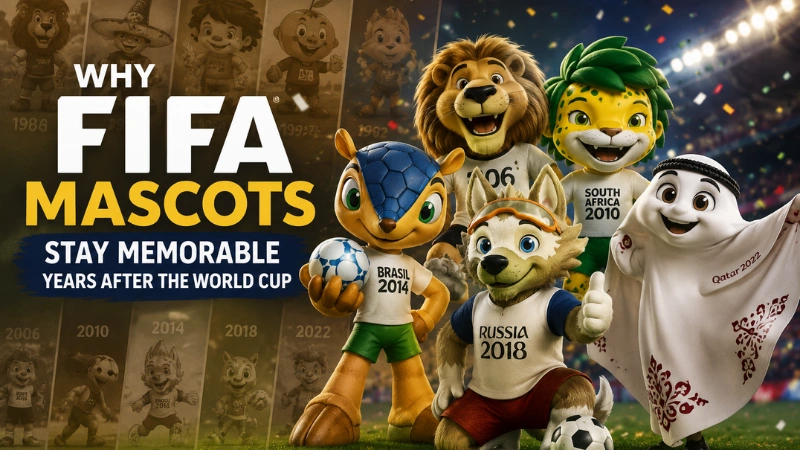
Think back to the first FIFA World Cup you truly remember. Maybe it was waking up in the middle of the night because your favorite team was playing. Maybe it was arguing with friends over who would win, collecting player stickers, or trying to recreate that one unforgettable goal in your living room. Every World Cup had something new to discover, a new official ball, a new tournament song, fresh jerseys, and an opening ceremony that made the event feel bigger than life. And somewhere in the middle of all that excitement was a new face waiting to welcome the world. For some, it was World Cup Willie, the cheerful lion who introduced the idea of a World Cup mascot back in 1966. Others grew up with Naranjito, the smiling orange from Spain, or Footix, the confident French rooster. More recent fans probably remember Zakumi, the green-haired leopard from South Africa, Zabivaka, the wolf in sports goggles from Russia, or La’eeb, the floating figure that sparked endless conversations during the Qatar World Cup. What’s fascinating is that these characters were never the stars of the tournament. They didn’t score goals, lift trophies, or deliver iconic moments on the pitch. Yet many of us can still picture them years, even decades later. That made me wonder: why? If I asked you to remember the official slogan from the first World Cup you watched, there’s a good chance you’d struggle. The same goes for the tournament logo. But the mascot? Somehow that memory feels much easier to retrieve. That isn’t a coincidence. Our brains are naturally better at remembering characters than symbols. At first glance, mascots seem like they’re made for children. They’re playful, colorful, and designed to make people smile. They wave to fans before the tournament kick-off, appear on merchandise, and often become the face of fan festivals. But that’s only part of the story. Behind every FIFA mascot is a carefully planned branding strategy. These characters help sell merchandise, create emotional connections, give sponsors a recognizable face, and represent the culture of the host nation in a way that a logo never could. Some even outlive the tournaments they were created for. The 2026 FIFA World Cup is perhaps the clearest example yet. Instead of introducing one mascot, FIFA introduced three, first Maple, a moose representing Canada, second Zayu, a jaguar for Mexico, and Clutch, a bald eagle for the United States. On the surface, it seems like a natural choice for a tournament hosted by three countries. The more I looked into it, the more intentional it felt. Were FIFA mascots always meant to be fun characters for children, or have they quietly become one of the most effective marketing tools in sports? To answer that, we need to go back long before football stadiums were packed with fans and long before mascots became collectible plush toys. We need to go back to where the idea of mascots began. Why Do We Remember Characters More Than Logos? Marketing has always been about making brands memorable. One way is to create a distinctive logo. Another is to tell great stories. Mascots sit at the intersection of both. They’re visual enough to be instantly recognizable and human enough to create an emotional connection. Researchers call this anthropomorphism that is our tendency to give human qualities to non-human things. It’s why we name our cars, talk to our pets, or feel bad when a robot in a movie gets hurt. Once something has a face and a personality, we stop treating it like an object and start relating to it like a character. Imagine explaining a football tournament to a seven-year-old. You could show them a tournament logo and explain what it represents. Or you could introduce them to a friendly lion who loves football and is excited to welcome the world. Which one do you think they’ll remember next week? The answer seems obvious, but it’s based on decades of psychology research rather than guesswork. Children, in particular, form emotional connections with fictional characters surprisingly quickly. Psychologists describe these one-sided emotional bonds as parasocial relationships. They’re the same reason children become attached to cartoon characters, superheroes, or animated movie characters they’ve never actually met. When Sports Discovered the Power of a Character It’s easy to assume that mascots have always been part of sports. They haven’t. In fact, for much of sporting history, the game itself was considered enough. Fans came to watch athletes, cheer for their teams, and celebrate victories. There wasn’t much thought given to creating a character that represented the event. That started to change in the 1960s. Television was bringing sports into living rooms across the world. Major tournaments were no longer local events, they were becoming global spectacles. Organizers suddenly had a new challenge. How do you make a tournament memorable after the final whistle? One of the earliest and most influential examples came in 1966, when England hosted the FIFA World Cup. Instead of relying only on traditional symbols, the organizers introduced World Cup Willie, a smiling lion wearing a Union Jack jersey. World Cup Willie wasn’t just there to entertain crowds. He appeared on souvenirs, posters, children’s books, television broadcasts, and promotional material. For perhaps the first time, a football tournament had a friendly face that fans of all ages could connect with. And once FIFA was successful with the experiment, others quickly followed. The Olympics expanded their use of mascots, professional leagues invested more heavily in characters, and teams around the world began introducing mascots that danced in stadiums, interacted with fans, and eventually became celebrities in their own right. Today, it’s difficult to imagine a major sporting event without one. The Olympic Games have memorable mascots. NBA and MLB teams have iconic characters roaming the sidelines. Even cricket leagues and Formula 1 races have experimented with mascots to engage younger audiences and create more family-friendly experiences. The role of these characters has evolved too. In the early days, mascots were

Why Do We Still Remember FIFA Mascots Years Later? The Answer Has Nothing to Do With Football Read More »

Top 7 Weirdest Marketing Moves In FIFA World Cup 2026

Top 7 Weirdest Marketing Moves In FIFA World Cup 2026

All Things Marketing FT. FIFA FIFA World Cup 2026 is starting to look very different from the World Cups we grew up watching. Of course, football is still the main product. That will never change. But around football, FIFA is building something much bigger. This World Cup is being marketed like a global entertainment festival with a creator economy event, a premium ticketing product, a gaming launchpad, a sponsorship machine, and honestly, sometimes even a tech experiment. Some of it is smart. Some of it is bold. And some of it is just plain weird. That is what makes World Cup 2026 such an interesting sports marketing case study. FIFA is not only trying to sell matches. It is trying to own the entire fan experience before, during, and after the 90 minutes. Let’s look at the weirdest marketing moves FIFA has made for World Cup 2026, and what they actually tell us about the future of sports marketing. Why FIFA World Cup 2026 Feels So Different Before we get into the weird stuff, we need to understand one thing. This World Cup 2026 is not a normal World Cup. The tournament returns to North America for the first time since 1994, after a 32-year gap, marking a major moment for football in the region. It is the first World Cup with 48 teams. It is being hosted across the United States, Canada, and Mexico. It has more matches, more cities, more sponsors, more digital content, and more commercial opportunities than any previous edition. That alone changes the marketing game. But the bigger shift is this: FIFA is treating the World Cup less like a football tournament and more like a global sports-entertainment platform. That means FIFA is thinking beyond stadiums and TV rights. It is thinking about: TikTok clips YouTube highlights Creator access Premium hospitality Digital collectibles Mobile games Sponsor exclusivity Fan festivals Music performances Data capture In simple words, FIFA wants the World Cup to live everywhere. Not just in the stadium. But inside your phone and even your shopping behavior. That is where things start getting interesting. And weird. So Let’s dive in, 1. The World Cup Final Is Getting a Halftime Show Let’s start with the most obvious one. FIFA is giving the 2026 World Cup final a proper halftime show. That may be normal for the Super Bowl, but in football. Football has always had a different rhythm. The halftime break is usually for team talks, quick analysis, a bathroom break, maybe a snack, and then back to the match. It is not usually treated as a full entertainment event. But FIFA is changing that. The 2026 final at MetLife Stadium is set to include the first-ever World Cup final halftime show in collaboration with Global Citizen. From a marketing point of view, it makes sense. A halftime show gives FIFA: More global entertainment value More celebrity appeal More brand partnership opportunities More social media moments More reasons for casual viewers to tune in But from a football point of view, it feels strange. World Cup finals are already emotional enough. You do not need to add a pop concert to make them important. That is why this move has divided people. Some fans see it as modern and exciting. Others see it as the “Americanization” of football. And honestly, both sides have a point. From FIFA’s perspective, this is not just about music. It is about turning the final into a full cultural event. But the risk is clear. If the entertainment starts to feel bigger than the football, traditional fans will push back. 2. Hydration Breaks That Feel Like Ad Breaks Another unusual talking point around the tournament is the use of mandatory hydration breaks. FIFA President Gianni Infantino has defended the breaks as a sporting and player-welfare decision, not a commercial one. Reuters reported that the breaks are being used in the 22nd and 67th minutes of matches to help players manage high temperatures in North America. On paper, that makes sense. The tournament is being played across large parts of North America, where heat can be a real issue. Player safety matters, and hydration breaks can help protect performance and health. But the marketing debate comes from how these breaks look to fans. Football is known for its continuous rhythm. It does not usually stop in the way American football, basketball, or cricket does. So when fixed breaks appear during matches, some people naturally read them as broadcast-friendly pauses. That is why the reaction has been mixed. Supporters see the breaks as necessary for player welfare. Critics argue they interrupt the flow of football and make the match feel more segmented. From a sports marketing angle, this is a good example of how one decision can carry two meanings at the same time. 3. FIFA’s Brand Protection Is Turning Stadiums Into Marketing Battlegrounds FIFA has very strict brand protection rules around its tournaments. FIFA’s own brand protection page explains that protecting intellectual property and stopping ambush marketing are central to protecting its commercial programme. This becomes especially interesting in the United States, where stadium naming rights are a major part of sports culture. Many American stadiums are known by corporate names. But during FIFA events, venues are often referred to by neutral tournament names rather than sponsor-linked names. That creates a strange effect: stadiums with strong local identities suddenly appear under generic names. From FIFA’s side, this is logical. It protects official sponsors and prevents non-sponsor brands from getting free global exposure. From a fan side, it can feel odd. Fans know these venues by their real names. Local teams know them by their real names. Cities know them by their real names. But during the World Cup, FIFA’s sponsor rules take priority. This is where the marketing tension appears. 4. FIFA Collect Is Linking Digital Collectibles With Ticket Access FIFA Collect is one of the clearest signs that FIFA is experimenting with digital products around the World Cup. The

Top 7 Weirdest Marketing Moves In FIFA World Cup 2026 Read More »

10 Weirdest AI Trends Taking Over Social Media Right Now

A few years ago, the weirdest thing on the internet was people arguing with strangers in YouTube comments. Now people are falling in love with chatbots, listening to AI-generated Drake songs, and following influencers who don’t technically exist. AI is no longer just a tech story. It has become internet culture woven into the memes we laugh at, the content we consume, and even the relationships we form. What started as a tool for automation has mutated into something far stranger: a mirror reflecting our deepest desires for connection, nostalgia, and entertainment, warped through an algorithmic lens. Here are the strangest AI trends currently reshaping social media. 1. AI Influencers Who Don’t Exist Lil Miquela has 2.5 million followers on Instagram. She’s landed brand deals with Prada and Calvin Klein. She’s been named one of Time’s most influential people on the internet. She also doesn’t exist. Miquela is a CGI (Computer Generated Imagery) creation, a fictional 19-year-old Brazilian-American influencer who posts about fashion, social justice, and her “life” in Los Angeles. And she’s not alone. Virtual influencers like Shudu (the world’s first digital supermodel) and Noonoouri (a cartoonish fashion avatar) are racking up followers and sponsorships from major luxury brands. People know these personalities are fictional. The accounts don’t hide it. Yet followers engage with them authentically, leaving heartfelt comments, debating their choices, and treating them as real celebrities. The commentary writes itself: the line between entertainment, advertising, and identity isn’t just blurring; it’s collapsing entirely. We’re entering an era where being real is optional, and sometimes, less profitable. 2. AI Girlfriends and Boyfriends Becoming Mainstream If you think virtual influencers are strange, wait until you meet the people dating them. Apps like Replika and Character.AI have exploded in popularity, offering users AI companions designed for emotional connection. Replika alone has millions of active users, many of whom form deep, daily relationships with their chatbot partners. They share their fears, celebrate victories, and yes, some even consider themselves in committed relationships with algorithms. This isn’t fringe internet culture anymore. TikTok is flooded with users showing screenshots of their “AI girlfriend” conversations. Reddit communities dedicated to Replika relationships have tens of thousands of members. The 2013 movie ‘Her’ depicts the scenario perfectly.  The parasocial attachment, the one-sided emotional bond audiences form with AI figures, has been supercharged by interactivity. These chatbots respond, they remember and adapt to human psychological needs.  People aren’t using AI just for productivity anymore. They’re using it for emotional validation, companionship, and love. In a world where dating apps feel like slot machines and genuine connection increasingly requires scheduling, an AI partner who is always available, always supportive, and never ghosts you holds undeniable appeal. The question isn’t why people are doing this, it’s what it says about the human connections we’re failing to build.  3. Deepfake Music Covers Are Everywhere Remember when you first heard an AI generated Drake song? Maybe it was ‘Heart on My Sleeve,’ the viral track that fooled millions into thinking it was a real collaboration between Drake and The Weeknd.  It wasn’t. It was created by an anonymous TikTok user using AI voice-cloning technology. And was also pulled from streaming platforms within days, but not before igniting a cultural firestorm. Now, AI-generated music covers are inescapable. Want to hear Kurt Cobain sing a Radiohead song? Freddie Mercury cover Lizzo? Taylor Swift performing in Klingon? Someone’s already made it, and it’s probably trending on TikTok. The ethical and copyright chaos is real: artists are suing, labels are scrambling, and legislation is lagging years behind the technology. But culturally, something fascinating is happening: the internet is increasingly valuing “vibes” over authenticity. If it sounds good, does it matter that it’s fake? For a generation raised on remix culture and TikTok mashups, the answer is increasingly “no.” The concept of an original recording is starting to feel as quaint as physical albums. 4. AI Yearbook Photos and Nostalgia Filters For a few weeks in late 2023, your Instagram feed was probably nothing but AI-generated yearbook photos. Apps like Epik allowed users to upload selfies and receive perfectly rendered ‘90s-style high school portraits, complete with feathered bangs, awkward poses, and that specific vintage lighting that makes everyone look like they attended the same fictional school in 1994. The trend was massive. Celebrities did it. Your mom did it. Everyone suddenly had an alternate-universe teenage self, and the results were weirdly compelling. Why did it explode? Two reasons: identity play and nostalgia. People love reimagining themselves, and AI makes it effortless. But more importantly, it taps into a powerful cultural current, the yearning for a past that feels simpler, even if we never actually lived it. AI is turning self-image into a customizable aesthetic. Your face becomes a template, and reality becomes just one option in an infinite menu of possible selves. 5. Fake AI Podcasts Fooling Millions Podcasts have long been considered an intimate and authentic medium. You hear someone’s actual voice, their unscripted thoughts, their real laugh. Right? Now imagine AI-generated podcasts. Synthetic voice technology has become so sophisticated that fake podcast clips featuring interviews with celebrities, politicians, and even deceased historical figures are flooding TikTok and Instagram Reels. These aren’t clearly labeled parodies; they’re designed to fool you. A clip of “Joe Rogan interviewing Obama about aliens” might get millions of views before anyone realizes both voices are AI-generated. The implications are staggering. If you can’t trust what you hear in a podcast on the very medium that was built on conversational authenticity, then what can you trust? We’re entering an era where seeing and hearing is no longer believing. The evidence of our senses, once the bedrock of truth, is now just another malleable surface. 6. Virtual Streamers and AI VTubers VTuber streamers who use animated avatars instead of showing their real faces have been huge in Japan for years. But now, AI is taking the concept further. AI-powered VTubers can stream 24/7 without human intervention, responding to chat, playing games,

10 Weirdest AI Trends Taking Over Social Media Right Now Read More »

Why Google Can't Find Your Content

Why Google Can’t Find Your Content (And It Has Nothing to Do With Keywords)

et’s say you’ve published a genuinely good piece of content. Researched, well-written, formatted cleanly. You wait. A week passes. Two. You check Google Search Console and your page is either missing entirely or sitting in a queue marked “Discovered or currently not indexed.” That’s a nightmare, right? You start questioning your keyword research, your writing, your entire strategy. The problem almost certainly isn’t any of that. There are three stages Google goes through before your content can rank for anything namely crawling, indexing, and rendering.  Most marketers know these words. Very few understand exactly where the breakdowns happen inside each one. And because the failures are silent in a corner of the internet with no error message, no penalty notice, just absence, they go undiagnosed for months while content piles up on a site. Google has quietly settled on the fact that the content on your website isn’t worth prioritizing due to poor SEO This blog walks through each stage, what breaks inside it, and how to diagnose it today, not theoretically, but with specific tools and specific things to look for. Stage One: Crawling Can Google Even Find the Page? Crawling is Google’s discovery process. Its bots travel the web following links, noting what exists and filing it for further processing. If the bot never reaches your page, nothing that comes after matters. The three most common crawl blockers are rarely dramatic. They’re quiet configuration mistakes that sit unnoticed for months. The robots.txt Problem Your robots.txt file accessible at yourdomain.com/robots.txt tells Google which areas of your site it’s allowed to visit. A single misplaced line can accidentally block your entire blog directory. This happens more often than you’d think, especially after site migrations or CMS changes where default configurations get overwritten. Go check yours right now. If you see a Disallow: / rule without a specific path after it, that’s a site-wide crawl block. If you see Disallow: /blog/ and that’s where your content lives, your SEO effort has been landing in a deep void. Pro Tip: Use Google Search Console’s robots.txt Tester (under Settings → robots.txt) to paste in specific URLs and see whether Googlebot is currently blocked from them. It shows you the exact rule causing the block, which is far faster than reading the file manually when it has dozens of directives. The Orphaned Page Problem Google’s bots follow links. If a page has no internal links pointing to it from anywhere else on your site, the bot has no path to find it, even if you’ve submitted it in your sitemap. This is called an orphaned page, and it’s surprisingly common on sites that publish frequently without a structured internal linking process. The fix is straightforward: every new post you publish should have at least two internal links pointing to it from existing, indexed pages. Not as a mechanical rule, as a genuine signal that this content belongs in the conversation your site is already having. The Crawl Budget Problem Google doesn’t crawl every page of your site every day. It allocates a crawl budget, a rough limit on how many pages it will visit per crawl cycle based on your site’s size, authority, and server speed. On large sites, this budget gets depleted by low-value pages: auto-generated tag archives, duplicate filter URLs on e-commerce sites, thin category pages with three posts each. Every crawl visit wasted on a page that doesn’t need to be indexed is a crawl visit not spent on the content that matters. Auditing and either consolidating or indexing thin pages isn’t a cleanup task, it’s a strategic reallocation of a finite resource. Diagnostic Checklist for Crawling Visit yourdomain.com/robots.txt and confirm no critical directories are blocked Check Google Search Console → Settings → robots.txt Tester for specific URL testing Run a site crawl with Screaming Frog filter for pages with zero inlinks Identify and no index thin, auto-generated, or duplicate pages eating crawl budget Confirm your XML sitemap is submitted in GSC and contains only indexable URLs Stage Two: Indexing Can Google Understand What It Found? Getting crawled is permission to enter. Getting indexed is being understood well enough to be filed. A page can be crawled repeatedly and still not indexed because Google read it and decided it didn’t offer enough distinct, reliable information to merit a place in the database. This is where “Discovered currently not indexed” lives rent-free. It’s not a penalty. It’s a judgment call. And it’s one you can influence. The Thin Content Judgment Google’s indexing systems evaluate whether a page adds something to the existing conversation on a topic. A 300-word post that broadly summarizes what other pages already cover thoroughly has a weak case for inclusion. A 300-word post that answers one very specific question with genuine precision and original detail has a strong one. Length is not the variable. Information density is. If your pages are consistently sitting in the “Discovered but not indexed” queue, the first question to ask is: does this page tell Google something it doesn’t already know? Not in terms of keyword novelty but in terms of actual informational contribution. If the honest answer is no, consolidating that page’s content into a stronger, more comprehensive piece will serve you better than any technical fix. Rethink Moment: Publishing frequency is not an indexing strategy. Forty thin posts do not accumulate into one authoritative signal, they spread your site’s credibility thin across forty weak signals. Twenty dense, substantive posts that each earn their place in the index will outperform them every time. Google’s indexing decision is essentially a quality gate. Respect it by meeting the standard, not gaming the volume. The Duplicate Content Dilution If your site has multiple URLs that serve essentially the same content  /blog/post-title and /blog/post-title?ref=newsletter, for instance, or HTTP and HTTPS versions of the same page, or www and non-www versions. Google has to decide which one is the “real” page. When it can’t, it sometimes indexes the wrong one, or splits the authority signal between

Why Google Can’t Find Your Content (And It Has Nothing to Do With Keywords) Read More »

The SEO Guide That Actually Tells You What's Going On in 2026

The SEO Guide That Actually Tells You What’s Going On in 2026

Most SEO guides hand you a checklist and call it strategy. This one hands you a map of the entire landscape, so you can navigate it when the map changes. Here’s a confession most SEO blogs won’t make: a significant portion of what gets published as “SEO strategy” in 2026 was written or at least conceived in 2019. The tactics got a fresh coat of paint but the fundamentals stayed the same. And while fundamentals matter, the ecosystem they operate in has been rebuilt from the ground up. The standard SEO guide gives you a checklist. Write a title tag under 60 characters.  Get backlinks from authoritative sites.  Produce “10x content.” These aren’t wrong, exactly. They’re just incomplete in the way a compass is incomplete when you need both direction and altitude. The terrain has a third dimension now, and most guides are still drawing flat maps. “SEO is not only a set of techniques you apply to content. It’s also a philosophy of communication, between you, your reader, and the machines that decide whether anyone sees the conversation at all.” What changed? Three things converged. First, Google’s algorithm stopped being a keyword-matching engine and became a meaning-understanding engine, the one that reads your page the way a thoughtful editor would, checking not just what you said but whether you actually know what you’re talking about.  Second, AI search features: Google’s AI Overviews, ChatGPT, Perplexity began pulling answers directly out of content and presenting them to users on top search results without requiring any additional click. Suddenly, “ranking #1” and “getting traffic” became two different objectives. Third, the sheer volume of content on the internet exploded past any human capacity to evaluate, which forced both users and search engines to rely on signals of trust more heavily than ever before. The result is a landscape where the old checklist still has a role but it’s the role of foundation, not a complete strategy. You need the checklist but you also need to understand the building you’re constructing on top of it. That’s what this guide is. Not a longer checklist. A way of thinking about search that makes every individual tactic make sense and helps you adapt when the tactics inevitably shift again. Let’s start at the bottom of the stack the technical infrastructure that makes any of this possible then build upward toward content, authority, and the future of search. The Technical Foundation: Crawling, Indexing & Rendering Imagine Google is a vast, restless librarian. Not just any librarian one who manages a library with hundreds of billions of books, adds thousands of new ones every minute, and whose job is to answer any question put to them in under a second. Before that librarian can help you, they need to do three things: find your book (crawling), read and categorize it (indexing), and understand what’s on the page (rendering). Miss any one of these, and your content simply doesn’t exist from the search engine’s perspective regardless of how brilliant it is. Crawling: Can Google Find Your Pages? Crawling is the process by which bots affectionately called Googlebot travel the web following links, discovering new pages, and revisiting old ones. Think of it like a spider moving across a web: it starts somewhere, follows threads, and maps what it finds. Your site needs to give that spider a clear, unobstructed path to rank.  Common crawl blockers are surprisingly mundane. A single misconfigured robots.txt file that tells search engines which parts of your site they can and can’t visit can accidentally hide your entire blog. Broken internal links create dead ends in this crawling path. An extremely slow server means the bot gives up before it finishes your site. These aren’t glamorous problems, but they are foundational. No amount of great content can fix them. So get your technicalities straight.  Pro Tip: Use Google Search Console’s Coverage report weekly, not monthly. It tells you exactly which pages Google has tried to crawl, which it’s indexed, which it’s skipped and why. The “Discovered, currently not indexed” status is a red flag worth investigating immediately. It means Google knows the page exists but isn’t prioritizing it, usually due to thin content, slow loading, or poor internal linking. One underappreciated lever here is crawl budget: large sites only get a finite number of crawl visits per day. If you have thousands of low-value pages, think auto-generated tag archives, duplicate product filter pages, or thin category pages, you’re burning that budget on pages that don’t deserve it, at the expense of pages that do. Pruning or consolidating thin content isn’t just a content strategy, it is a technical efficiency play. Indexing: Can Google Understand Your Pages? Once a page is found, it enters the indexing phase Google’s process of reading, analyzing, and filing the page in its vast database. This is where meaning gets extracted. The librarian isn’t just recording that the book exists; they’re cataloguing what it’s about, who wrote it, what other books it references, and how it fits into the broader conversation happening across the library i.e Google’s database.  For indexing to work properly, your content needs to be readable by machines. This means clear HTML structure: a single, descriptive <h1> that tells Google the page’s main topic, logical heading hierarchy underneath it, descriptive alt text on images (since Google can’t see images, only their descriptions), and a canonical tag that tells Google which version of a page is the real one when duplicates exist. Structured data, code added to your page in a format called Schema.org markup  is the accelerant here. It’s the difference between giving the librarian a book and giving them a fully annotated book with a table of contents, an author bio, a summary, and category labels pre-filled.  Google uses structured data to generate rich results: star ratings in search snippets, FAQ accordions, event dates, recipe cards. These visual enhancements in the search results don’t just look pretty, they increase the click-through rate of your listing even

The SEO Guide That Actually Tells You What’s Going On in 2026 Read More »

From Resurrection to Reels: How Easter Colours Became the Internet’s Favourite Aesthetic

Open Instagram in April and you already know what you’re about to see. A perfectly set brunch table catching golden morning light. Someone’s floral nails. A lavender latte held up to a sun-drenched window. A flowy dress that looks like spring itself decided to wear it. That is Easter now, not exclusively in churches or scripture, but in square frames, curated feeds, and 15-second reels that rack up millions of views before you’ve even finished your coffee. But here’s the thing nobody talks about: these colours have a history that predates Instagram by about nine centuries. Understanding where the Easter colour palette actually comes from and how it quietly conquered social media turns out to be one of the more interesting stories sitting at the intersection of faith, psychology, and modern marketing. What Are the Easter Colours, Really? Most people, if asked “what are the Easter colours?”, will instinctively reach for the pastels, soft pink, mint green, baby yellow, lilac. And they’d be right, but only partially. The full answer is layered in a way that most spring brunch posts on TikTok don’t quite capture. The three liturgical colours of Easter, the ones used in churches across Catholic, Lutheran, Anglican, and many Protestant traditions are purple, white, and gold. Each carries a specific theological weight that has been carefully maintained for hundreds of years. Purple arrives first. During Lent, the forty days of preparation and reflection leading to Easter, purple vestments fill churches as a symbol of penance, royalty, and the solemnity of what is coming.  In the Catholic tradition, as the United States Conference of Catholic Bishops notes, purple is the designated colour for Lent, carrying the weight of mourning and spiritual preparation. It is not a decorative choice, it is a liturgical instruction, first systematised by Pope Innocent III around the 12th century, when he codified the Catholic Church’s colour system into what would become the foundation of liturgical colour use across Western Christianity. Then, on Easter Sunday itself, everything changes. White and gold replace purple on the altar. According to the EWTN Liturgical Vestments Guide, white and gold signify “rejoicing and purity of soul” and are worn specifically during the Easter and Christmas seasons to mark the resurrection of Christ. White, with its roots in early Christian baptismal practice, candidates for baptism traditionally wore white to symbolise new life. Gold amplifies it, representing divine glory, eternal riches, and the luminosity of resurrection. So the ‘official’ Easter colours are serious, ancient, and intentional. They tell a story moving from grief to glory. The pastels, though? Those came from somewhere else entirely. Where the Easter Colour Palette Comes From The shift to soft, candy-bright pastels is the result of a centuries-long blending of Christian observance with pre-Christian spring traditions.  Many historians believe Easter itself absorbed elements from pagan spring equinox celebrations, with some pointing to the Anglo-Saxon goddess Eostre, a figure associated with fertility, renewal, and the turning of winter into spring, as a cultural influence on the holiday. With that absorption came the visual vocabulary of spring: eggs symbolising new life, flowers representing rebirth, and the tender, washed-out colours of the natural world waking up from winter. As interior designer and colour expert Diana Hathaway has noted, traditional Easter colours have religious origins dating back to the Christian faith as early as the 11th century, but the emergence of Easter as a commercial holiday layered new, softer shades over those older foundations. The result is a palette that straddles two worlds, the liturgical and the seasonal with each colour carrying its own meaning. Lavender speaks to purity and spiritual renewal, a softer echo of the deep purple used during Lent. Pale pink reflects the first blush of tulips and cherry blossoms, what colour experts describe as the visual language of new beginnings. Mint green, as Samuel Charmetant of the Artmajeur art gallery has observed, represents the literal new growth of spring, whether you read that metaphorically or biologically. Baby yellow carries the warmth of sunlight returning after months of grey. Baby blue mirrors the clear sky of a cool spring morning, evoking the serenity that Easter’s narrative of resurrection promises. What is striking about this Easter colour palette is that it wasn’t designed by a branding team. It was accumulated, through centuries of seasonal association, religious symbolism, and the simple fact that these are the colours the world turns when it comes back to life each April.  The Psychology Behind Why This Palette Works So Well Online There is a reason the Easter aesthetic travels so effectively across social media, and it has as much to do with neuroscience as it does with nostalgia. Pastel colours, as a category, are specifically calibrated to reduce visual stress. They sit in the lighter, less saturated range of the colour spectrum, which means they trigger a calmer psychological response than bold or high-contrast hues.  When someone is scrolling through a feed full of noise and information, a soft lavender flat lay or a mint green tablescape acts almost as a visual exhale. The algorithm rewards content that makes people pause, and content that soothes tends to stop thumbs in their tracks. The timing compounds this effect. Easter arrives at exactly the moment when people in the Northern Hemisphere are psychologically craving a reset. After months of dark mornings, grey skies, and the slow compression of winter, the Easter aesthetic shows up as the chromatic equivalent of opening a window. It doesn’t just communicate a holiday. It communicates a feeling and that feeling was already building in people before they ever opened the app. This is what makes the Easter colour palette such a potent marketing asset. It is, as Hathaway has described, “filled with soft and sweet pastels” that inspire nostalgia, but it is also precisely timed to land when people are most emotionally receptive to its promise. What the Numbers Tell Us About Colour and Commerce It is worth pondering on the commercial aspect, because the numbers are genuinely

From Resurrection to Reels: How Easter Colours Became the Internet’s Favourite Aesthetic Read More »

What Is SkiMo? Why Is It Making Headlines at the Winter Olympics

What Is SkiMo? Why Is It Making Headlines at the Winter Olympics

When most people think of the Winter Olympics, they picture speed. Downhill skiers carving through ice at 130 km/h. Bobsleds screaming down frozen tracks. Figure skaters floating across polished arenas. But at the 2026 Winter Olympics, something very different made its debut. It wasn’t louder. It wasn’t flashier. And it didn’t rely on billion-dollar arenas. It was SkiMo! It may quietly represent the future of the Winter Games. In the winter of 1943, Swiss soldiers moved across the Alps under cover of darkness, skis cutting through wind-hardened snow. They were not racing for medals. They were testing endurance, navigation, and survival in unforgiving terrain. Heavy packs pressed into their shoulders. Glaciers stretched beneath them. Avalanches were not a metaphor; they were a threat. Those military patrol missions would later evolve into the legendary Patrouille des Glaciers, one of the most demanding alpine races in the world. Early editions were so brutal that fatalities forced suspensions. The mountain did not forgive mistakes. SkiMo, a.k.a ski mountaineering, was not created for spectacle. It emerged from necessity. And in February 2026, that same discipline stepped onto the Olympic stage at the 2026 Winter Olympics. To understand why that moment matters, you have to understand what SkiMo carries with it. Climbing, Descending, Repeat: What SkiMo Really Is Ski mountaineering, unlike traditional skiing which is performed in downward motion, it combines both uphill climbing and downhill skiing in one continuous race. Athletes attach removable “skins” to their skis so they can grip snow while ascending steep slopes while playing SkiMo. At transition zones, they strip the skins off in seconds, lock their bindings, and descend technical terrain at speed. Some sections require competitors to shoulder skis and climb on foot before dropping back into a descent. The Olympic sprint format condenses this entire cycle into roughly three to four minutes of high-intensity racing. It is explosive and fast enough for modern broadcast rhythms, yet the essence of SkiMo remains unchanged: lungs burning at altitude, legs straining against gradient, precision demanded at every transition. Unlike many winter disciplines shaped by engineered tracks or enclosed arenas, SkiMo remains visibly dependent on landscape. The terrain dictates rhythm. The snowpack influences tactics. Altitude shapes pacing. Even in a compressed Olympic format, the mountain remains an active participant. From Survival Skill to Structured Sport SkiMo’s origins lie in practicality. In Alpine regions, skis were tools for winter mobility long before they became competitive equipment. Military patrols during World War II formalized endurance skiing into organized events, but the skill itself had centuries of precedent. Ski mountaineering belongs to a broader lineage of Olympic sports that began as survival or warfare skills. Archery developed from battlefield practice. The marathon traces back to military dispatch. Wrestling evolved from combat training. Biathlon emerged directly from Scandinavian military patrol competitions. Over time, these necessities for survival became rituals of peaceful competition. What once preserved life became a celebration of human capability. SkiMo stands out because its connection to that origin is still palpable. Watching a race, you can see the practical logic embedded in every movement. Climb efficiently. Transition quickly. Descend decisively. Conserve energy. Adapt to terrain. The sport has modern equipment and refined rules, but its core remains elemental. Why Mountains Are Drawing People Again SkiMo’s Olympic debut in 2026 arrives during a period of renewed fascination with mountains and endurance culture. Trekking communities are expanding globally. Ultra-endurance races fill within hours of opening registrations. Mountaineering documentaries consistently draw international audiences. This attraction reflects more than recreational preference. In an era defined by digital saturation, urban density, and constant connectivity, mountains offer contrast. The Culture Behind the Climb The timing of SkiMo’s Olympic debut comes amid a noticeable cultural shift: across the globe, participation in winter sports and related outdoor pursuits has been growing. It is not a mere contemplation but the statistics back it up. The global number of winter sports participants reached 358 million in 2022, up 4.2 % since 2020. Alpine skiing alone had 145 million participants worldwide that year. Beyond structured sports, trekking, backcountry skiing, and mountain exploration communities have expanded rapidly in recent years, with outdoor and adventure tourism emerging as a major cultural force. Mountains offer challenge, silence, and consequence, a counter-rhythm to urban life and digital saturation. The Olympic Moment: Milan-Cortina 2026 The 2026 Winter Olympics marks Italy’s return to hosting the Winter Games, with events spread across northern regions that blend metropolitan venues in Milan with historic alpine settings in Cortina d’Ampezzo. Approximately 2,800 athletes from more than 90 nations are competing in 116 medal events across eight winter sports. The official mascots Tina and Milo were chosen from over 1,600 entries from Italian schoolchildren. They’re stylised stoats meant to capture agility, adaptability, and the alpine spirit traits that also reflect SkiMo’s character. Within that broader Olympic program, SkiMo’s debut includes sprint and mixed relay events staged in high-altitude environments that maintain the sport’s connection to natural terrain. Its inclusion expands the Winter Games while preserving their mountain character. A Contemporary Undercurrent Ski mountaineering’s arrival on the Olympic stage also reflects broader global dynamics. Winter sports increasingly navigate questions of sustainability as climate variability affects snow reliability. Disciplines that rely more directly on adaptable alpine terrain offer flexibility within this shifting landscape. At the same time, audiences have shown sustained interest in endurance competitions that foreground visible effort. Mountain sports carry a narrative of resilience that resonates beyond podium results. In a world often marked by political tension and accelerated information cycles, mountains offer a different rhythm. They are indifferent to rhetoric. They demand preparation and humility. SkiMo channels that ethos into a structured, international competition without stripping away its origins. From Battlefield to Broadcast The arc from wartime patrol missions to Olympic finals is not merely a timeline of sport; it is a transformation of context. What began as a military endurance test now unfolds in peaceful competition among nations. Uniforms have changed. Equipment has evolved. Spectators line the course and broadcasts reach

What Is SkiMo? Why Is It Making Headlines at the Winter Olympics Read More »

Valentine's Day: From Saint Valentine to a $29 Billion Holiday

How Valentine’s Day Changed From Saint Valentine To A Billion-Dollar Holiday

In the second week of February, suddenly hearts pop up everywhere on store fronts, social feeds, restaurant menus, and brand emails. Valentine’s Day has become not just a celebration of love, but a season of spending and cultural expectation. But it wasn’t always like this. What if we told you that it wasn’t always the same. What began as a religious observance slowly evolved into a multi-billion-dollar commercial holiday shaped by marketers, advertisers, cultural trends, and shifting social values. From Martyrdom to Romance: The Origins of Valentine’s Day Valentine’s Day has deep roots, but not initially in love and commerce. In 496 AD, Pope Gelasius I set February 14 as the feast day of Saint Valentine, a Christian martyr. Legends vary about who Valentine was, but one story describes him secretly marrying off young couples in defiance of Roman law, linking him retrospectively to love and companionship. For centuries, Valentine’s Day remained relatively obscure, tied more to native traditions and Christian observance than mass culture. It was European poets like Geoffrey Chaucer in the Middle Ages who helped shift the day’s meaning toward romantic love. He began writing about the time where birds and humans paired up in courtly affection. Romance at this stage was literary and symbolic, not commercial. There were love poems and perhaps tokens exchanged privately, but the holiday did not yet drive product categories or sales. Cards, Candy, and the Commercial Turn (19th–20th Century) The Rise of Valentine’s Cards The first major pivot toward commercialization came with the industrial revolution and mass printing. In the 1840s Esther Howland, later called the “Mother of the American Valentine” began selling elaborate lace-trimmed Valentine’s cards in the United States, turning what had been a local custom into a marketable product. These were not just notes; they were ornamental, collectible expressions of sentiment. By the early 20th century, companies like Hallmark had embraced Valentine’s Day as a key seasonal product category. Hallmark and other greeting card manufacturers expanded designs and distribution, encouraging people to buy tokens of affection rather than craft them by hand. Today, Valentine’s Day cards are second only to Christmas in the number of cards exchanged each year, with Hallmark reporting sales of 145 million Valentine’s cards annually in the U.S. alone. Chocolates and Flowers: Packaging Love As greeting cards became widespread, other industries saw opportunity. In the 1920s, Russell Stover introduced heart-shaped boxes of chocolates specifically for Valentine’s Day, pairing sweetness with symbolism. Meanwhile, the floral industry particularly rose growers and national delivery networks like Florists’ Transworld Delivery (FTD) made bouquets a seasonal must-have. The Valentine’s floral rush now fills shops and online orders with millions of roses in mid-February. These products were not incidental; they were framed as essential gifts, marketed with imagery that tied them to romance, affection, and the emotional currency of the day. “A Diamond Is Forever”: Marketing That Shaped Contemporary Culture One of the most influential pieces of advertising in 20th-century history belongs to the diamond industry. In 1947, copywriter Frances Gerety created the iconic slogan “A Diamond Is Forever” for De Beers not originally tied to Valentine’s Day but soon adopted into it as the holiday became a major gift-giving occasion. Before this campaign, diamond rings were not universally expected in engagements or romantic rituals. Afterward, by the early 1980s, more than 80% of American engagement rings contained diamonds, up from around 10% in the 1940s, a transformation credited largely to this campaign’s influence. De Beers played a significant role in shaping cultural narratives around diamonds and love, contributing to the widespread association between enduring love and diamond jewelry and by extension, made them a Valentine’s Day staple as well as an engagement tradition. This campaign redefined romantic expectations for an entire generation, embedding luxury gifts within emotional rituals and shaping how people visually express love. Valentine’s Day Today: A Multi-Billion-Dollar Cultural Phenomenon The influence of marketing and commercialization is perhaps clearest in the scale of contemporary Valentine’s spending. In the United States alone, the National Retail Federation (NRF) expects Valentine’s Day spending to reach a new record of $29.1 billion in 2026, with consumers budgeting about $199.78 per person. This level of spending encompasses: Jewelry is one of the largest categories, often driven by diamond and luxury gifting. Dining and experiencing restaurants and hospitality venues benefit from one of their busiest seasons. Flowers and chocolates perennial favorites with broad participation. Cards and personal gifts tokens of affection across relationships. According to recent retail data, about 53% of Valentine’s spending in 2025 went toward significant others, while the rest was split among gifts for friends, family, and even pets, a sign that the holiday’s reach has broadened well beyond the couple’s paradigm. This commercial scale is not accidental; it reflects decades of strategic marketing that linked specific products to emotional needs, convincing audiences that tokens of affection were a meaningful part of celebrating love. Cultural Shifts: From Romance to Inclusive Expressions of Love While commercialization has driven growth, cultural attitudes toward Valentine’s Day have also shifted. In the early 2000s and 2010s, Valentine’s narratives began expanding beyond romantic couples. What started as a joke on the TV show Parks and Recreation Galentine’s Day on February 13 became a genuine cultural phenomenon, celebrated by friends and embraced by brands looking to tap into broader definitions of love and connection. This reflects a wider trend: Valentine’s Day is now less about protocol and more about personal feel and meaning. Some people celebrate with partners, others mark the day with friends, family, self-care, participation is voluntary and varied. Yet the commercial machinery continues rolling, adapting to these cultural layers rather than driving them unilaterally. How Brands Continue to Shape Valentine’s Day in the Digital Age Valentine’s Day marketing has evolved with the media. In the 20th century, television commercials and print ads set visual norms for romance; in the 21st century, digital media and social platforms carry the narrative. Brands now launch social campaigns, user-generated content activations, and personalized offers weeks ahead

How Valentine’s Day Changed From Saint Valentine To A Billion-Dollar Holiday Read More »

The Ultimate Thanksgiving Dinner Playlist!

The Ultimate Thanksgiving Dinner Playlist!

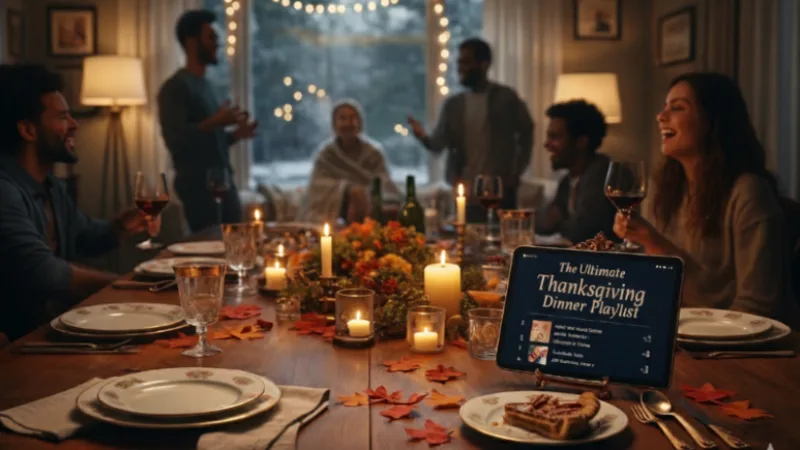
Every year, Thanksgiving comes with two guarantees, Someone will dramatically whisper in the background,”Is the turkey… done?” or My Thanksgiving dinner playlist will carry the mood better than the gravy ever will. Because here’s the thing: Thanksgiving is never just about the food. It’s the symphony of clinking glasses, the shuffle of socks on hardwood floors, the swirl of steam rising from pots like tiny weather systems. It’s the chaos of a kitchen that looks like it’s auditioning for a disaster movie. Even in the midst of all of this, the warmth of a living room where soft lamps make everyone’s faces look a little kinder than usual. And right in the middle of all this beautiful, messy humanity? Music is what holds it all together. This dinner playlist is what will save the day. The kind that makes your house feel like a cozy little movie set, where everything is golden, guests laugh a bit louder, and even the chaos starts to feel charming instead of catastrophic. These are the songs that let me pretend I’m gliding through the day with chef-level elegance, even when I’m actually sprinting between the oven and the fridge like a struggling contestant on a cooking show. So here’s the playlist saving me this year, warm and cozy filled with the kind of songs that instantly pull the room together. The kind that makes the air a little lighter, conversations softer, smiles easier. Cause MUSIC is what connects us all! Soft Glow Starters (Set the Mood Before the Food) Perfect to start the evening complimentary candles are lit, the oven is humming, and people start arriving with stories and wine to elevate the vibes. 1. Autumn Leaves by Nat King Cole The evening begins gently, with the soft voice of King Cole drifting through the room as coats are hung and chairs are pulled out. Humming the lyrics like “The falling leaves…” floats in the background, giving the space a golden glow like the night itself is settling in with the guests. 2. Keep Driving by Harry Styles As the first plates appear on the table and conversations start to deepen, Harry sings, “We held darkness and withheld clouds… I would ask should we just keep driving?” There’s something calming about it, almost like a reminder to let the evening unfold naturally. To stay present. To keep moving through the night together, gently and unhurried. 3. Before the Rain by Lee Oskar Perfect blend of classic Jazz with wine glass twirling elegantly between fingers. A quiet stillness fills the room as this soft instrumental flows in. It feels like the pause right before candlelight turns everything warmer. A peaceful breath before the dinner truly begins, giving everyone a moment to sink into the evening. 4. Harvest Moon by Neil Young When everyone gathers closer, passing dishes and leaning into familiar conversations, this song wraps the table in a tender glow. As the song says,”Because I’m still in love with you…” hums like a quiet blessing, making the room feel full of warmth, of history, and of people who matter. 5. The Look of Love by Dusty Springfield Soft and elegant, this track plays just as the table settles into its rhythm. The song moves slowly, almost mirroring the way people pause between stories and taking in the comforting glow of the moment of being together. 6. Holocene by Bon Iver When the room feels suspended for a second. As the soft chatter in the corner begins, while someone is laughing quietly at an inside joke and your cousin wrapped in a blanket by the window. Lyrics saying “I could see for miles, miles, miles.” Feels like that moment when Thanksgiving reminds you how small the worries are compared to the warmth in the room and how far you’ve actually come. 7. Slow Dancing in a Burning Room by John Mayer Not for the drama but for the warm guitar, the low lights, the post-dinner sway that always happens when someone turns into “the person who controls the aux.” Singing “I was the one you always dreamt of.” It hits in that soft way when old memories surface of the people who’ve stayed, the ones you grew with and the familiar comfort that only comes out on holidays. 8. Somewhere Only We Know by Keane Dessert is on the table with pecan pie, apple crumble leaving the room feeling like a secret little universe of its own. In the background the humming “Oh simple thing, where have you gone?” It captures that sweet nostalgia of Thanksgiving giving the chance to revisit the “simple things” we forget we love all year. 9. Every Breath You Take by The Police There’s always a quiet stretch during Thanksgiving, usually right after the big laughter dies down and everyone is finally breathing again after that second (or third) round of food. That’s when this song slips into the room. Its gentle, steady rhythm feels like a heartbeat for the evening that is calm, familiar, and unexpectedly comforting. As “Every breath you take, every move you make…” floats through the warm glow of the dining room, it doesn’t sound haunting tonight; it sounds grounding. Like a reminder that in this room, around this table, you’re surrounded by people who’ve watched you grow, drift, return, change, and still show up every year. The song wraps around the moment like a soft exhale, a quiet pause where the whole room feels connected, just by being here, breathing the same warm, cinnamon-scented air. 10. Fly Me to the Moon by Frank Sinatra There’s a moment in every Thanksgiving evening when everything simply glows and when someone finally sits down after hours in the kitchen, and the whole room feels softer. That’s exactly when Sinatra steps in with “Fly me to the moon, let me play among the stars”, a line that feels like a gentle lift to the entire evening. It’s elegant, timeless, and adds the kind of charm that makes even

The Ultimate Thanksgiving Dinner Playlist! Read More »