
RethinkTrends

Pop Culture

How Self-Love Is Rewriting Valentine's Week Culture

How Self-Love Is Rewriting Valentine’s Week Culture

Valentine’s Week still arrives every February like clockwork. Same dates, same calendar presence, and the same subtle background noise suggesting love should be visible, celebrated, and maybe even showcased. Yet the vibe has shifted. It does not land with the same intensity anymore. The emotional pressure feels dialed down. Conversations feel easier. Fewer awkward pauses, fewer polite explanations, less of that strange social choreography where people felt obligated to justify their plans or lack thereof. Valentine’s Week did not vanish. It simply stopped feeling like a performance review for your personal life. That transition was not loud or dramatic. No cultural press release. No sudden turning point. It unfolded gradually as people began relating to love in ways that actually mapped to their real experiences rather than inherited scripts. This evolution is not just unreliable. Recent Pew Research Center analysis shows that the share of adults living without a spouse or partner has shifted over time, a reminder of how partnership culture continues to change and how traditional sets of rules no longer define most adult lives in the way they once did. Not Just “Taken” or “Single” Anymore There was a time when relationship identity felt binary, with people largely seen as married, dating, or single. Those statuses seemed to matter more than expected, especially during Valentine’s Week. The holiday had a way of turning into an unspoken social scoreboard, nudging people to measure where they fit. Being single rarely felt neutral. It often felt like something you were expected to explain away with humor or casual indifference. Now the landscape looks very different. People move through far more nuanced relational spaces. Single. Happily single. Focused on self-love. In something undefined. Emotionally involved but not formally labeled. Somewhere in between. There is no universal template anymore, which subtly rewrites the emotional contract of Valentine’s Week. The question is no longer just who you are choosing. It increasingly becomes how you are choosing to experience connection, affection, and care. That shift changes everything. When Valentine’s Week Came With Expectations, Before Self-Love Shifted the Narrative Valentine’s Week once carried a set of invisible rules that most people absorbed without discussion. If you were in a relationship, participation was assumed. If you were not, you learned adaptive strategies. Deflect. Joke. Downplay. Stay busy. The awareness never really disappeared though. Plans meant something. Gestures meant something. Even opting out somehow meant something. Silence could feel as loaded as action. The holiday did more than reflect dating culture. It reinforced it. It made the most sense in a world where relationships followed predictable trajectories and intentions were easy to define. That version of dating has largely dissolved. Pew Research Center’s analysis of the modern dating landscape highlights how relationships today are more fluid, less linear, and increasingly shaped by digital interactions rather than traditional pathways. Commitment itself is being reimagined, with many connections no longer viewed as permanent milestones but as relationships that evolve over time. In many ways, love is starting to resemble a subscription model, where participation, intensity, and expectations adjust as circumstances change rather than settling into fixed paths. Dating changed. The holiday just lagged behind for a while. Modern connections often resist neat categorization. People spend long stretches in ambiguous territory. Emotional closeness can precede clarity. Commitment unfolds slowly or never quite stabilizes. Deep care can coexist with uncertainty about direction. This is not a retreat from love. It is a more honest reflection of how complex relationships can be. How Self-Love Softened the Pressure Self-love did not emerge as a rejection of romance. It arrived more like a pressure release valve. Initially, it functioned as relief. Relief from expecting one relationship to supply identity, stability, validation, and meaning. Relief from treating a single week as evidence of whether life was on track. Relief from the exhausting ritual of public happiness displays. Over time, that relief became normalized. Self-love reshaped the emotional texture of Valentine’s Week. Opting out stopped feeling like a statement. Quiet celebration stopped feeling incomplete. Not providing explanations started to feel entirely acceptable. The cultural energy moved from obligation toward choice. What Self-Love Looks Like Now The self-love that endured is not necessarily aesthetic or performative. It rarely resembles the curated social media version. Instead, it shows up in ordinary decisions. Canceling plans without guilt spirals. Spending money based on desire rather than expectation. Prioritizing comfort over optics. Saying no without elaborate justifications. Friendships are no longer framed as substitutes. Staying in does not automatically read as protest or failure. Being single is not treated as a temporary malfunction. It is simply one valid mode of living. That neutrality marks the real transformation. How Self-Love Quietly Changed Behavior First Cultural change rarely announces itself directly. It surfaces through patterns of behavior long before formal narratives catch up. Around Valentine’s Week, attention is no longer monopolized by dates, gifts, and couple rituals. There is comparable interest in rest, personal care, comfort, and low-pressure experiences. Turning inward does not require an excuse. Even broader consumer behavior data shows Valentine’s Day evolving beyond couple-centric rituals. Recent retail and spending insights for 2026 reveal that self-gifting has gone mainstream, and many shoppers now approach Valentine’s Day with low-pressure and intentional personal care, suggesting the holiday increasingly doubles as a moment for self-celebration and well-being rather than external validation. When the Pressure Faded and Self-Love Became More Visible Valentine’s Week once carried an unspoken evaluation framework. People often wondered whether the gesture was thoughtful enough, excessive, insufficient, too casual, or too intense. That ambient pressure has noticeably eased. Couples feel less compelled to stage grand performances. Single individuals feel less socially exposed. Friends require fewer disclaimers. Choosing yourself does not demand narrative defense. People did not stop valuing love. They simply stopped treating the holiday as a mandatory demonstration of success. Recent YouGov survey data on Valentine’s Day attitudes shows that most Americans now view the holiday as celebrating both romantic and platonic relationships, suggesting people are increasingly treating Valentine’s Day

How Self-Love Is Rewriting Valentine’s Week Culture Read More »
5. Coupon Book (Acts of Service) illustration

Handmade Love: 10 Thoughtful Gifts for Your Boyfriend That Need Effort

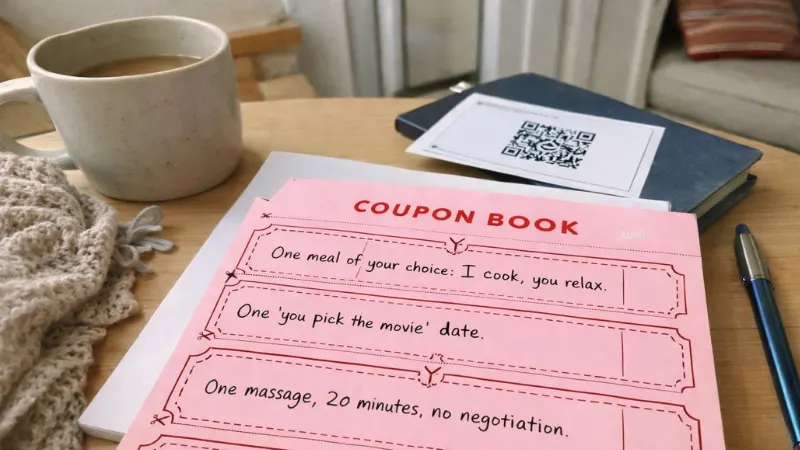
Valentine’s Day has turned into a checkout line with a heartbeat. Buy the roses. Add the teddy. Upgrade to the “deluxe” box of chocolate that tastes like sugar and guilt. Then post it, prove it, move on. And plenty of people refuse to participate. Fair. Love cannot be stapled to February 14 like it’s a school notice. Real affection shows up on random Tuesdays, in quiet favors, in patience when nobody is watching. Here’s the useful middle ground. You do not need to worship the holiday. You can hijack it. Use the attention around Valentine’s Day to do something that actually means something: effort over expense. Handmade over mass-made. Personalize over generic. In this blog, you’ll find 10 handmade gift ideas that are personal, practical, and genuinely romantic. The Problem with “Prove-You-Love-Me” Season The world sells love like it expires in 24 hours. Brands push the idea that romance is a product, and you are one impulse purchase away from being “a good partner.” That’s not romance. That’s retail therapy. If you are someone who rolls your eyes at the whole thing, you are not wrong. But refusing to celebrate can also become its own lazy shortcut. “Love isn’t one day” is true. It is also a convenient excuse to do nothing. So here’s the play: keep your values, ditch the cynicism, and choose a gift that costs time, attention, and intention. The kind of currency that actually holds value. The Effort Economy 10 Handmade Gifts That Hit Harder Than a Price Tag 1. Handmade Valentine’s Card (Yes, Bare Minimum. Make it Maximum.) A card is only “basic” when it’s vague and your love note is AI-written. Personalisation makes it a keepsake. Front line: Skip “Happy Valentine’s.” Write something with spine. Examples: “I choose you on ordinary days too.” | “You’re my favorite habit.” Inside: Split it into three parts: Five micro-moments you remember (tiny, real things). One thing you admire about him, with proof. One promise you intend to keep. Pro-Tip: Date it. Signed. Done. A card becomes history when you stamp time on it. This is just a suggestion on how you can do it, if you follow the same damn thing you might upset your partner (Yes, they read our blogs too.). 2. The Coffee-Stained Letter Write it like a time capsule, not like a school assignment. Coffee-staining is just the costume. The writing is the soul. Structure that works: Paragraph 1: What you’ve noticed about him lately. Paragraph 2: What you respect about his character, with one example each. Paragraph 3: A fear you had about love and how he softened it. Final lines: “If you ever forget what you mean to me, read this part” and add 4 to 6 short sentences. Coffee stain tip: Stain the edges lightly and let it dry flat. Don’t drown it. You’re aging paper, not marinating it. 3. 365 Gratitude Notes in a Jar (A Year of “I See You”) This is high effort. Do it only if you can avoid repetition. Use these themes to keep it organized: Green notes: Appreciation Blue notes: Memories Yellow notes: Future plans Label the jar: “Open one a day. On bad days, open two.” (You can add another colour with additional notes for the bad days) 4. Photobook of Your Favorite Text Threads (Receipts of Real Love) This one is dangerously good if curated, dangerously cringe if dumped. Divide it into chapters: “How we started” “Our funniest moments” “When you showed up for me” “Us being idiots” Add glimpses of your memory together, all those moments you spent. Final page: “Things I still want to do with you” (10 ideas). 5. Coupon Book (Acts of Service) A coupon is sweet, not transactional. Coupons: One meal of your choice: I cook, you relax. One “you pick the movie” date. One massage, 20 minutes, no negotiation. A no phones cuddles night. One errand day: I handle annoying tasks with you. 6. Playlists for Every Version of You Two Make the playlists tight and intentional (12 to 20 songs). Playlist set ideas: “Listen to this when I’m mad,” “When you miss me,” or “When you need confidence.” Bonus points: Print a QR code he can scan and attach it to a physical note card explaining the vibe. 7. Scented Candle That Smells Like You (Trust me, it’s not weird) Scent is memory. Important: Use candle-safe fragrance oil that matches your perfume’s vibe rather than spraying perfume directly into hot wax. Label ideas: “Smells like you found home” or “Light this when you want my presence without my noise.” If you want to go a step ahead you can also try mixing both your perfumes. 8. A T-Shirt with Kisses (Make it Wearable, Not Costume-y) Keep it minimal so he actually wears it. Placement: One kiss mark near the chest pocket area. Detail: A small handwritten line near the hem: “yours” or an inside joke. Durability: Use fabric paint or a heat transfer so it survives washing. 9. The “Good Luck Kit” (A Pocket-Sized Proof You’ve Got Him) Trust me this is not “performative”, this is romance. Give him a box or a pouch, label it as “for the days that are heavier than the rest”. Inside, add 8 to 12 tiny items, each with a one-line note that explains the point. Everything has a meaning. What you can put inside: A handwritten note that calms him instantly. A mini photo strip or one ridiculous photo that forces a smile. A tea bag or instant coffee sachet with a note: “Coffee or Date?” A QR code to a playlist: “For the days your brain won’t shut up.” A “wins list” of 10 things he’s good at, this is affirming. A tiny inside-joke token: a doodle, sticker, or note only the two of you understand. A grounding checklist card: water, food, shower, sunlight, one tiny task. One coupon: “Call me. I’m here.” How you can wrap it: Put items into mini envelopes labeled by mood: “Stress,”

Handmade Love: 10 Thoughtful Gifts for Your Boyfriend That Need Effort Read More »

Valentine's Day: From Saint Valentine to a $29 Billion Holiday

How Valentine’s Day Changed From Saint Valentine To A Billion-Dollar Holiday

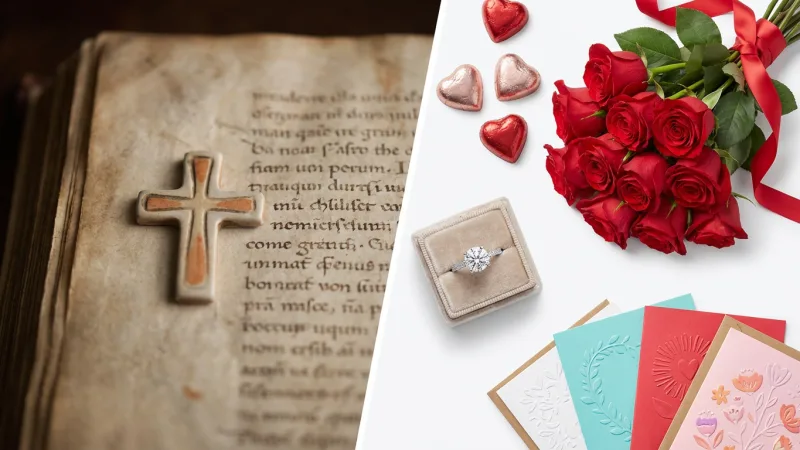
In the second week of February, suddenly hearts pop up everywhere on store fronts, social feeds, restaurant menus, and brand emails. Valentine’s Day has become not just a celebration of love, but a season of spending and cultural expectation. But it wasn’t always like this. What if we told you that it wasn’t always the same. What began as a religious observance slowly evolved into a multi-billion-dollar commercial holiday shaped by marketers, advertisers, cultural trends, and shifting social values. From Martyrdom to Romance: The Origins of Valentine’s Day Valentine’s Day has deep roots, but not initially in love and commerce. In 496 AD, Pope Gelasius I set February 14 as the feast day of Saint Valentine, a Christian martyr. Legends vary about who Valentine was, but one story describes him secretly marrying off young couples in defiance of Roman law, linking him retrospectively to love and companionship. For centuries, Valentine’s Day remained relatively obscure, tied more to native traditions and Christian observance than mass culture. It was European poets like Geoffrey Chaucer in the Middle Ages who helped shift the day’s meaning toward romantic love. He began writing about the time where birds and humans paired up in courtly affection. Romance at this stage was literary and symbolic, not commercial. There were love poems and perhaps tokens exchanged privately, but the holiday did not yet drive product categories or sales. Cards, Candy, and the Commercial Turn (19th–20th Century) The Rise of Valentine’s Cards The first major pivot toward commercialization came with the industrial revolution and mass printing. In the 1840s Esther Howland, later called the “Mother of the American Valentine” began selling elaborate lace-trimmed Valentine’s cards in the United States, turning what had been a local custom into a marketable product. These were not just notes; they were ornamental, collectible expressions of sentiment. By the early 20th century, companies like Hallmark had embraced Valentine’s Day as a key seasonal product category. Hallmark and other greeting card manufacturers expanded designs and distribution, encouraging people to buy tokens of affection rather than craft them by hand. Today, Valentine’s Day cards are second only to Christmas in the number of cards exchanged each year, with Hallmark reporting sales of 145 million Valentine’s cards annually in the U.S. alone. Chocolates and Flowers: Packaging Love As greeting cards became widespread, other industries saw opportunity. In the 1920s, Russell Stover introduced heart-shaped boxes of chocolates specifically for Valentine’s Day, pairing sweetness with symbolism. Meanwhile, the floral industry particularly rose growers and national delivery networks like Florists’ Transworld Delivery (FTD) made bouquets a seasonal must-have. The Valentine’s floral rush now fills shops and online orders with millions of roses in mid-February. These products were not incidental; they were framed as essential gifts, marketed with imagery that tied them to romance, affection, and the emotional currency of the day. “A Diamond Is Forever”: Marketing That Shaped Contemporary Culture One of the most influential pieces of advertising in 20th-century history belongs to the diamond industry. In 1947, copywriter Frances Gerety created the iconic slogan “A Diamond Is Forever” for De Beers not originally tied to Valentine’s Day but soon adopted into it as the holiday became a major gift-giving occasion. Before this campaign, diamond rings were not universally expected in engagements or romantic rituals. Afterward, by the early 1980s, more than 80% of American engagement rings contained diamonds, up from around 10% in the 1940s, a transformation credited largely to this campaign’s influence. De Beers played a significant role in shaping cultural narratives around diamonds and love, contributing to the widespread association between enduring love and diamond jewelry and by extension, made them a Valentine’s Day staple as well as an engagement tradition. This campaign redefined romantic expectations for an entire generation, embedding luxury gifts within emotional rituals and shaping how people visually express love. Valentine’s Day Today: A Multi-Billion-Dollar Cultural Phenomenon The influence of marketing and commercialization is perhaps clearest in the scale of contemporary Valentine’s spending. In the United States alone, the National Retail Federation (NRF) expects Valentine’s Day spending to reach a new record of $29.1 billion in 2026, with consumers budgeting about $199.78 per person. This level of spending encompasses: Jewelry is one of the largest categories, often driven by diamond and luxury gifting. Dining and experiencing restaurants and hospitality venues benefit from one of their busiest seasons. Flowers and chocolates perennial favorites with broad participation. Cards and personal gifts tokens of affection across relationships. According to recent retail data, about 53% of Valentine’s spending in 2025 went toward significant others, while the rest was split among gifts for friends, family, and even pets, a sign that the holiday’s reach has broadened well beyond the couple’s paradigm. This commercial scale is not accidental; it reflects decades of strategic marketing that linked specific products to emotional needs, convincing audiences that tokens of affection were a meaningful part of celebrating love. Cultural Shifts: From Romance to Inclusive Expressions of Love While commercialization has driven growth, cultural attitudes toward Valentine’s Day have also shifted. In the early 2000s and 2010s, Valentine’s narratives began expanding beyond romantic couples. What started as a joke on the TV show Parks and Recreation Galentine’s Day on February 13 became a genuine cultural phenomenon, celebrated by friends and embraced by brands looking to tap into broader definitions of love and connection. This reflects a wider trend: Valentine’s Day is now less about protocol and more about personal feel and meaning. Some people celebrate with partners, others mark the day with friends, family, self-care, participation is voluntary and varied. Yet the commercial machinery continues rolling, adapting to these cultural layers rather than driving them unilaterally. How Brands Continue to Shape Valentine’s Day in the Digital Age Valentine’s Day marketing has evolved with the media. In the 20th century, television commercials and print ads set visual norms for romance; in the 21st century, digital media and social platforms carry the narrative. Brands now launch social campaigns, user-generated content activations, and personalized offers weeks ahead

How Valentine’s Day Changed From Saint Valentine To A Billion-Dollar Holiday Read More »