
RethinkTrends

Technology

Understanding the Importance of MarTech in Modern Marketing

Understanding the Importance of MarTech in Modern Marketing

Introduction MarTech in Modern Marketing has become a game-changer, enabling businesses to streamline their marketing efforts and create more personalized experiences for their customers. By integrating technology tools such as CRM systems, email automation, analytics platforms, and social media management tools, companies can better track consumer behavior, optimize campaigns, and improve overall marketing performance. As businesses continue to embrace MarTech, the ability to leverage data for targeted marketing strategies has never been more crucial for staying competitive in today’s digital landscape. In the current era, data is the fuel that helps in making informed decisions. Offline marketing comes with various challenges such as data collection, engagement, and labour-intensive tasks. On the contrary, online marketing overcomes these challenges by offering cost-effectiveness, speed, timeliness, and effectiveness. Both offline and online marketing segments play a significant role in the market, and the combination of marketing and technology is referred to as MarTech. What is MarTech? MarTech is fundamentally technology created to help you more effectively reach your marketing objectives, which will ultimately affect your marketing strategy and financial results. In essence, it can free up your marketing team to focus more on what they do best by assisting you and your marketing team in creating, implementing, and measuring the performance of marketing assets and initiatives. For example: With the use of MarTech, sales can be facilitated and marketing and sales teams can easily work together and support one another’s initiatives. By modifying just preapproved portions of marketing assets with the help of a platform like digital asset management, sales teams may create their own marketing materials without having to be concerned about legal or compliance repercussions. MarTech for business MarTech is adopted by both B2C and B2B industries. Tracking user behaviour can help businesses target the right audience for their products and services, effectively engaging with prospects. The ability to monitor the customers’ journey provides valuable insights into their preferences, interests, and behaviours, enabling companies to personalize their marketing campaigns to a greater extent. With the integration of technology, MarTech has enabled businesses to achieve significant improvements in customer engagement, lead generation, and sales. This has resulted in higher ROI, increased brand loyalty, and customer satisfaction. In addition, MarTech has revolutionized the way businesses operate by enabling them to automate various marketing tasks, making them more efficient and cost-effective. One of the most significant benefits of MarTech is the ability to leverage customer data to create highly targeted and personalized marketing campaigns. Data-driven marketing campaigns enable businesses to identify and target the most profitable customer segments, which results in higher conversion rates and increased revenue. By analyzing customer data, businesses can also gain insights into their customers’ preferences, interests, and behaviours, enabling them to tailor their marketing messages to meet their customers’ specific needs. Another advantage of MarTech is the ability to automate various marketing tasks, enabling businesses to streamline their processes and reduce operational costs. Automation of marketing tasks such as lead generation, lead scoring, and lead nurturing allows businesses to focus on other critical aspects of their operations, such as product development and customer service. Why MarTech is the rising sun? Whether you’re using a DAM system, marketing automation platform, customer relationship management tool, or analytics tool, almost all MarTech can prove to be an advantage for sales enablement, helping your organisation attract and retain clients. MarTech is intended to simplify marketing, as was previously mentioned. Like the digital environment, MarTech is constantly evolving. Martech suppliers are always improving their products to stay competitive. You are making an investment that will adapt — and subsequently help you adapt — to new trends by deploying a MarTech solution from a provider that is consistently inventing and improving their product. For instance, most Martech solutions were in advance of the curve with cloud-based capabilities already built in, which might have aided their clients in adjusting to the “new normal” of remote when the world went remote owing to Covid-19. In conclusion MarTech has become an essential tool for businesses looking to improve their marketing efforts. The integration of technology and marketing has enabled companies to streamline their processes, reduce costs, and improve customer engagement, lead generation, and sales. The ability to leverage customer data to create highly targeted and personalized marketing campaigns has resulted in higher ROI, increased brand loyalty, and customer satisfaction. Businesses that embrace MarTech will undoubtedly have a significant competitive advantage in the current market.

Understanding the Importance of MarTech in Modern Marketing Read More »

Ai Is booming Google Bard vs ChatGPT

Why Ai Is booming? ChatGPT vs Google Bard

Why AI is Booming? Machines may learn from experience, adapt to new inputs, and carry out activities similar to those performed by humans thanks to artificial intelligence (AI). Most AI examples that you hear about today – from chess-playing computers to self-driving cars – rely heavily on deep learning and natural language processing. Computers may be taught to perform particular jobs using these technologies by processing vast volumes of data and identifying patterns in the data. Why is artificial intelligence important? By automating repetitive processes, AI can discover new information through data. Artificial intelligence performs repetitive, high-volume, computer-based tasks instead of automating manual ones. As well as being reliable and fatigue-free. For the system to work and to ask the right questions, humans are still necessary. AI adds intelligence to existing products. AI capabilities will be added to many of the items you already use, much way Siri was brought as a feature to a new generation of Apple products. Large volumes of data can be used with automation, conversational platforms, bots, and smart machines to advance numerous technologies. Improvements at home and at business include everything from smart cameras and security intelligence to investment analysis. AI uses neural networks with numerous hidden layers to analyse more and more data. It used to be impossible to create a fraud detection system with five hidden layers. Big data and incredibly powerful computers have transformed everything. As deep learning models take their cues straight from the data, you need a lot of data to train them. A long-awaited artificial intelligence chatbot called Google AI Bard has finally made its debut. The chatbot is the latest advancement in conversational artificial intelligence from Google. Search engines are undergoing a revolution because of this cutting-edge artificial intelligence technology. What is Google Bard? The Google Bard AI is powered by LaMDA (Language Model for Dialogue Applications), a language model developed by Google for conversational applications. Using its massive language models in conjunction with human knowledge, Google hopes to combine the strength, wit, and inventiveness of its AI chatbot, Bard. Bard will use the plethora of data available on the internet to deliver original and accurate answers. Why Bard? Enter Bard, Google’s own chatbot which Sundar Pichai, the company’s CEO, says “seeks to combine the breadth of the world’s knowledge with the power, intelligence and creativity of our large language models”. How does Google Bard work? As part of Google Bard’s algorithm, words, phrases, and ideas are scanned on the internet and “learned” to work together. Testing begins after AI scientists have fully “trained” the software. Using the search engine, users can enter full sentences or questions and receive responses in the form of sentences. Using keywords such as “what new discoveries from the James Webb Telescope can I share with my 9-year-old”, the search engine will provide you with a short text summary of all the latest news from the telescope. What is the key difference between ChatGPT and Google’s Bard? It seems that Google has an ace up its sleeve to fend off ChatGPT: the ability to draw information from the Internet. A blog post by Google says that Bard provides fresh, high-quality responses based on information from the web. Albeit to varied degrees of accuracy, ChatGPT has wowed with its capacity to respond to complicated queries. Yet, this technology’s largest drawback may be its inability to acquire real-time information from the Internet. ChatGPT’s language model was trained on a vast dataset to generate text based on the input, and the dataset, now, only includes information until 2021. According to a demo shown by Google, it appears that for questions where there might not be a clear-cut answer, Bard will synthesise a response that reflects differing opinions. The blog post mentions Bard’s ability to provide high-quality, fresh answers based on information from the web. When will Bard launch? The public will be able to access Bard beginning in the next few weeks, while the testing phase is still underway.

Why Ai Is booming? ChatGPT vs Google Bard Read More »

The Potential of Electric Vehicle Growth: What to Expect

Introduction In recent years, the streets of our cities have witnessed a silent revolution that is slowly but surely changing the way we move around. It’s the rise of electric vehicles (EVs), and it’s no longer a novelty but a trend that’s set to continue for many years to come. The numbers speak for themselves: the global market for EVs is growing at an astonishing rate, with a compounded annualized growth rate (CAGR) of 21.7 per cent. By 2030, the number of EVs on our roads is expected to skyrocket from 8.1 million units to an impressive 39.21 million units. The automotive industry is undergoing a seismic shift, as the roar of internal combustion engines is slowly being replaced by the hum of electric motors. As technology improves and battery costs decrease, more and more consumers are considering making the switch to EVs. But why is this happening? What’s driving this exponential growth? What does this mean for the future of transportation, and how will it impact the energy industry? The answer lies in the many benefits that EVs bring to the table. One thing is for sure: it’s going to be electrifying. For one, they are environmentally friendly, emitting significantly less pollution than their gas-guzzling counterparts. This is a welcome relief for our planet, as we strive to combat the effects of climate change and air pollution. With cleaner air, quieter streets, and greater efficiency, EVs are set to transform the way we move around our cities and beyond. The road ahead may not be without its bumps, but the destination is a brighter, greener future for us all. But EVs aren’t just better for the environment – they’re also more efficient and cost-effective. With lower fuel costs and fewer maintenance needs, EVs are proving to be a smart investment for individuals and businesses alike. And as battery technology continues to improve, the range and reliability of EVs are only getting better. So, whether you’re a city dweller looking to reduce your carbon footprint or a business owner seeking cost-effective transportation solutions, EVs offer a compelling proposition. With their sleek designs, quiet engines, and powerful performance, it’s no wonder that EVs are the talk of the town. Picture this: sleek, silent electric vehicles gliding along the roads, seas, and skies, leaving a trail of cleaner air in their wake. This is the future that we’re hurtling towards, with electric vehicle sales in the US skyrocketing by over 40 percent a year since 2016. By 2035, the largest automotive market will be fully electric, ushering in a green revolution that promises both a brighter future and significant economic opportunities. But with this growth comes a new set of challenges. As the number of EVs on the road increases, so too does the demand for electricity to power them. This poses a significant challenge for energy producers and distributors, who must ensure that they can meet this demand while keeping the lights on for everyone else. The good news is that the energy industry is already preparing for this shift, with new infrastructure and technologies being developed to support the growth of EVs. From smart charging stations to renewable energy sources, the potential of EV (Electric vehicles) growth is being harnessed to drive innovation and sustainability. The Current State of Electric Vehicle Growth The wheels of progress keep turning, and the automotive industry is no exception. With each passing year, more and more drivers are making the switch to electric vehicles, and the numbers speak for themselves. Despite the challenges posed by the COVID-19 pandemic, electric car sales have been on the rise. In 2020, the number of electric cars on the road worldwide reached an impressive 10 million, representing a 43% increase from the previous year. China, Europe, and the United States are leading the charge, but other countries such as Canada, India, and South Korea are also investing in the necessary infrastructure and incentives to support the growth of EVs. The road ahead may not be without its bumps, but the destination is a greener, more sustainable future for us all. In 2021, electric car sales hit a new record high, despite ongoing supply chain bottlenecks and the ongoing Covid-19 pandemic. Sales nearly doubled compared to the previous year, with 6.6 million EVs sold, accounting for nearly 9% of all car sales. This surge brought the total number of electric cars on the road to an impressive 16.5 million. The sales share of electric cars increased by 4 percentage points in 2021, signaling that the future is electric. But this is just the beginning. According to the Net Zero Emissions by 2050 Scenario, the number of electric cars on the road is set to skyrocket to over 300 million by 2030, with EVs accounting for a whopping 60% of new car sales. Achieving this ambitious goal requires an increase in their sales share by less than 6% percentage points per year, which is well within reach. So, get ready to plug in and hit the road toward a brighter future. With electric cars leading the way, we’re on track to create a cleaner, more sustainable planet for generations to come. Factors Driving Electric Vehicle Growth The winds of change are blowing, and they’re carrying with them a new era of transportation. The factors driving the growth of electric vehicles are like a perfect storm, combining to create a powerful force that is reshaping the automotive industry. First and foremost, there are environmental concerns that are driving more and more consumers to seek out sustainable options. With the world reeling from the effects of climate change, the need to reduce our carbon footprint has never been more urgent. Electric vehicles are a solution that’s both practical and effective, emitting fewer greenhouse gases than their gas-guzzling counterparts. But it’s not just the environment that’s driving the growth of EVs; governments worldwide are also playing a crucial role. By offering incentives such as tax credits, rebates, and grants, policymakers are encouraging

The Potential of Electric Vehicle Growth: What to Expect Read More »

A New Way to Experience Life: The Rise of Virtual Reality

A New Way to Experience Life: The Rise of Virtual Reality

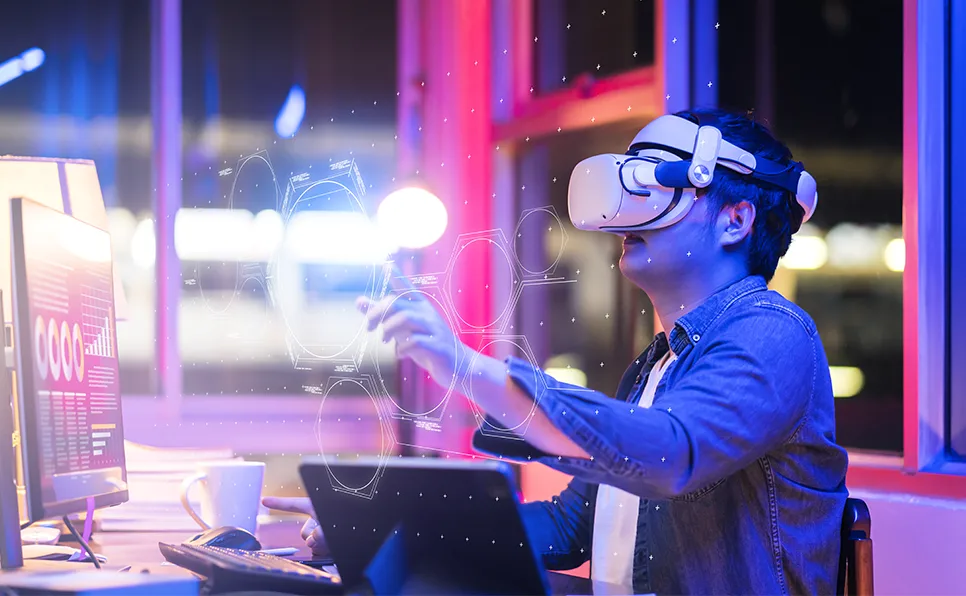
Introduction  Virtual reality (VR) technology has come a long way in recent years and is no longer just a gimmick. With advancements in hardware and software, VR has become a powerful tool for experiencing life in new and exciting ways. This technology is rapidly advancing, and it’s changing the way we experience life. From exploring new worlds to learning new skills, VR provides an entirely new level of immersion and creativity.    In this blog post, we’ll explore how virtual reality is changing the way we see the world and how it’s providing a new level of immersion and creativity.  What is Virtual Reality?  Virtual Reality (VR) is a technology that creates a computer-generated simulation of a three-dimensional (3D) environment that can be interacted with in a seemingly real or physical way by a person using special electronic equipment, such as a headset, gloves, or body suit. VR technology is designed to immerse the user into an alternate world where they can interact with digital objects and environments as if they were physically present. The technology is built using a combination of hardware and software that generates a lifelike experience by simulating sight, sound, touch, and even scent.   How Does Virtual Reality Work?  Virtual reality works by tricking the brain into perceiving a digital environment as real. This is achieved by generating an immersive experience using a headset that covers the user’s eyes and ears, creating the illusion of being in a virtual world. The headset uses sensors to track the user’s movements and adjust the virtual environment in real-time, allowing the user to interact with digital objects and environments as if they were physically present.   Additionally, VR systems can also use hand-held controllers or body suits to allow for more complex interactions, such as grabbing and manipulating virtual objects, or simulating physical movements like walking or running. The combination of hardware and software creates a seamless and convincing experience that can be used for various purposes such as gaming, education, therapy, and more.  Differences Between Virtual Reality and Traditional Forms of Entertainment   Virtual reality offers a level of immersion that is not possible with traditional forms of entertainment such as video games, movies, or television.   In traditional forms of entertainment, the user is passive and watches the action unfold on a screen. In VR, the user is an active participant, able to interact with the virtual environment in a natural and intuitive way.   Virtual reality also offers the potential for a more personal and tailored experience, as the user’s actions and decisions can affect the outcome of the virtual experience.   Unlike traditional forms of entertainment, virtual reality can also provide a social aspect, allowing users to interact with others in virtual environments, opening up new possibilities for communication and collaboration.  Unlike traditional video games or movies, VR allows users to experience a completely new world with their own senses. With the use of VR headsets and hand-held controllers, users can look around and interact with their virtual surroundings as if they were there.  How is Virtual Reality Changing the Way We Experience Life?  Virtual reality has the potential to revolutionize the way we experience life, by offering new and immersive ways to explore, learn, play, and interact with the world. VR is no longer just for gaming and entertainment, but has found applications in fields such as education, healthcare, and even military training. With the advancements in VR technology, we can experience things imagine in the past, breaking down the barriers of time and space, and making the world a smaller place. As VR continues to evolve, it holds the promise to transform our lives and how we engage with the world around us.  One of the most exciting aspects of virtual reality is its potential for education and training. With VR, students can learn about subjects in a way that is both engaging and memorable. For example, instead of reading about the human body in a textbook, students can use VR to explore and interact with the different systems and organs in a way that makes the information more accessible and memorable.  In addition, virtual reality is being used to help people overcome phobias, such as fear of heights or public speaking. By gradually exposing patients to their fears in a controlled virtual environment, they can learn to overcome their anxieties and lead a more fulfilling life.  The Benefits of Virtual Reality  Virtual reality offers many benefits, including:  Immersive experiences: VR offers a level of immersion that is not possible with traditional forms of entertainment. With VR, users can become completely immersed in new worlds and experiences, making them feel as if they are really there.  Increased creativity: Virtual reality opens up new avenues for creative expression and personal growth. From exploring new landscapes to creating new worlds, VR provides endless opportunities for creativity and imagination.  Improved education and training: VR has the potential to revolutionize the way we learn and train for new skills. By providing immersive and interactive experiences, VR makes learning more engaging and memorable.  Overcoming phobias: VR is being used to help people overcome their fears and phobias. By exposing patients to their fears in a controlled virtual environment, they can learn to overcome their anxieties and lead a more fulfilling life.  Applications of Virtual Reality in Day-To-Day Life  Gaming   Virtual reality has revolutionized the gaming industry by offering a highly immersive and interactive experience that traditional gaming methods cannot match. VR gaming allows players to physically move around, interact with objects, and experience game environments in a way that feels real, providing a new level of excitement and engagement. The gaming industry has embraced VR, developing a wide range of games that take advantage of the technology, from action and adventure games to puzzle and simulation games.  Education and Training   Virtual reality has the potential to revolutionize the way we learn and train, providing a highly engaging and interactive way to acquire new skills

A New Way to Experience Life: The Rise of Virtual Reality Read More »

Future of online gaming: esports gaming.

Esports is short for electronic sports and has transformed how sports were previously looked at. Being good at sports meant being physically ‘fit’ -commonly spelled as the condition in which the candidate is expected to have a muscled-up body that is thin, tall, and ‘preferably’ male (until very recently). Esports destroyed these barriers not only to entry but also to the success a player could achieve irrespective of their physical appearance. The 3 important esports sectors: Players: (No guesses here!) The gamers out there realize that becoming a champion is no easy task. Some players practice for more than 10 hours to hone their skills. But that’s not all. Apart from being the champion and having “chicken dinners” post winning within your friend circle, you could either be a ‘streamer’ or a ‘pro player.’ Streamers are players who livestream themselves playing on platforms such as Twitch and YouTube. They have their own “streaming personalities” that viewers love watching. (PewDiePie fans say CHEERS!) Moreover, upon gaining a fan following one can also monetize from the broadcasts through ad revenues, donations, and subscriptions. via GIPHY While only a few rise to the level of becoming pro players, those who do, have to compete in global tournaments. These pro players build a fan following for themselves and the teams that they pay for. Teams: The next important sector is the teams. Pro players join teams in multi-games to fight for monetary prizes. Every team competes in a specific game such as the League of Legends, Dota, and Counter-Strike. People love watching their favorite teams fight against their biggest rivals. It’s just like going to a FIFA world cup mixed with the comfort of Netflix & Chill (and some thrill) for the viewers. Leagues: Esports teams representing your organization compete in regular seasons, playoffs, and video game leagues with world championships. They compete in video game leagues in a way similar to the NBA basketball teams competing against each other. League tournaments are organized by companies such as Major League Gaming (MLG) and Electronic Sports League (ESL). Leagues include the North American League of Legends Championship Series, or the Call of Duty World League (sponsored by MLG).  Your Favorite Esports:   Future of Esports If you are a gamer, you must have cursed your network at least once when your game lags at a crucial moment. Well, worry no more. 5G is here to put a full stop to the commas during your game! With the fast connectivity, 5G offers several benefits for multiplayer game communities by improving the overall cloud streaming experience. Now you can play all you want without any buffering. Organizations can add as many enhancements to the game without any worries, and even in dense markets, gamers can play without any latency or glitches. Overall, gamers can have the new features and smooth experience in the games without losing much (you do need the dollars for a 5G phone and connectivity). Bottom Line Gone are the days when playing games on the phone was just meant for recreation. The youth and the gaming community take their games as seriously as any other athlete – they have a fixed time when they religiously play, they have a close-knit community, and they are interested in what more can any organization offer them. Game developers and companies must capitalize on the explosive demand for new gaming platforms and higher levels of interaction. As these new technologies become more dominant, the gaming experience will change fiercely, with a new generation of massively multiplayer games launching online to appeal to new audiences.

Future of online gaming: esports gaming. Read More »

Evolution of 5G Network Technology

5G, or fifth generation, wireless technology is the latest and greatest in mobile network technology. It promises to revolutionize the way we communicate, work, and live. With its lightning-fast speeds, ultra-low latency, and increased capacity, 5G has the potential to change the way we interact with technology and the world around us. What is a 5G Network Technology? 5G is the fifth generation of mobile networks, following 4G, 3G, and 2G. It is a new type of wireless technology that promises to offer faster speeds, lower latency, and increased capacity compared to previous generations of mobile networks. 5G networks are designed to support a wide range of new use cases, including virtual reality, augmented reality, the Internet of Things (IoT), and other emerging technologies. This will enable new business models and create opportunities for innovation in various sectors. 5G networks are designed to be more energy efficient than 4G networks, which will make them more sustainable in the long run and reduce the environmental impact of mobile networks. Networks are also designed to support a higher level of reliability than 4G networks, which will make them suitable for mission-critical applications such as self-driving cars, remote surgery, and industrial automation. 5G networks work by using a combination of different types of spectrum, including high-frequency millimeter wave spectrum and lower-frequency sub-6GHz spectrum, which allows for better coverage and penetration in buildings and other hard-to-reach areas. Overall, 5G technology is a new generation of mobile networks that promises to revolutionize the way we communicate and interact with technology, providing faster, more reliable, and more efficient wireless connections for a wide range of devices and applications. Features, Benefits, and Advantages of 5G Network Technology: One of the key features of 5G is its impressive speed. While 4G networks typically max out at around 100Mbps, 5G networks can reach speeds of up to 10Gbps. This means that 5G networks can download an entire HD movie in just a few seconds, compared to several minutes on a 4G network. This increased speed will have a huge impact on how we use our mobile devices, allowing us to stream high-definition videos, play online games, and download large files with ease. Another major advantage of 5G is its ultra-low latency. Latency is the time it takes for a device to send a signal to the network and receive a response. On 4G networks, latency is typically around 50 milliseconds, but 5G networks can have latency as low as 1 millisecond. This ultra-low latency will enable new use cases such as remote surgery, autonomous vehicles, and industrial automation. In addition to speed and latency, 5G networks also offer increased capacity. This means that more devices can connect to the network at the same time without any loss of speed or performance. This is especially important as the number of connected devices continues to grow. According to a study by Ericsson, there will be around 29 billion connected devices by 2024. With 5G, we will have the capacity to oversee this influx of devices without any issues. Some additional Benefits: Improved coverage: 5G networks use a combination of high- and low-frequency spectra, which allows for better coverage and penetration in buildings and other hard-to-reach areas. This means that 5G networks will be able to reach more people in more places than 4G networks. More efficient use of spectrum: 5G networks use a technique called “massive MIMO” (multiple input, multiple outputs) which allows for more efficient use of spectrum. This means that more data can be transmitted in the same amount of spectrum, which will increase capacity and reduce congestion on the network. Support for new use cases: 5G networks are designed to support a wide range of new use cases such as virtual reality, augmented reality, and the Internet of Things (IoT). This will enable new business models and create opportunities for innovation in various sectors. Improved reliability: 5G networks are designed to have a higher level of reliability than 4G networks, which will make them suitable for mission-critical applications such as self-driving cars, remote surgery, and industrial automation. Increased energy efficiency: 5G networks are designed to be more energy efficient than 4G networks. This will make them more sustainable eventually and reduce the environmental impact of mobile networks. Advanced Network slicing: 5G networks will allow for advanced network slicing, which enables network providers to create multiple virtual networks that can be tailored to specific use cases. This will allow for more efficient use of network resources and enable new business models. How did 5G Network Technology evolve? The evolution of 5G network technology can be traced back to the early days of mobile communication. The first generation (1G) of mobile networks was introduced in the 1980s and primarily focused on voice communication. The second generation (2G) of mobile networks, introduced in the 1990s, introduced the concept of digital communication and data services such as text messaging. The third generation (3G) of mobile networks, introduced in the 2000s, brought significant improvements in data speeds and the ability to access the internet on mobile devices. The fourth generation (4G) of mobile networks, introduced in the 2010s, brought even faster data speeds and the ability to support more devices and applications. The development of the 5G network technology began in the early 2010s, with the goal of addressing the limitations of existing 4G networks and meeting the growing demand for mobile data. 5G networks are designed to provide faster download and upload speeds, lower latency, and increased capacity for connected devices. This is achieved through the use of higher frequency spectrum bands, advanced modulation techniques, and the deployment of small cells and other types of infrastructure. The 5G standardization process has been ongoing for several years, and the first commercial 5G networks were launched in 2019. Since then, the deployment of 5G networks has been gaining momentum globally, and it is expected that 5G will become the dominant mobile network technology in the coming years. The evolution of 5G network technology

Evolution of 5G Network Technology Read More »

What do gaming glasses do

What do gaming glasses do?

Whether you are a pro gamer, streamer, casual gamer, or just a fashion buff, gaming glasses are the new accessories that are gaining popularity among other gaming gadgets. Gaming glasses are a tool every gamer craves for. Be it hours of hours on Minecraft or strategies over strategies for Valorant, the only thing that can sustain your gaming habits are these gaming glasses! But do they really work? And does it improve your gaming efficiency? Let’s find out. What are gaming glasses? You must have seen a pair of yellow glasses every streamer fashioning beneath their headsets. And yes, it is quite cool and looks fab. Not to forget paid collaborations and sponsorships for the streamers to promote them. But is it all about style? Apparently not! These yellow-tinged lenses with anti-reflective (AR) coating have their usability. These gaming glasses are targeted at gamers and are often paired with headsets. These gaming glasses are designed to prolong gaming hours and sustain your gaming career by reducing the strain on your eyes. But what causes the strain? How do gaming glasses work? All electronic devices including monitors, TVs, and phones emit ultraviolet light. This wavelength often causes strain and disrupts sleep cycles. Gaming glasses filter the UV light. And while there is no direct evidence to support that gaming glasses help protect your eye, but anecdotal research like wearing blue light-blocking glasses for a few hours before sleep can reduce melatonin suppression induced by light to improve the sleep cycle. Because the blue light from artificial light sources has a bad rep, marketers often target this aspect to claim by blocking blue light you can improve your eyesight and overall gaming performance in the long run. While there may be some science behind improving eyesight, there is absolutely no science behind gaming glasses improving gaming efficiency. Do Gaming Glasses work to help reduce strain on your eye? Given the exposure to screentime, the youths are putting themselves, after hours of a raid in World of Warcraft, your eyes probably start to water, you seem to lose focus, and even may itch or pain. Coupled with the usage of mobile, tv, and other electronic gadgets, we are bombarded with UV emissions from every device all the time. And albeit low, these glasses do provide a certain amount of magnification in view and reduction in blue light which is beneficial for the eyes. There are some prescription standard blue light-blocking glasses as well. It will be difficult to quantify to what degree these glasses protect the eye, but it certainly does to an extent. Benefits of Gaming Glasses Three main functionalities of gaming glasses are: Anti-Reflective properties: Apart from enhancing color contrast and focus, the AR coating in the gaming glasses reduces the glares from the monitors which can reduce the strain caused in your eye. Magnification: A mild magnification in the glasses will reduce squinting. Protection from Blue Light: Yellow or amber-tinted gaming glasses can help reduce eye fatigue and improve sleep cycles. How to choose the right gaming glasses? Lens tint: The darker the tints, the lesser the exposure, and the better the protection. Darker tints block a higher percentage of blue light. Black tints compromise the brightness and hence the visibility. Material: The gaming glasses are designed to be compatible with your headset and hence are needed to be lightweight and flexible, resistant to damage. Materials like nylon and acetate are often considered prime. Size of the Frame: Comfort is key hence always pick the glasses as per your fit. Coating: The gaming glasses should reduce glare from the screen and should be resistant to scratches. Hence, they should be coated with compatible films. Portability: Minimal and easy-to-carry gaming glasses are the most desirable ones. The Final Verdict: Should you as a gamer go for Gaming Glasses? As a pro gamer or a streamer, you will be spending hours and hours in front of the screen. That too for a considerable amount of time in your life. Even if you are a casual gamer, the extent of UV emissions we are subjected to is unprecedented. In these scenarios, we should use every measure possible to reduce the strain on our eyes and improve sleep cycles. And even if you are not gaming or not even an avid gamer, you can use these glasses throughout the day as they are versatile, funky, and adds a swagger. So, no harm in using them. However, these gaming glasses will not help you achieve a higher score in the game you are invested in.

What do gaming glasses do? Read More »

What is voice phishing and how does it work

What is voice phishing and how does it work?

Voice phishing, also known as vishing, is a type of fraud that involves the use of phone calls or voice messages to trick victims into revealing sensitive information, such as passwords or credit card details. This form of cybercrime involves using the telephone to trick individuals into giving out sensitive information such as bank account numbers and passwords. Vishing scams are often carried out by attackers who use automated voice recordings or live operators to impersonate legitimate organizations, such as banks or government agencies, in order to gain the trust of their victims. Voice phishing is also a type of social engineering attack that aims to steal sensitive information from individuals through the use of phone calls. This technique is often used by scammers to obtain personal information such as credit card numbers, bank account information, and login credentials. How does Voice Phishing work? The process of voice phishing typically begins with the attacker calling the victim and pretending to be a legitimate representative of a company or organization. The attacker may claim that the victim’s account has been compromised or that there is a problem with their account that needs to be resolved. The attacker will then try to convince the victim to provide sensitive information, such as their password or credit card details, by using various tactics such as creating a sense of urgency or making the victim believe that they are in danger if they do not provide the information. Once the victim has provided the sensitive information, the attacker can use it to gain access to the victim’s accounts or steal their money. Voice phishing can be difficult to detect because the attackers often use sophisticated technology to mask their phone numbers and make it appear as if they are calling from a legitimate organization. However, there are some signs that can help victims identify voice phishing attempts, such as being contacted out of the blue by someone claiming to be from a company or organization, being asked to provide sensitive information over the phone, or being pressured to make a decision quickly. Other Voice Phishing Techniques One common vishing scam involves an attacker calling a victim and claiming to be a representative of their bank. The attacker will then ask the victim to provide their account information and password in order to “verify their identity” or “prevent fraudulent activity.” In reality, the attacker is using this information to access the victim’s bank account and steal their money. Another type of vishing scam involves attackers pretending to be from the Internal Revenue Service (IRS). The attacker will tell the victim that they owe back taxes and must make a payment immediately or face legal consequences. The victim is then instructed to provide their bank account information or credit card number in order to make the payment. Vishing attacks can be difficult to detect, as the attackers often use advanced technology to make their voices sound legitimate and to hide their true identities. In addition, many vishing scams use caller ID spoofing, which allows the attacker to display a fake phone number on the victim’s caller ID. This can make it appear as though the call is coming from a trusted organization, further increasing the likelihood that the victim will fall for the scam. They use techniques like ID spoofing to mask their caller IDs and hence it becomes difficult for users to gauge the credibility. From a promise of reward to converting loyalty points into hard cash, and from loan repayments to social security threats, vishing comes in all forms. The more you know about it, the better! How to identify Vishing Scams? The process of voice phishing typically begins with the attacker placing a phone call to a potential victim. The caller may claim to be a representative from a legitimate organization, such as a bank or a government agency, and may use a variety of tactics to convince the victim to disclose sensitive information. One common tactic used by attackers is to create a sense of urgency. The caller may claim that there is a problem with the victim’s account and that immediate action is needed to prevent it from being compromised. This can be especially effective if the caller uses technical language and provides a phone number for the victim to call back, further increasing the sense of legitimacy. Another tactic used by attackers is to use social engineering techniques to build trust with the victim. This can include asking personal questions and using the information provided to create a more personalized and convincing pitch. For example, the caller may mention the victim’s name, address, or other personal details in an attempt to gain their trust. Once the attacker has established a sense of trust and urgency, they will typically try to obtain sensitive information from the victim. This can include asking for credit card numbers, bank account information, or login credentials for various accounts. In some cases, the attacker may even try to convince the victim to transfer money directly to a bank account under their control. How to protect yourself from Voice Phishing scams? To protect yourself from vishing attacks, it is important to be cautious when providing sensitive information over the phone. If you receive a call from someone claiming to be from your bank or the IRS, do not provide any personal information. Instead, hang up and call the organization back using the phone number listed on their official website. This will ensure that you are speaking with a legitimate representative. It is also a good idea to use security software, such as a firewall or antivirus program, to protect your computer and personal information from being accessed by attackers. And be sure to regularly update your software and operating system to stay ahead of the latest threats. It is important for individuals to be aware of voice phishing and to be cautious when receiving phone calls from unknown numbers. If you receive a call from someone claiming

What is voice phishing and how does it work? Read More »

7 Best Bill Counters for Small Business Owners

7 Best Bill Counters for Small Business Owners

Have you every shopped from a small business? If you haven’t, you definitely should because, not sure about you but I definitely feel good after shopping from a small business. Small businesses have a lot to offer on the plate, but they sometimes fail when competing against the massive corporations. Small businesses are different as they offer a lot of customization options with a touch of personalization and creativity. When shopping small, you can almost be sure that the product that is being sent your way is not produced in masses and will make you stand apart in the crowd. Things that keep the small businesses behind in the race are the hefty appliances and personnel available to the large MNCs. The MNCs have the capital that they can use for buying any appliances that they require or even for hiring more work personnel. Small businesses are not able to catch up to the MNCs as they do have the capital to buy important stuff or for even paying wages for extra staff. One such understaffed department in many small businesses is the accounts department. For most of the small businesses, the founders only take care of the accounts. And as boring as it sounds, it is one important task, because hello we are talking about money! It is also not necessary that all small businesses would need a separate accounts department, but all of them certainly need a bill counter. via GIPHY So here we are with 7 best bills counters for you to choose from: What is a Bill Counter? As the name suggests, a bill counter is a machine that either just counts the number of currencies or gives you the total value of the currencies. No science there! This simple device is very essential for small businesses because the money that comes in needs to be counted and accounted for, right? On a serious note, counting money is one of the most tedious tasks for small business owners which is why we are here to help you choose a bill counter. Continue reading to find out the 7 best bill counter that are suitable for small businesses. 7 Best Bill Counters for Small Businesses Kolibri UV The number one on the list is light-weight cash counter Kolibri UV. It can be used by those looking for a machine that can tally up their green notes (spelled as money). It retails for a price of $145, but buying it on Amazon will always save you some bucks. The device can count up to 1400 bills per minute, (Isn’t that amazing?), and comes with a detachable cord. Pros Compact-design suitable for small businesses Budget-friendly Comes with a one year-warranty Has no continuous run-time limit Con Does not give you the total dollar amount Pyle-PRMC500 This next bill counting machine is something that can save you from counterfeits, because let’s be honest, we’ve all been there and hate it when we are on the receiving end of a fake currency. The Pyle PRMC500 will give you accurate and reliable results and retails for $168.93 on Walmart. Pros Audible alarm function for fake currency detection Compatible with American, Canadian, European, and British currencies Has a detachable LED screen Comes with a strong feeding mechanism and bill thickness adjustment screw Works with varying condition bills such as old, new, wrinkled, ripped, bent, fatigued bills Con Might spit out the bill instead of stacking them Goplus Worldwide This bill counter is inspired from the FRIENDS character Monica Geller and comes with dust-cleaning bush for itself, because cleanliness is a priority (insert: I KNOWW in Monica’s voice). The Goplus Worldwide is a great tool if you’re looking for a device that can help you with batching and counting bills. It retails for $48.24 on various online shopping sites. via GIPHY Pro Fast, accurate, and budget-friendly Comes with a dust-cleaning brush Has a double-LED display Comes with a one-year warranty Compatible with international currencies Con Does not give you the total dollar amount Cassida 6600 If you were looking for something that could give you cumulative total, Cassida 6600 is the one for you. It has a dual screen display and uses ultraviolet and magnetic sensors to authenticate bills, ensuring no counterfeit bills are included in the total. It retails for $277 on Amazon. Pros Can stack up to 250 bills Has a compact size Comes with a retractable handle which makes it easy to transport Con Counterfeit detection is not quite accurate Royal Sovereign RBC 650 Pro This one comes with 6-button interface and has a sleek design. The Royal Sovereign RBC 650 Pro retails for around $200 on Amazon. Pros Holds up to 200 notes Can stack batches of 999 notes at a time Has automatic start and stop function Cons Occasionally shoots cash everywhere Cassida Professional Scale Cassida Professional Scale is one of the most viable options for cashiers as it is quick and accurate, just as their job requires them to be. It retails for around $250 for Amazon. It has a relatively small footprint and counts by denomination. Pros Measures bills and coins both Can be connected to a printer to issue invoices Ideal for a small business with less workload Cons Can only handle 15 bills at a time Domens Portable Mini For those who like to go on workcations, we have a match for you. The Domens Portable Mini is ideal for anyone looking for a compact bill counter. It retails for around $48 on Amazon and is small enough to fit into a backpack or briefcase. Pros Weighs less than a pound Can be charged from an AC adapter or even four AA batteries Cons Not good with worn-out notes Cannot detect counterfeits Conclusion Small businesses are changing the way markets function by actually respecting customers’ choices and providing the most value for their money. They are paving the way for new competitors in the market. Small businesses fulfill our needs with a touch of

7 Best Bill Counters for Small Business Owners Read More »

How to differentiate between a fake & a genuine crypto project

How to differentiate between a fake & a genuine crypto project?

The recent upsurge of cryptocurrency brought forth prominent players & investors. This inadvertently also led to the rise of fake investors & crypto exchanges. But as of 2022, the market revenue of crypto has plummeted significantly. And the main reason for this is the crypto scam plaguing investors. Because cryptocurrencies are relatively new in the market, inexperienced investors are often falling prey to such swindles amidst its nonchalant hype and promise of quick & easy returns. It was only in 2021 that a Singapore-based blockchain data platform got robbed out of a record $14 billion, whereas Axie Infinity got hacked and was robbed out of a whopping $615 million. With a little bit of research and googling about Crypto frauds, you will come across hundreds of other such reported cases of crypto scams. The most infamous crypto scam so far has been the Squid Game token. Crypto has created the Fear of Missing Out syndrome among gullible investors who invest in these speculative schemes and are left with nothing. The reason is mainly because of a lack of regulation in the crypto market. Does that mean should we stop investing in cryptocurrencies? No! There are many genuine crypto platforms where you can invest safely. We just need to be more cautious and learn how to differentiate between a fake and a genuine crypto project! This guide will help you navigate the same. To start with, let us understand what the methodology of a fraud cryptocurrency is: The whole saga starts usually with a launch of a new cryptocurrency platform with exaggerated and promising returns. Then an Initial Coin Offering is held to procure money from a pool of investors. This is followed by halting the operations. And finally, the individuals holding the ICOs vanish in thin air leaving the investors high and dry. Usually, the scammers conceal their identity, conduct business in a decentralized and anonymous virtual currency environment, and make it difficult for individuals to track and trace. This charade continues if investors keep falling for these without proper background checks and research. So, how to identify fake crypto projects from a real one? 1. Documentation (White Papers) A white paper is easily one of the sure-shot ways to differentiate a fake crypto project from a genuine one. It is a critical marketing document that pitches the idea to prospects and potential investors. A white paper will have all the details and fundamentals of the token you are about to purchase. The white paper will also cover the blockchain design, the name of the token, the address of the creator, the contact source, and other minute details. If any of these details are missing, it can serve as a red flag, raising questions about the legitimacy and transparency of the crypto. But here is the deal: Having a white paper does not on its own justify the legitimacy of the currency. For example, Bitconnect’s Ponzi scheme did not have any white paper that extracted $2.6 billion as project value. Whereas Plexcoin, on the other hand, had very convincing white papers and yet managed to swindle $15 million. Hence, we need other checks to ensure the crypto we are investing in is genuine. 2. Detailed Road Map Peer into the intricate details of the crypto you are planning to invest in. Learn about the purpose, method, USPs, and utilities of the crypto you are interested in. If you come across a project that does not specify solving a definite problem, you can skip that one. 3. Exaggerated Promises, Ludicrous Claims The niche term is “Rug-Pull”. A scheme where scammers launch a new coin, promote it aggressively with the promise of high returns and as soon as investors spend their money, the platform dissolves and its participants go AWOL. Phishing emails and social media handles are targeted to trap gullible first timers. Patience is the key and anyone promising easy and high return should raise suspicions. And hence, to be avoided. 4. Tracking the Team: Gather as much information as you can about the creators and the team managing it. From websites to social handles, dig deep into the background of the creators to authenticate. Scammers often leverage the name of a celebrity and create fake accounts. Always keep an eye out for the responses on these posts. Another way of doing this is to keep a tab on their mutuals and connection and reach out to other people who are following them. Also, cross-refer with your friends, family, or any expert to corroborate. 5. Token Sales: Most fraud companies will hide the token sale progress from the investors. By doing so, they create a sense of urgency as investors have no clue when the deal is going to close. This lack of transparency is a tell-tale sign, something is not right. Usually, for any new projects, ICOs have a large audience on social handles, creating a platform for transparent and open discussions. Without such transparency and real-time updates on token sales, investors must be cautious to avoid these. 6. Marketing Strategy: Usually, a genuine project would adopt long-term methodologies. However, a fake crypto project will aggressively push its products with quick returns and no long-term planning. Do consult among your friends and experts before committing to a project. 7. Be Cautious: Swindlers will create fake accounts, use fake videos with prominent faces and lead the investors astray. If such is the case, make sure to trace the information to its source to establish credibility. 8. Fraudulent URLs: Most hoaxes start with a fraudulent website. If the website is not secured and lacks the “lock icon” in its URL, chances are the website is unsafe and the project is an outright scam. Also, ensure the new coin is trading on popular exchanges. Vigilance is the key to avoiding getting scammed. While scammers and fraudsters are always looking for new ways to swindle people of their money, investors should leverage digital platforms and the incessant information access to effective use. Before

How to differentiate between a fake & a genuine crypto project? Read More »