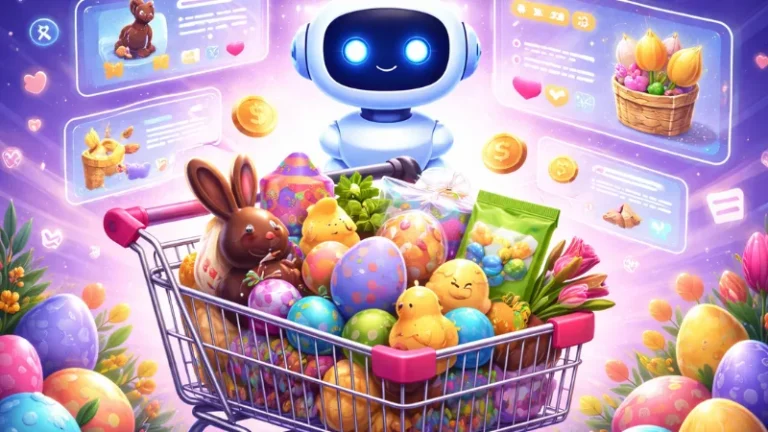
The Easter Cart Takeover: How AI Is Quietly Deciding What You Buy
You were just talking about something. Out loud. Not searching. Not typing. Just casually mentioning to a friend that your apartment feels a little empty. And then it shows up. In your feed. In your ads. In your “recommended for you,” it’s that specific brand of digital déjà vu that makes you wonder if your phone is actually your closest confidant. Now fast forward to the actual moment of impact. You opened the app to just look. Head empty, zero thoughts of spending a single cent. You were probably just killing time between meetings or waiting for your coffee. Then suddenly, your cart is “looking like a complete Pinterest aesthetic” that your savings account definitely didn’t expect. You have items in there you didn’t even know existed five minutes ago. Pastel candles for an apartment you never clean. A bunny-shaped waffle maker that you will use exactly once. A full hosting setup is like you are actually inviting Martha Stewart over for brunch. And you are sitting there like, “Wait, when did this become my type of cart?” The plot twist? It didn’t. You didn’t choose the vibe. The vibe was assigned to you by a series of high-performing algorithms that know you better than your own mother does. Welcome to Easter 2026, where your cart does not get filled by your own hand. It gets plotted and twisted by a digital ghost that knows exactly how to make you hit that checkout button. Shopping Does Not Start With You (RIP Free Will) Shopping used to be a very linear, very normal process. If you felt a need, you went to a store or a website. You searched for a specific item. You compared a few prices. You made a final decision. You bought the thing. Now? That whole “I want” part of the equation is literally optional. We have entered the era of predictive consumption, where the needs and wants are created for you before you even feel the itch. AI is already ten steps ahead of your own brain, mapping out your next three moves like a grandmaster playing chess against a toddler. Platforms like Google Gemini have turned shopping into a literal DM. You aren’t browsing through endless pages of search results anymore. You are just having a conversation, and products are appearing as if by magic. This is not a coincidence. This is the result of massive data sets being fed into big data models that understand your intent better than keywords ever could. When you ask a simple question like, “What should I get for Easter brunch?” you aren’t getting a list of blue links to different websites. You are getting a pre-packaged lifestyle delivered in a conversational tone. You are being sold a feeling, not just a product. AI has the receipts because it has been studying your digital body language: It knows exactly what you bought last spring and whether you actually kept it. It tracked that one item you hovered over for 0.5 seconds while scrolling at 1 AM last week. It has categorized your entire personality as “clean girl” or “maximalist chaos” based on your media consumption. That perfect Easter basket that feels so you? It’s not luck. It’s data doing soft manipulation. It’s the algorithm whispering that this specific shade of sage green is what your life is currently missing to finally feel “complete.” Your Cart Has Main Character Energy (You Don’t) Earlier retailers waited for you to come to them. They spent money on SEO and hoped you would land on their page. But that model is dead. Brands aren’t waiting for you to find them anymore. They are basically pre-shopping for you, acting like a digital personal assistant that also happens to be a “world-class salesperson.” Take Amazon, for example. It’s no longer just a warehouse with a search bar. It’s an optimization engine. Amazon is optimizing the logistics of what you will buy before you even buy it, building dynamic bundles in real-time. We are talking about Easter decor, specific candy assortments, and hosting kits that change based on who is looking at them. Your cart is not just a reflection of your taste anymore. It’s a mathematical output of: Your past taste, algorithmic pressure, and people also bought this gaslighting. AI-driven recommendations are now responsible for a massive 10 to 30 percent of total e-commerce revenue. That is billions of dollars generated by things people didn’t even know they wanted until an AI suggested it. So when your cart randomly grows while you are just clicking around? It’s not a glitch. It’s the system working perfectly to optimize your average order value. The Easter Bunny Is An Algorithm Now The Easter Bunny has officially retired to a beach in Florida. The new one is a complex line of code living in a server farm in Northern Virginia. This shift is what the tech world likes to call agentic commerce. It’s the evolution from AI that suggests things to AI that actually does things. We are moving past the era of “You might also like” and into the era of “I have handled this for you.” Inside tools like Gemini or advanced Shopify integrations, the AI does not just show you a bunny waffle maker. It compares the reviews across five different sites, checks which one has the fastest shipping to your house, applies a discount code it found in a dark corner of the internet, and asks if you want to use the card on file. You can gift-wrap and check out without ever leaving the chat. There aren’t fifty open tabs. There are no rabbit holes of research. There is only the smooth, frictionless path to spending money. You just say, “Yeah, this slays, buy it.” It’s dangerously convenient because it removes the “friction of thought” that used to save our bank accounts from ourselves. Instagram Didn’t Just Influence You. It Programmed You. This is where the whole situation gets slightly unhinged and a
The Easter Cart Takeover: How AI Is Quietly Deciding What You Buy Read More »