

Nobody warned us about this part.
You signed up to write blogs, build content calendars, manage editorial pipelines, maybe craft a few email sequences and LinkedIn posts along the way.
And then AI arrived and everyone in your industry started saying things like “workflow automation,” “agent oversight,” and “signal-based personalisation” in meetings, in job descriptions, in performance reviews as if these were words that had always existed.
They were not words that had always existed.
But here’s the thing. The shift is real, it’s already happened, and panicking about it is not a skill listed anywhere on this list.
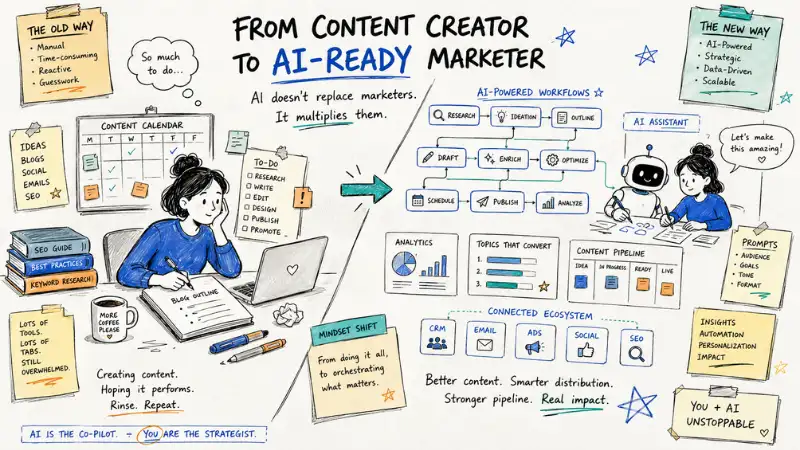
What is on this list: ten things that will make you genuinely more valuable in a market where AI handles the generic and humans are expected to handle everything else.
None of these require a computer science degree. All of them require paying attention.
1. AI Workflow Design: Because One Good Prompt Is Not a Strategy
Writing a prompt that produces a decent output is a starting point, not a skill. The real skill is building a repeatable system around that prompt.
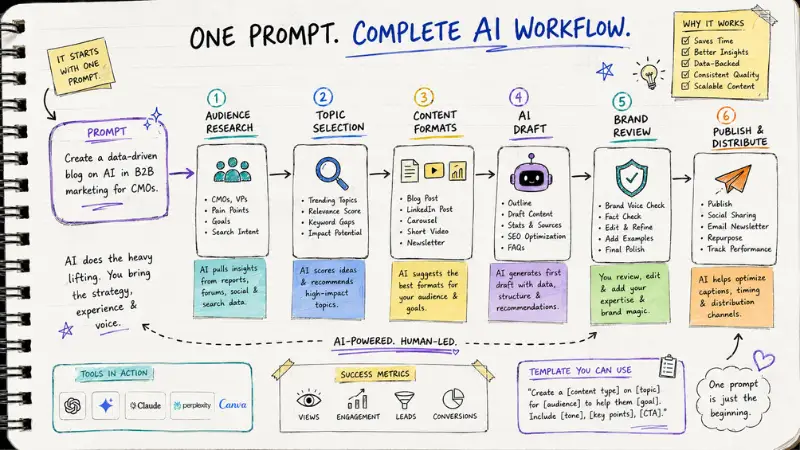
Instead of asking AI to “write a content campaign,” an AI-ready content marketer breaks the task into something the machine can actually work through:
- Analyse audience research and past content performance
- Pull out the topics and angles that consistently drive engagement
- Suggest content formats based on funnel stage
- Generate draft variations for different channels and personas
- Check the copy against brand voice and editorial guidelines
- Flag it for human review before anything goes live
That’s a workflow. That’s a system that produces consistent, useful output instead of one good draft followed by three confusing ones.
The goal is not to generate content faster. It’s to make better editorial decisions, more reliably. Speed is a side effect.
2. Prompting With Context: Stop Asking Vague Questions
If you prompt an AI, “Write a LinkedIn post about content marketing.”
You will get a LinkedIn post about content marketing. It will be perfectly fine. It will also sound like every other LinkedIn post about content marketing written by someone who knows nothing about your audience, your editorial angle, or your brand’s point of view.
AI produces what you give it. If you give it nothing, it produces the average of everything it has ever seen on the topic.
Strong prompts include:
- Who the reader is and what they care about
- What the brand’s content position is
- What objections or content fatigue the audience typically has
- What the brand voice actually sounds like
- Where in the buyer journey this content sits
- What evidence or data is available
- What the reader should think, feel, or do next
Prompting is less about cleverness and more about context. The more specific you are about the situation, the more useful the output becomes.
3. Human Editing and AI Quality Control: The Most Underrated Skill on This List
AI can write a paragraph that sounds completely authoritative and is factually wrong.
It can sound like your brand without actually sounding like your brand.
It can produce content that is polished, confident, and entirely pointless.
This is why editing is becoming more valuable, not less. Someone still has to ask the uncomfortable questions:
- Is this claim accurate?
- Is this message specific enough to mean anything?
- Does this actually reflect how the company thinks?
- Is there any real evidence here, or just confident sentences?
- Is this genuinely useful to a content marketer reading this, or does it just exist?
AI may write the draft. But a content marketer still decides whether the draft deserves to go anywhere.
The most valuable people on content teams will not be the ones who produce the most. They will be the ones who recognise what is actually worth publishing.
4. Audience Intelligence: The Thing AI Cannot Research for You
AI can summarise audience data beautifully.
But it cannot replace the actual understanding that comes from reading through six months of blog comments, sitting in on a content debrief, or going through reader feedback and noticing the same gap appearing over and over.
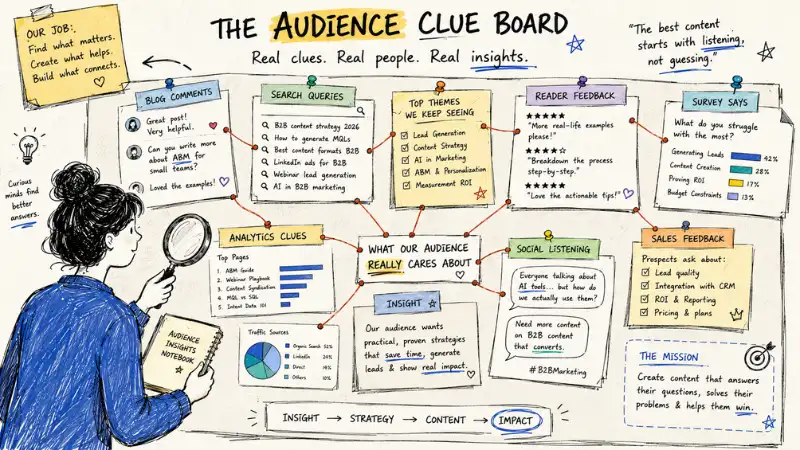
Real audience intelligence for content marketers comes from:
- Content performance data (especially the pieces that underperformed despite strong effort)
- Reader surveys and direct feedback
- Comments, replies, and social responses to published work
- Search queries your audience is actually using
- Topics your sales team hears repeatedly but your blog has never addressed
- Newsletter unsubscribe reasons
Here’s what this can produce: AI analyses thirty underperforming blog posts and surfaces a pattern. It found a reason that readers weren’t disengaged because of the topics. They were bouncing off because the intros spent too long framing the problem before getting to anything useful.
That one insight will change how every article on the site gets structured going forward. AI found the pattern. The content marketer knew what to do with it.
5. Answer-Engine Optimisation (AEO): SEO Is Not Dead, But It Has a New Roommate
Business buyers don’t just use search engines the way they used to in 2019.
They ask questions through AI-powered experiences, conversational tools, and platforms that may return an answer without sending the user anywhere at all. No click required. No website visit. Just an answer, and then they move on.
This creates a new challenge for content marketers specifically. You now need to create content that AI systems can understand, trust, and cite not just pages that rank for a keyword.
Content that performs in this environment tends to have:
- Clear, direct answers to specific questions
- Strong headings that signal what each section covers
- Original data that isn’t available anywhere else
- Expert perspectives, not just explanations
- Comparison sections
- Real reader evidence
- Consistent brand information across every channel
- FAQs that actually answer what buyers ask
The objective has shifted. It’s not just about ranking. It’s about becoming part of the answer and ideally, becoming the answer itself.
6. Original Point-of-View Creation: Generic Content Has Nowhere to Hide Anymore
AI can explain anything in seconds.
This means content that simply explains common knowledge is now commoditised. It exists everywhere. It sounds the same everywhere. Nobody needs another version of it.
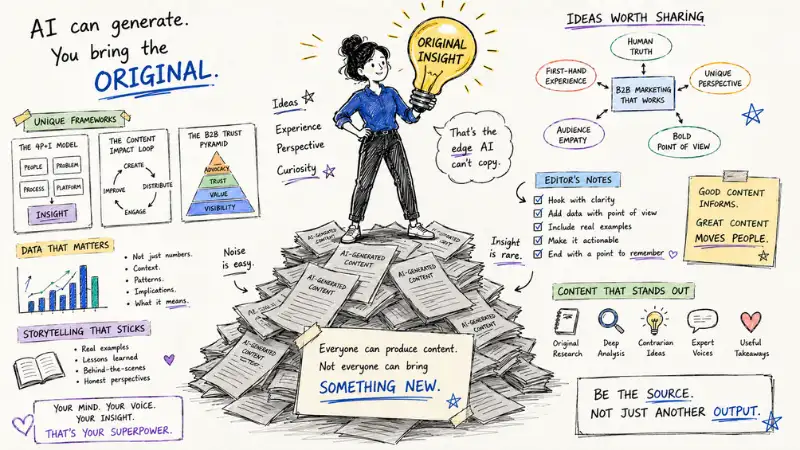
What is still hard to replicate: a content team’s actual opinion, built from real editorial experience.
A strong content point of view might come from:
- Internal performance data nobody else has access to
- Patterns from publishing hundreds of pieces across different audiences
- A contrarian editorial take the industry doesn’t usually say out loud
- A framework built from real content failures, not theory
Compare these two ideas:
“Five Benefits of a Content Calendar”
“Why most content calendars fail when the brief quality going into them is inconsistent”
The second one is specific, credible, and harder to copy because it comes from somewhere real.
AI can help organise the argument. The insight has to come from the humans who’ve actually been in the work.
7. First-Party Data Fluency: The Cleanest Dataset Wins
AI-powered content personalisation is only as good as the data you feed it.
If subscriber records are incomplete, content engagement signals are inconsistently tracked, or lead sources tied to content are misattributed, the AI’s recommendations will be unreliable too.
Garbage in. Confident, well-written garbage out.
Modern content marketers don’t need to become data engineers. But they do need to understand:
- How content engagement data flows into the CRM and where the gaps are
- What “clean data” actually means for a content programme
- Where consent and privacy fit in
- How content-influenced pipeline is defined and whether anyone follows that definition consistently
- What behavioural signals the company is tracking from content and what’s being ignored
Clean first-party data makes content personalisation better, automation smarter, lead scoring more accurate, and reporting more trustworthy.
It’s not glamorous. It is, however, the thing that makes everything else work.
8. Signal-Based Personalisation: Adding Someone’s First Name Is Not Personalisation
True story: putting “{FirstName}” in an email subject line is not personalisation. It is a mail merge with aspirations.
Real personalisation for content marketers is built on signals, signals of meaningful information about what a reader is actually consuming and where they are in their decision.
Content signals that matter:
- Which articles they’ve read, and how many times
- Content formats they engage with most (video, long-form, case studies)
- Topics they’ve returned to repeatedly
- Whether they’ve moved from awareness content to evaluation content
- How recently they’ve come back
A reader who’s been consuming implementation guides is in a different place from one reading introductory explainers. They should receive different content recommendations, different nurture sequences, different follow-up timing.
The goal isn’t to make every content touchpoint feel artificially personal. It’s to make the next piece genuinely relevant to where the reader actually is right now.
9. Marketing Automation and Agent Oversight: You Are Now the Supervisor
Content automation used to mean scheduled social posts and drip email sequences.
But now AI agents can assist with content research, repurposing long-form pieces into multiple formats, updating editorial briefs, analysing content performance, and generating first drafts often without being asked each time. They produce things. And sometimes they even publish things.
Which means someone needs to be responsible for what they produce. That responsibility belongs to the content marketer.
Before any agent touches live content work, the marketer needs to define:
- What the agent is allowed to produce or modify
- What brand and editorial guardrails it must follow
- When it needs a human to approve before anything moves forward
- How errors or off-brand output will be caught
- How its performance will be measured
An AI agent should not publish content, send it to a distribution list, or update editorial records without the right controls in place. The fact that it technically can is not a reason to let it.
The content marketer’s role is shifting from writing every piece to designing and supervising the system that produces the pieces. That’s a different skill, and it matters more than it might sound.
10. Revenue Experimentation: More Content Is Not the Same as Better Content
AI makes it very easy to produce fifty versions of a blog post, an email, or a content offer. Producing fifty versions is not a strategy. It is a very fast way to generate noise.
Useful content experiments change one meaningful variable at a time, whether it’s audience segment, content format, topic angle, distribution channel, CTA, or page structure and connect the result to something that actually reflects business value.
Page views tell you something was read. Content-influenced pipeline, conversion rate, subscriber growth, and content-attributed revenue tell you whether anything that was read turned into something real.
The content marketers who will thrive are the ones who run clean tests, read the results honestly, and change their editorial approach based on what they find.
The Skill That Runs Through All of This: Judgement
Tools will keep changing. The specific platforms content marketers use today may be completely different in two years.
What won’t change: the need for someone to decide what actually matters.
Which audience problem is worth addressing? What content signal is genuinely meaningful rather than simply interesting? Is the message credible enough to resonate with the intended audience? Does the chosen metric reflect real content progress instead of just activity? Finally, determine which tasks should not be automated, regardless of whether they could be.
AI increases output speed. Judgement determines whether the output is going in the right direction.
Where to Start
You don’t need to master every AI platform on the market before you’re allowed to call yourself an AI-ready content marketer.
A more honest starting point: get very good at understanding your audience, give AI enough context to do useful work, verify what it produces before it goes anywhere, and measure whether the content actually moved something that matters.
The future content marketer is part researcher, part editor, part systems thinker, part data interpreter, part revenue partner and a full original thinker.
The job title might still say “content marketer.” The job description has clearly been updated.
Time to catch up!