
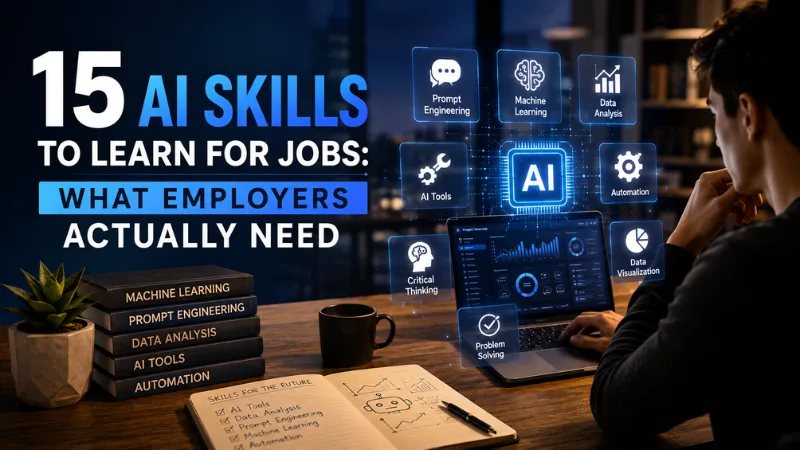
A few years ago, learning AI often meant learning to code or studying machine learning. That is no longer the whole picture.
Today, a marketer can use AI to research customers, an analyst can examine data faster, a recruiter can streamline repetitive tasks, and a manager can build AI-assisted workflows without becoming an AI engineer.
That is why the best AI skills to learn are not simply technical skills. They include knowing how to communicate with AI, evaluate its answers, work with data, automate repetitive processes and apply AI within your existing profession.
The World Economic Forum’s Future of Jobs Report 2025 identifies AI and big data among the fastest-growing skill areas through 2030, alongside cybersecurity and technological literacy. At the same time, human capabilities such as analytical thinking, creativity and adaptability remain important.
So the goal should not be to learn every AI tool that appears.
The better strategy is to build a combination of AI capability, professional knowledge and human judgment that remains useful even when individual tools change.
What Are the Best AI Skills to Learn?
If you want the short answer, these are the 15 AI skills worth understanding:
| AI skill | Who should learn it? | Coding needed? |
|---|---|---|
| AI literacy | Everyone | No |
| Prompt and instruction design | Everyone | No |
| AI output evaluation | Everyone | No |
| Critical thinking | Everyone | No |
| AI-assisted research | Knowledge workers | No |
| Data literacy | Most professionals | Usually no |
| Workflow automation | Business and operations roles | Usually no |
| AI agent orchestration | Business and technical roles | Sometimes |
| AI business strategy | Managers and founders | No |
| Responsible AI and privacy | Everyone using AI at work | No |
| LLM fundamentals | Advanced AI users | No/basic |
| RAG and knowledge grounding | Technical/product roles | Usually |
| APIs and Python | Developers and automation roles | Yes |
| Machine learning fundamentals | Technical AI careers | Yes |
| Domain expertise + AI | Everyone | No |
You do not need to master all 15. What matters is choosing the right combination for the kind of work you want to do.
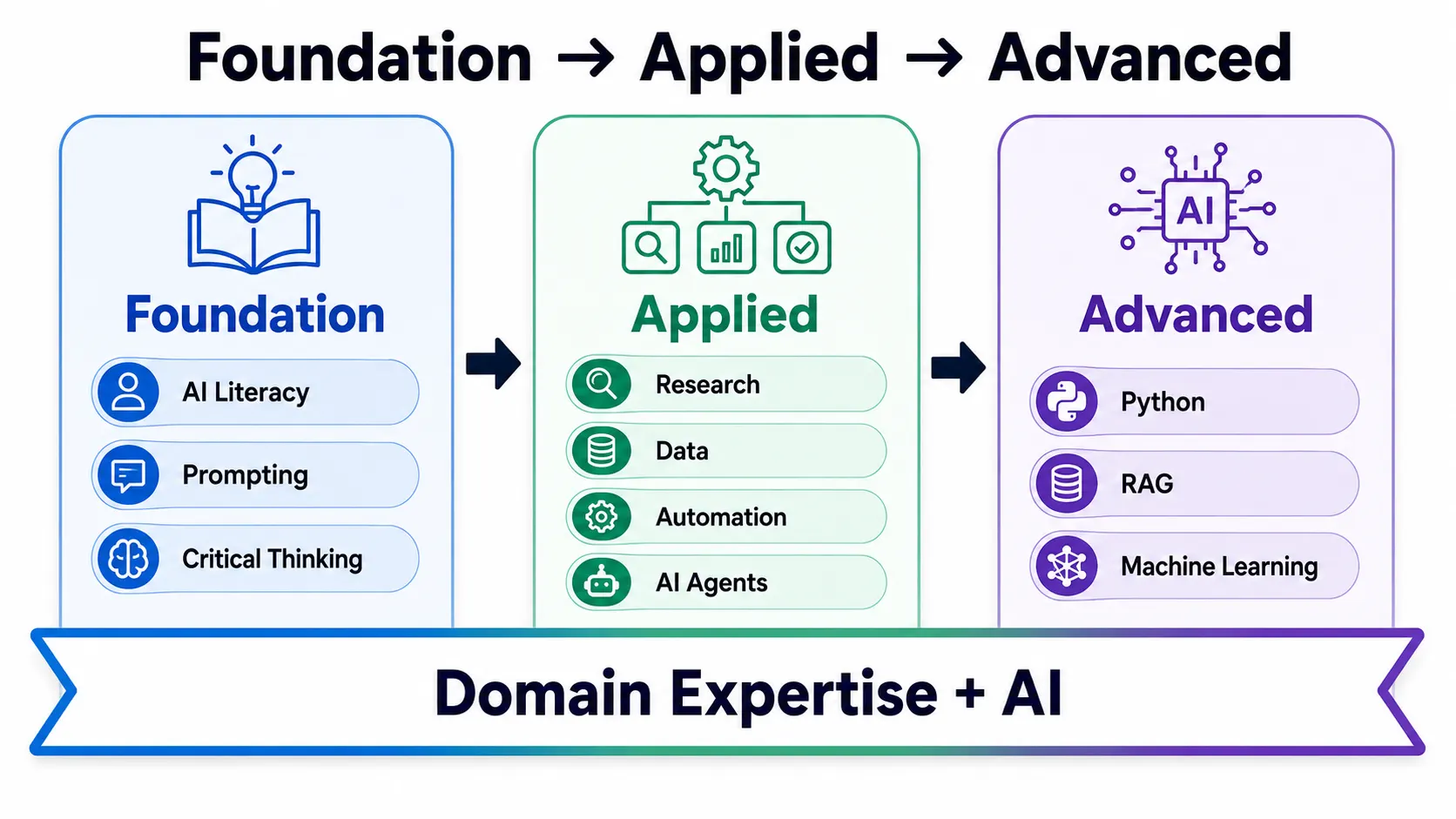
Start With the Skills That Make AI Useful
1. AI Literacy
AI literacy means understanding what modern AI can do, where it struggles and how to use it responsibly.
You do not need to understand the mathematics behind a large language model. You should, however, understand basic ideas such as generative AI, AI agents, hallucinations, context, training data and privacy.
This prevents a common mistake: assuming that an answer must be correct because it sounds confident.
A useful AI user knows when to accept an output, when to edit it and when to verify it elsewhere.
2. Prompt and Instruction Design
Prompting is often presented as a collection of secret commands. In practice, the more durable skill is giving clear instructions.
Compare “Create a marketing plan” with a request that explains the audience, product, budget, objective, limitations and expected format.
The second request is better because the problem itself is better defined.
Good instruction design usually means giving AI enough context to understand the objective while setting clear constraints around what you expect.
3. AI Output Evaluation
Generating AI content takes seconds. Evaluating whether that output deserves to be used can take much more judgment.
Microsoft’s 2026 Work Trend Index found that AI users considered quality control of AI output and critical thinking among the human capabilities becoming more important as AI takes on additional work.
This skill includes checking facts, identifying weak assumptions, reviewing calculations, verifying sources and asking whether the answer actually solves the original problem.
The employee who can produce ten AI-generated reports is useful. The employee who knows which report contains a flawed conclusion may be considerably more valuable.
4. Critical Thinking and Problem Framing
AI is very good at answering questions. It cannot guarantee that you asked the right question.
Before using AI, consider what outcome you actually need. Ask what information is missing, what assumptions are being made and what evidence might change the answer.
Critical thinking becomes more important, not less important, when producing information becomes easier.
5. AI-Assisted Research
AI can help you understand unfamiliar subjects, compare ideas, summarize documents and identify questions worth researching.
But it should not automatically become your final source.
If an AI assistant provides a statistic from a government report, company study or scientific paper, find the original research before publishing the claim.
That simple habit separates AI-assisted research from AI-assisted misinformation.
Learn How to Use AI Inside Real Work
6. Data Literacy
You do not need to become a data scientist to benefit from data skills.
Understanding percentages, averages, trends, correlations and basic visualization can make AI far more useful.
A marketer might analyze campaign data. A salesperson could review lead patterns. An operations manager might use AI to identify recurring problems across hundreds of customer comments.
The value is not simply making a chart. It is understanding what the data does—and does not—support.
7. AI Workflow Automation
Using AI in a chatbot can save a few minutes. Building a good workflow can save the same minutes every day.
Imagine a business process where a new customer enquiry is categorized automatically, relevant information is collected, a response is drafted and a human receives it for approval.
That is more powerful than repeatedly copying information into an AI tool.
The key skill is learning which parts of a process should be automated and where a person should remain responsible.
8. AI Agents
AI agents take the idea of automation further.
Rather than answering one question, an agent may work through multiple steps, retrieve information or interact with tools while pursuing an objective.
Microsoft’s 2026 research describes more advanced AI users as people who increasingly redesign workflows and use agents for complex, multi-step work.
You do not necessarily need to build an agent from scratch. Understanding objectives, permissions, quality checks and human approval points can already be valuable in business, marketing and operations roles.
9. AI Business Strategy
Knowing how AI works is useful. Knowing where it should be used is often more valuable.
Before introducing AI into a business process, ask: What problem are we solving? What does the current process cost? Is reliable data available? What could go wrong? How would success be measured?
Sometimes AI is the answer. Sometimes a spreadsheet or conventional automation is better.
Good AI strategy involves knowing the difference.
10. Responsible AI and Privacy
AI skills are incomplete without understanding risk.
Employees regularly work with customer information, internal documents, financial data and other sensitive material. Before entering that information into an AI system, they need to understand company policies and how the platform handles data.
Responsible AI also includes issues such as bias, copyright, security and accountability.
Being fast with AI is not impressive if the result creates a larger problem for the company.
Technical AI Skills: Who Actually Needs Them?
Not everyone needs to learn Python or machine learning. But if you want to build AI products rather than mainly use them, technical skills become important.
11. Large Language Model Fundamentals
Learn practical concepts such as tokens, context windows, embeddings, hallucinations and model limitations.
Understanding these ideas helps explain why an AI model may perform well on one task and poorly on another.
12. RAG and Knowledge Grounding
Retrieval-Augmented Generation, usually called RAG, helps an AI system use relevant information from trusted documents or knowledge bases before producing an answer.
It is useful in applications such as internal knowledge assistants, customer support systems and document search.
13. APIs and Python
APIs allow AI models to communicate with other software. Python is widely useful for automation, data analysis and AI development.
If you want to move from manually using AI tools to building AI-powered applications and workflows, these skills become significantly more valuable.
14. Machine Learning Fundamentals
People pursuing careers such as machine-learning engineer, AI engineer or data scientist need a deeper foundation.
That usually means understanding statistics, training and validation, classification, regression, overfitting and model evaluation before moving into more advanced areas.
Someone using AI professionally and someone building AI professionally are following different learning paths. Both are valid.
15. Domain Expertise + AI May Be the Most Valuable Combination
This is the skill people sometimes overlook.
Do not try to become “an AI person” while forgetting the profession you want AI to improve.
A marketer who understands customers, positioning and analytics can use AI more effectively than someone who only knows how to generate marketing copy.
A developer who understands architecture and security can make better decisions about AI-generated code.
The same principle applies to finance, cybersecurity, design, sales, healthcare, education and almost every other profession.
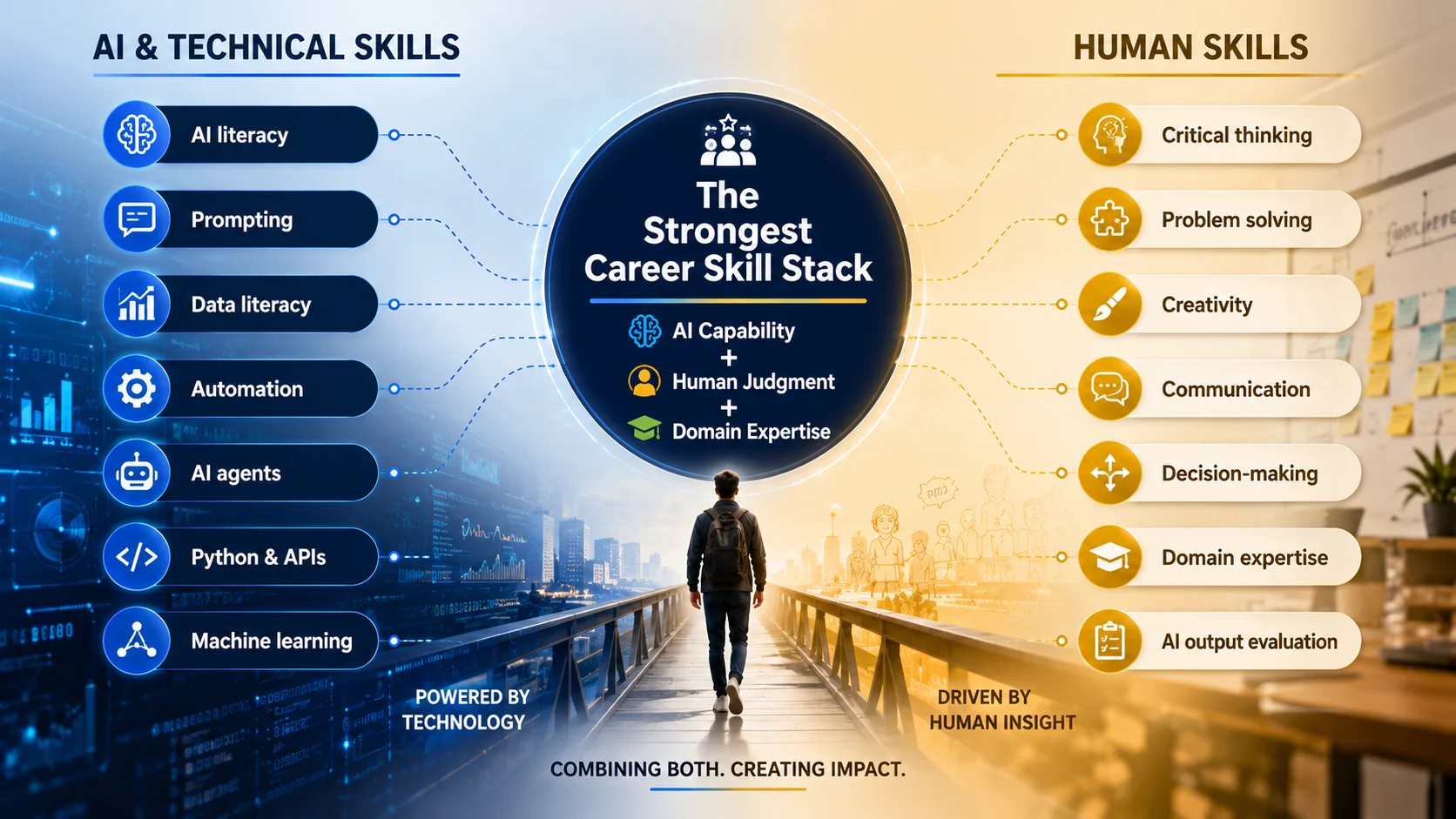
Your strongest career advantage may come from combining:
Something valuable you understand deeply + AI skills that make you better at it.
That combination is harder to copy than simply knowing the latest AI tool.
Best AI Skills for Beginners, Students and Non-Technical Jobs
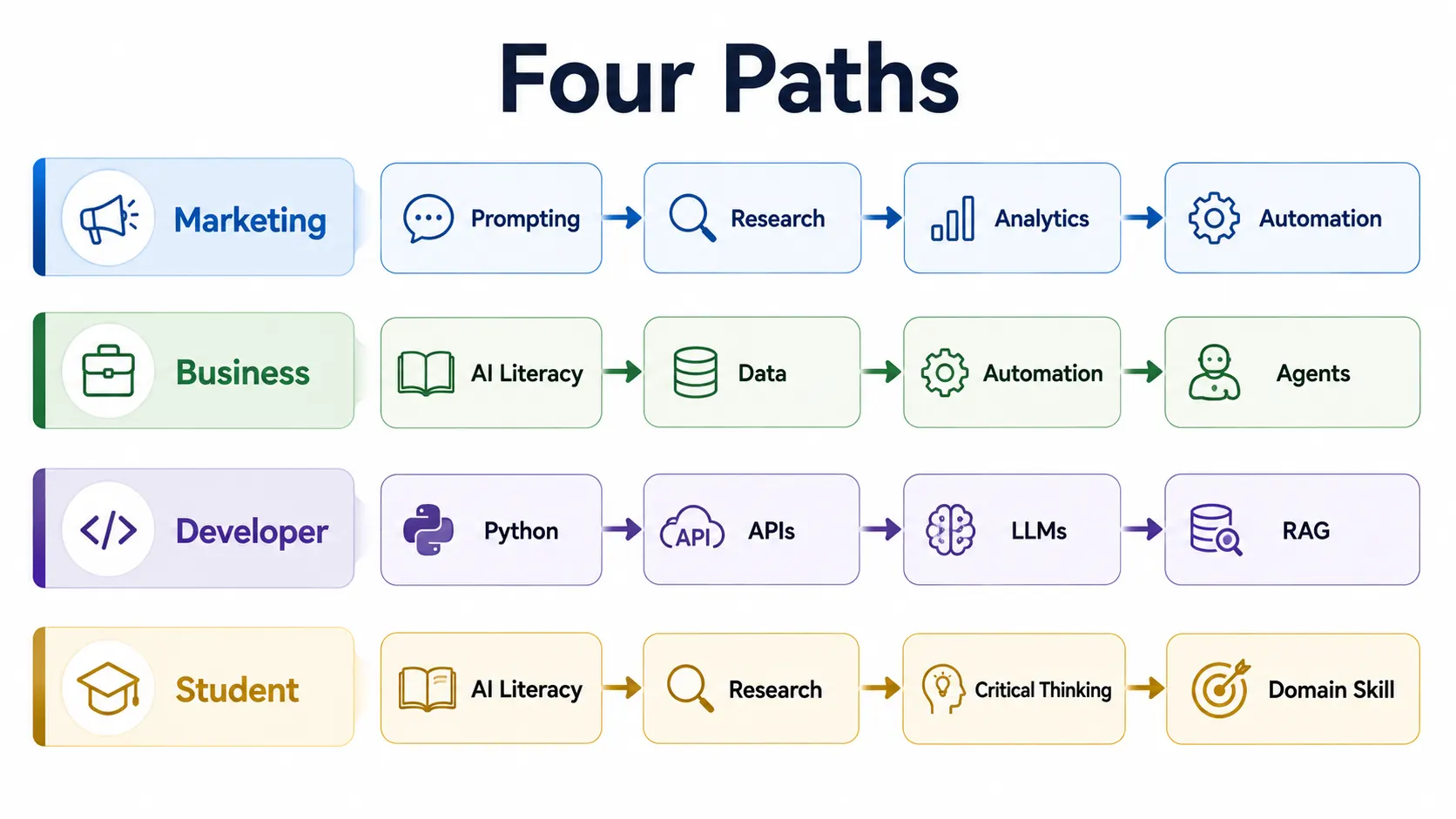
Beginners should start with AI literacy, prompting and output evaluation before moving into more advanced tools.
For non-technical jobs, the strongest combination is usually AI literacy, research, data interpretation, automation and AI strategy. Coding is useful only when the role or project requires it.
Students should focus on using AI to understand difficult subjects, explore questions and practise skills rather than using it merely to avoid doing the work themselves.
Marketers should develop AI-assisted research, analytics, content evaluation, automation and creative experimentation while retaining strong knowledge of customers, positioning and brand strategy.
A Practical 90-Day AI Skills Roadmap
During the first 30 days, learn how generative AI works at a practical level. Use more than one AI assistant, practise structured instructions and deliberately test situations where the model gives weak or incorrect answers.
During days 31–60, apply AI to real work. Choose a few repetitive or research-heavy tasks and redesign them. Experiment with data analysis and simple automation. Pay attention to which parts still require human judgment.
During days 61–90, specialize. A marketer might build an AI-assisted research workflow. A business professional could learn automation and agents. A technical learner could begin Python, APIs or RAG.
Finish the 90 days with something tangible that you can explain or demonstrate.
How to Put AI Skills on Your Resume
Writing “ChatGPT, Gemini, AI, Prompt Engineering” in a skills section tells an employer very little.
Show what you actually did.
Instead of simply claiming “AI automation,” explain that you created an AI-assisted reporting process that reduced repetitive analysis and kept human review before publication.
Instead of listing “AI research,” explain how you used AI to accelerate competitor research while verifying statistics against original sources.
The principle is straightforward:
Skill + real application + result.
A small portfolio of genuine AI projects can often communicate more than a long collection of tool names.
Will Learning AI Skills Future-Proof Your Career?
No skill can guarantee that a job will never change.
The more useful objective is to become adaptable.
The World Economic Forum expects technological skills to grow rapidly through 2030, but its research also emphasizes human abilities such as analytical thinking, creativity, resilience and lifelong learning.
Microsoft’s research reaches a related conclusion: more advanced AI use does not eliminate the need for human judgment. Its 2026 survey found that 86% of AI users treated AI output as a starting point rather than a finished answer.
That suggests a better career formula:
Domain expertise + AI capability + critical thinking + judgment.
If you are concerned about how automation may affect different professions, read our related guide on jobs that are harder for AI to replace
Frequently Asked Questions
What are the best AI skills to learn for jobs?
For most professionals, the best AI skills include AI literacy, prompt design, output evaluation, critical thinking, research, data literacy, automation and AI agents. Technical professionals can also benefit from Python, APIs, RAG and machine learning.
What AI skill should a beginner learn first?
Start with AI literacy. Understand what generative AI can and cannot do before learning prompting, verification and workflow automation.
Do I need coding to learn AI?
No. Many valuable AI skills do not require programming. Coding becomes more important if you want to build AI applications or pursue roles such as AI engineer or machine-learning engineer.
Is prompt engineering still worth learning?
Yes, but focus on clear instruction design rather than memorizing “magic prompts.” Being able to define objectives, context and constraints is more transferable between AI tools.
What AI skills are useful for non-technical jobs?
AI literacy, research, data interpretation, prompting, automation, AI agents, business strategy and responsible AI are particularly useful for non-technical professionals.
How should I add AI skills to my resume?
Describe how you applied AI to a real task and what happened as a result. Specific examples are more credible than simply listing AI product names.
Final Takeaway
The best AI skills to learn are not necessarily the most technical ones.
Start by learning how AI works, how to communicate with it and how to identify when its answers are wrong. Then develop data, research, automation and workflow skills that fit your profession.
If you want a technical AI career, go deeper into Python, APIs, RAG and machine learning.
But do not neglect the skill that AI cannot simply hand you: experience in a real field.
The professionals who stand out are unlikely to be those who know the most AI tools. They will be the ones who understand a valuable problem, know when AI can help, recognize when it cannot, and take responsibility for the final result.