
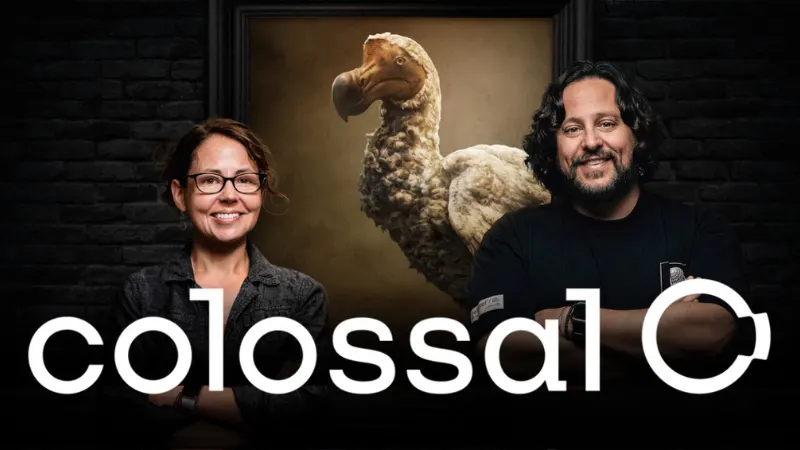
Imagine giant shadows returning to living ecosystems. Mammoths trudging through the snowy tundra, Thylacines slinking through Tasmanian grasslands or Moas towering menacingly in New Zealand. The mere thought feels like a scene from the next installment of the famous dinosaur movie series, yet Colossal Biosciences has turned it into a roadmap. The company’s flagship ‘Project Colossal’ aims to push this vision into reality.
What is Colossal Biosciences?
Colossal Biosciences is a biotechnology and genetic engineering company founded in 2021 by serial entrepreneur Ben Lamm, and George Church, a pioneering geneticist at Harvard and MIT. Based in Dallas, the company brands itself as the first dedicated de-extinction company. Its mission is to apply computational genomics, synthetic biology, and artificial intelligence to revive lost species and to preserve those on the brink.
The company secured heavy financial support from Investors likeThomas Tull, Paris Hilton, and numerous venture funds. In January 2025 Colossal raised a 200 million dollar Series C, valuing it at over 10 billion dollars. Partnerships span universities, conservation groups, and indigenous organizations, creating a broad foundation for its programs.
Project Colossal Explained
Project Colossal serves as the umbrella for Colossal Biosciences’ entire de-extinction pipeline. The company has not hidden its ambitions. It has publicly declared its targets, which include the woolly mammoth, the Tasmanian thylacine, the long-vanished dodo, the legendary dire wolf, and the towering giant moa of New Zealand. These names may read like the pages of a natural history book come to life, yet they represent distinct, carefully structured scientific efforts.
The technical blueprint is sequential, each stage designed to build on the accuracy of the previous one. The first step requires assembling ancient genomes from samples such as bones, teeth, or preserved tissue. DNA degrades over time, so piecing it together calls for sophisticated genomics pipelines. Once assembled, these genomes undergo comparison with those of modern relatives. Here artificial intelligence and computational systems play a central role, aligning ancient sequences with living benchmarks to identify what is missing or mutated.From that comparison arise genetic clues about key traits, whether dense insulating hair, metabolic cold-resilience, or skeletal adaptations. Scientists then apply CRISPR and other genetic tools to edit those traits into embryos of surrogate species. The development stage is completed either in surrogate mothers or through artificial wombs that Colossal claims to be building.
Colossal Achievements so far
Since its founding, Colossal Biosciences has rolled out a series of headline-grabbing and scientifically notable milestones. Each one marks a new test of whether de-extinction can move from theory to practice.
The thylacine program delivered its first breakthrough with the most complete genome ever assembled for the species. Using computational genomics and AI-driven modeling, researchers compared the thylacine genome against those of living marsupials, mapping out genes that control reproduction and phenotype. These insights now feed into experiments using the fat-tailed dunnart, a tiny yet genetically useful marsupial surrogate.
Momentum accelerated in 2024 with the dramatic announcement of Dire Wolf Proxies. Scientists used DNA gleaned from a 13,000-year-old tooth and a 72,000-year-old skull to make twenty germline edits in living canids, fifteen of those edits matching extinct variants. The resulting pups carried physical traits associated with the legendary Dire Wolves.
Not all of Colossal’s experiments involved predators. They revealed the Woolly Mice in early 2025. These were small mammals engineered with mammoth-like traits such as elongated golden fur and metabolic adaptations for cold environments. This endeavour was a success with the offspring being alive and thriving.
Soon after, the spotlight shifted south. In July 2025, the giant moa joined Colossal’s portfolio through a partnership with the Ngāi Tahu Research Centre in New Zealand, supported by filmmaker Sir Peter Jackson and projected on a five-to-ten-year timeline.
Together, these achievements reveal a pipeline steadily evolving from genome assembly, to live proxy births, to global conservation partnerships.
Pipeline and Future Projects
Beyond the named projects, Colossal has referenced longer term ambitions. These include Steller’s sea cow, The woolly mammoth, Columbian mammoth, saber tooth cat, and giant ground sloth. Each moves through stages of research, genome editing, surrogate development, and eventual ecological planning. For elephants and other large mammals, the company is also pursuing artificial womb technology.
Are They Visionaries or Just Overambitious Visionaries?
Colossal attracts comparisons to fiction because of the scale of its claims. Media coverage often plays on Jurassic Park themes. Experts have expressed caution. The IUCN Canid Specialist Group argues that dire wolf proxies do not restore true conservation status since they are not the same species. Other scientists note that the line between conservation and synthetic biology is blurred.
Supporters emphasize that the technologies could provide conservation benefits even if exact species are not recreated. Colossal itself stresses that its work will generate reproductive and genomic tools that aid living endangered species as well.They claim that the reintroduction of these lost keystone species will be pivotal for the stabilization of a rapidly deteriorating ecosystem and argue that the benefits outweigh the risks.
The balance between spectacle and science remains an open question as the fears and reassurances both remain hypothetical.
Ethical, Ecological, and Regulatory Considerations
Wherever de-extinction is mentioned, ethical questions are never far behind. Conservationists and ecologists have warned that efforts to revive long-lost animals might divert attention and resources from endangered species still fighting for survival today. The practical challenge of limited funding becomes a philosophical one: should money, time, and talent flow toward animals gone for thousands of years when many still-living creatures stand on the brink of extinction?
Another concern is ecological fit. Even if Colossal produces organisms that closely resemble mammoths, thylacines, or moas, these proxies are not exact genetic copies. They are engineered hybrids designed from reconstructed genomes. Critics ask whether such animals can be safely integrated into complex ecosystems that have shifted in their absence. A tundra changed by human activity for centuries or a Tasmanian forest already altered since the thylacine’s extinction may not welcome proxies without unforeseen disruption.
Colossal has worked to show that it is not ignoring these dilemmas. The company established the Colossal Foundation as a mechanism to invest in biodiversity and reintroduction planning. It also highlights formal collaborations with indigenous communities. The partnership with Ngāi Tahu in New Zealand, guiding the moa project, emphasizes cultural values and local ecological knowledge as critical inputs, not afterthoughts.
Still, regulatory frameworks trail behind innovation. There are no established legal pathways for releasing de-extinct or proxy organisms into the wild, and the few public documents available provide little detail. As Colossal advances its agenda, governments and international bodies will need to define standards that balance scientific ambition with biodiversity stewardship.
The Role of Artificial Intelligence, Computational Methods, and Genomics
Artificial intelligence plays a central role in Colossal’s approach. Machine learning models process degraded ancient DNA sequences to predict missing bases. AI systems also speed up genome assembly and annotation by comparing fragments to living relatives. This allows scientists to reconstruct large stretches of extinct genomes with higher accuracy.
Colossal also uses AI driven comparative genomics to identify which gene variants control target traits. For example, analysis of mammoth genomes across 700,000 years revealed metabolic and hair growth adaptations. AI pipelines flagged the variants most likely responsible for cold climate survival.
Form Bio, a software company spun out of Colossal in 2022, provides computational tools for storing and analyzing genomic datasets. The platform uses AI guided workflows to assist with CRISPR edit design and variant testing.
Together, these computational and AI methods form the backbone of Project Colossal. They convert fragmented DNA into usable genetic blueprints and allow precise editing strategies.
Implications if They Succeed
Colossal Biosciences publicly outlines a pipeline that extends beyond mammoths, thylacines, dodos, dire wolves, and moas to species such as Steller’s sea cow, the Columbian mammoth, the saber‑toothed cat, and the giant ground sloth. Success would bring ecological shifts: mammoth proxies could reshape tundra landscapes by compacting snow and fostering grass savannas, while moa proxies might restore lost seed dispersal roles in New Zealand ecosystems.
The larger path forward extends beyond animals themselves. If Colossal fulfills these ambitions, synthetic biology and conservation genomics may enter the mainstream of global biodiversity strategies. Conservation groups, indigenous communities, and government regulators would need to engage with new categories of organisms that blur traditional definitions of endangered species. In that way, Project Colossal could influence not only landscapes and wildlife but also the policies, partnerships, and ethics that shape the future of conservation science itself.
Yet the future may not be entirely rosy. Introducing proxies into ecosystems carries real ecological risk. Even carefully reconstructed species stand as engineered hybrids that may not behave exactly as their ancestors did. If released prematurely or in poorly studied habitats, such organisms could disrupt food webs or outcompete vulnerable natives. Conservation scientists caution that without rigorous monitoring and long-term impact studies, de-extinction could operate less like ecological restoration and more like opening a modern Pandora’s box. The path forward is as much about responsibility as it is about revival.
In Conclusion
Colossal Biosciences has turned a speculative dream into a working pipeline. Genomics, CRISPR, artificial intelligence, and paleogenetics come together in Project Colossal. Achievements such as dire wolf pups, woolly mice, and thylacine genomes demonstrate steady progress. At the same time, ethical and ecological debates shape every announcement.
The company stands at a crossroads of imagination and science. Whether their work leads to genuine conservation breakthroughs or sparks controversy depends on transparent regulation and ecological responsibility. Readers curious about the future of synthetic biology and de-extinction should dive into the cited sources. The story is already unfolding.