You have probably heard about AI in self-driving cars, smart assistants, and chatbots. But here is something you may not have expected: AI is now stepping into skincare and even cancer care in the U.S. Imagine your daily routine with cleansing, moisturizing, and sunscreen. Now picture AI quietly working in the background to protect not just your glow but your health too.
Here’s the big question: Will your skincare routine soon be able to help you detect skin cancer symptoms early? The answer might surprise you.
AI Skincare Apps: Turning Phones into Personal Skin Coaches
You already use your phone to count steps, track your sleep, or remind you to drink water. Now, AI-powered skincare apps are becoming like personal skin coaches for all. Tools like Olay Skin Advisor and Revieve are leading the way.
Why do people in the U.S. love them?
Because of personalized recommendations. Instead of guessing which serum or sunscreen to buy, these apps scan your skin and suggest what works best for you. It’s quick, it’s easy, and it’s like having a dermatologist in your pocket (minus the long appointment wait times).
AI for Early Skin Cancer Detection: Life-Saving Technology in Action
Now, let’s move from beauty to something even bigger: health. In the U.S., AI tools are being used to detect skin cancer early, and this is a game-changer. Devices like DermaSensor have received FDA approval, meaning they’re trusted at a medical level.
Here’s how it works: AI scans your moles or spots and flags anything suspicious, with accuracy close to what dermatologists can deliver. For many Americans, this makes early detection easier and far more accessible, because detecting skin cancer early can literally save lives.
Japanese Early Cancer-Detection Tech Inspiring the U.S.
Do you know, while the U.S. is moving fast, some of the most exciting breakthroughs in early detection are coming from Japan, and they are starting to shape how we do things.
Olympus and Fujifilm have developed AI-powered endoscopy tools that can spot and flag unusual tissue growths instantly during the procedure. These are already being studied in the U.S. to improve early cancer screening.
Japanese researchers trained AI on 120,000 skin lesion images, reaching an accuracy of about 86 percent, which outperformed many specialists. This kind of innovation is driving smarter skin-monitoring tools worldwide.
And then there is Toshiba’s microRNA test, which uses a single drop of blood to detect up to 13 different cancers with 99 percent accuracy. It is still in development, but U.S. scientists are closely watching to bring similar liquid-biopsy methods here.
Here is the most interesting part. Japan even built AI for bakeries. Originally designed to recognize bread types at checkout, the same image-recognition technology was later adapted to detect cancer cells in scans. It proves that everyday AI can evolve into life-saving healthcare.
And this is not just theory. Notable U.S.–Japan collaborations are already underway:
The U.S. Frederick National Lab (NCI/FNL) and the National Cancer Center of Japan (NCC) are working together on AI-assisted drug discovery.
The MONSTAR Project in Japan, one of the largest precision-oncology studies, now partners with U.S. companies like Caris Life Sciences to integrate AI tumor profiling into trials.
Conferences continue to connect the two countries, including the upcoming 12th U.S.–Japan Conference on AI-Empowered Cancer Research with AI on 5th September 2025 in Washington, D.C.
In short, America’s cancer-care future is being shaped not just at home but also through Japanese precision and innovation.
AI Self Cancer-Care Meets Preventive Skincare in the U.S.
What’s exciting is how skincare and cancer care are blending together. Americans are using AI not just for beauty tips but also for preventive health. With apps and telemedicine, you can monitor changes in your skin at home, without waiting for your yearly checkup.
It’s about empowerment. Instead of reacting late, AI helps you act early, whether it’s booking a dermatologist visit or just adjusting your routine. Your skincare steps suddenly double as health check-ins, and that’s powerful.
Challenges of AI in Skincare and Cancer Detection
Of course, AI isn’t flawless. Sometimes it can give false alarms, known as false positives or miss something important known as false negatives. And then there’s the privacy factor. Your skin selfies aren’t just pictures; they’re medical data. Americans are right to ask: who’s storing this info and how safe is it?
That’s why dermatologists still play a crucial role. AI can guide, support, and alert you, but human expertise is essential in cancer care. Think of AI as the assistant, not the replacement.
Future of AI in Cancer-Care: From Smart Mirrors to Wearables
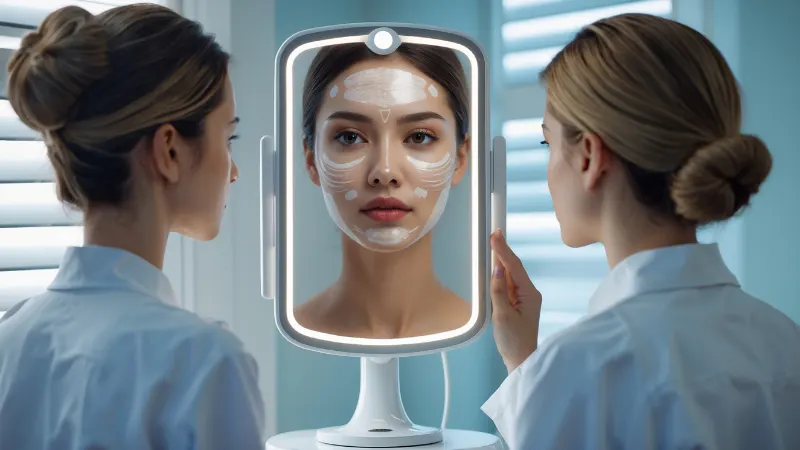
Now, let’s look ahead. AI in cancer care isn’t stopping with apps and scanners. It’s moving into everyday objects you already use. Imagine standing in front of your bathroom mirror, and instead of just showing your reflection, it’s an AI-powered smart mirror that tracks changes in your skin daily. No more guessing if that mole looks different; it tells you.
Then there are AI wearables that measure UV exposure and notice subtle changes in your skin over time. In the U.S., the trend is clear. Proactive, AI-driven health monitoring at home. Instead of waiting until something feels wrong, you’ll have real-time insights, helping you protect your skin and health before problems even start.
Final Thoughts: Smarter AI Skincare, Safer Self Cancer-Care
To wrap this up, AI is giving Americans smarter ways to care for their skin, from suggesting suitable products to spotting unusual moles and reminding them when it’s time to visit a doctor. And with Japanese innovations fueling U.S.–Japan collaborations, the future looks even brighter.
The balance is key. Think of it this way: AI empowers you, but doctors confirm for you.
The future of skincare in the U.S. is not just about beauty anymore. It is about prevention, protection, and survival. With AI stepping in as your skincare partner, you are not just glowing, you are staying safe.
FAQ
Q: Can AI skincare really detect skin cancer early?
Yes. Tools like FDA-cleared DermaSensor and research-backed Japanese systems can help identify suspicious changes early. While not perfect, they are making detection more accessible.
Q: Are AI-powered skincare apps reliable in the U.S.?
They are excellent for personalized skincare tips and spotting changes, but they should not replace medical advice. Think of them as guides, not final answers.
Q: Do I still need a dermatologist if I use AI for self cancer-care?
Absolutely. AI can support you, but only a dermatologist can diagnose and treat skin cancer. AI is the assistant and the expert is still required.
Q: What is the future of AI in skincare and cancer detection?
Expect more smart mirrors, AI wearables, and even Japanese-inspired microRNA blood tests making their way into American homes. The future is all about prevention, convenience, and collaboration.