The Power of a Debt Free Life: Why It Matters
0
0


India finished the Birmingham Commonwealth Games in 2022 with an impressive 61 medals and fourth place in the overall medal standings. However, expecting the country to repeat that number at Commonwealth Games 2026 would create an unfair comparison.
The reason is not necessarily a decline in the performance of Indian athletes.
Glasgow 2026 has a much smaller sports programme. Several disciplines that delivered a large share of India’s medals in Birmingham—including wrestling, badminton, table tennis, hockey, squash and cricket—are not part of the 2026 Games.
Together, those sports accounted for exactly 30 of India’s 61 medals at CWG 2022.
This creates what can be called India’s “30-medal problem.” Even if Indian athletes perform well in Glasgow, the country could finish with approximately half as many medals simply because many of its strongest events are unavailable.
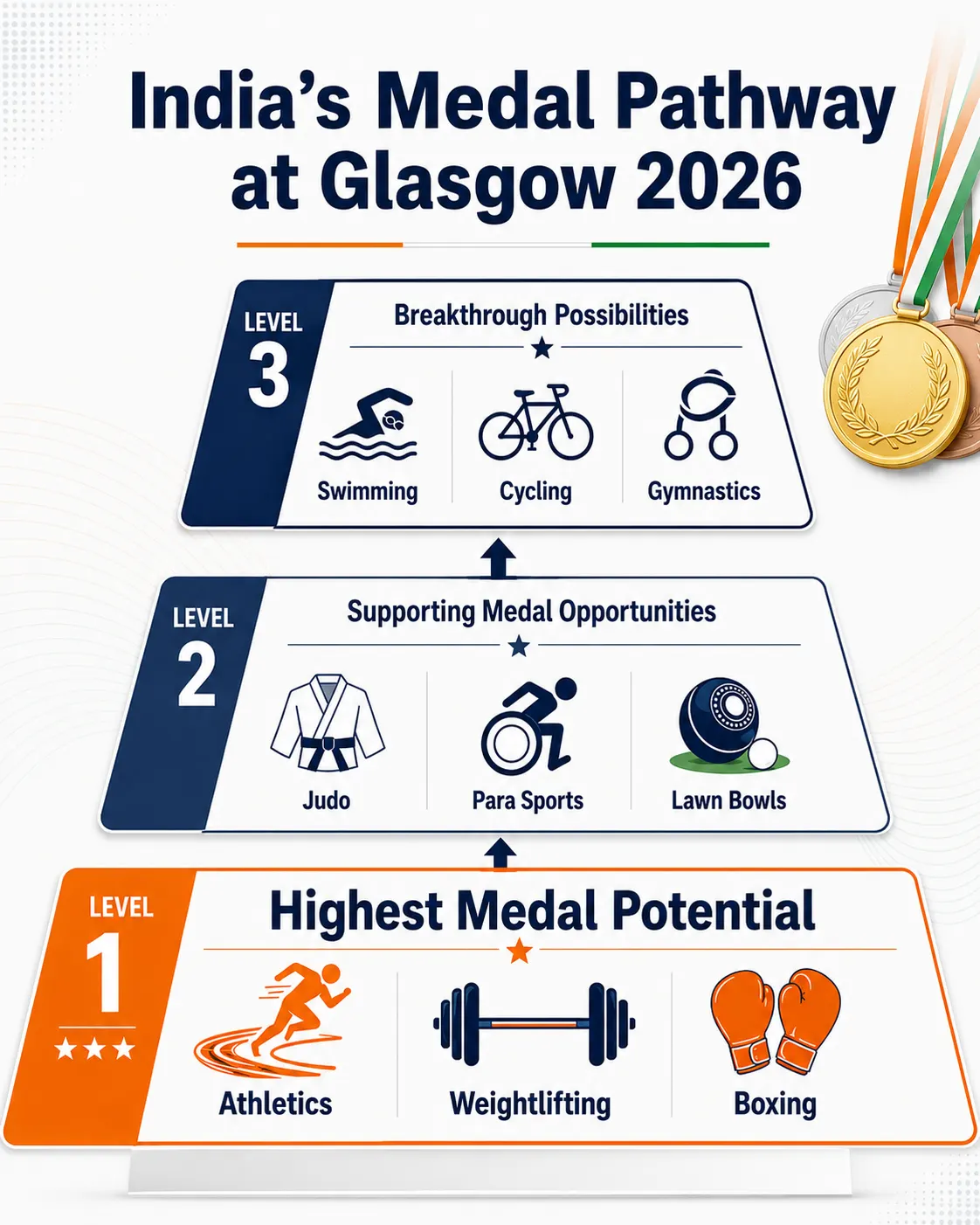
Quick answer: A total of around 30 medals would be a realistic and respectable result for India at Commonwealth Games 2026. Athletics, weightlifting and boxing are likely to carry much of India’s medal responsibility, while judo, lawn bowls and Para sports could provide important additions.
| Key measurement | Figure or outlook |
|---|---|
| India’s medal total at CWG 2022 | 61 |
| Gold medals won in 2022 | 22 |
| Medals from sports absent in 2026 | 30 |
| India’s Glasgow 2026 contingent | 124 competitors |
| Realistic editorial target | Around 30 medals |
| Main medal-producing sports | Athletics, weightlifting and boxing |
| Supporting opportunities | Judo, lawn bowls and Para sports |
| Glasgow 2026 dates | July 23–August 2, 2026 |
Glasgow 2026 features a compact ten-sport programme, including six fully integrated Para sports, staged across four main venues. Readers can review the complete list of sports, dates and venues through the official Commonwealth Games 2026 programme.
India won 22 gold, 16 silver and 23 bronze medals at Birmingham 2022. The country finished behind Australia, England and Canada in the final standings.
The complete list of Indian medal winners can be viewed in the official Birmingham 2022 India medal tally.
However, the Glasgow programme is very different from Birmingham.
Six sports that contributed heavily to India’s medal total are missing in 2026:
| Sport absent from Glasgow 2026 | India’s medals at CWG 2022 |
|---|---|
| Wrestling | 12 |
| Table tennis, including Para table tennis | 7 |
| Badminton | 6 |
| Hockey | 2 |
| Squash | 2 |
| Cricket | 1 |
| Total | 30 |
These were not minor sports for India.
Every Indian wrestler who competed in Birmingham returned with a medal, producing a total of 12. Badminton delivered six medals, including three golds, while table tennis and Para table tennis contributed seven.
India also reached the podium in men’s hockey, women’s hockey, women’s cricket and two squash events.
Removing these disciplines does more than reduce the size of the Indian team. It eliminates dozens of possible medal routes across individual, doubles and team competitions.
Those lost opportunities cannot automatically be replaced by stronger performances in athletics, boxing or weightlifting.
Glasgow 2026 was designed as a smaller and more concentrated edition of the Commonwealth Games.
The ten-sport programme includes:
The Games are being staged at four main venue groups located within an eight-mile corridor in Glasgow. This approach reduces the need for new construction and creates a more compact schedule for athletes, broadcasters and spectators.
Glasgow 2026 also includes a record 47 Para medal events across six sports, making it the largest integrated Para sports programme in Commonwealth Games history.
India’s official team contains 124 competitors, including able-bodied and Para athletes.
The team will compete in athletics, boxing, weightlifting, judo, gymnastics, cycling, lawn bowls and swimming, alongside Para athletics, Para powerlifting, Para swimming, Para track cycling and wheelchair basketball.
The official contingent information is available through the Indian Olympic Association’s Glasgow 2026 announcement.
A smaller team does not automatically mean that India is sending weaker athletes. It does mean that India has fewer entries, fewer events and fewer possible paths to the podium.
That is why the total medal count must be evaluated in the context of the available opportunities.
India’s performance in Glasgow is likely to depend heavily on three sports:
These sports produced 25 Indian medals at Birmingham 2022. With several traditional medal-winning disciplines removed, their importance has increased considerably.
Athletics gives India medal opportunities across javelin, long jump, triple jump, high jump, shot put, race walking, distance running and relay events.
India has developed considerably greater depth in track and field over the past decade. The country is no longer dependent on a single athlete or event to produce results.
However, Commonwealth athletics remains highly competitive. Indian athletes will face strong opposition from countries including Australia, England, Canada, Jamaica, Kenya, South Africa, Grenada and Pakistan.
Strong qualification performances will not always guarantee medals. India will need its leading athletes to produce their best results during the finals.
India’s outlook: Athletics should be one of the country’s largest medal sources, but it is also one of the hardest sports to predict accurately.
Weightlifting delivered ten medals for India at Birmingham 2022, making it the country’s most productive sport among those retained for Glasgow.
India has traditionally performed well in Commonwealth weightlifting because several Indian lifters enter with totals capable of challenging for medals.
The format also gives the country opportunities across multiple weight categories for both men and women.
Nevertheless, repeating the ten medals won in Birmingham should not be considered automatic. Athlete form, weight-category changes, injuries and the final quality of the competition will influence the outcome.
India’s outlook: Weightlifting could once again provide one of India’s highest medal-conversion rates.
Indian boxing has produced medals across both the men’s and women’s categories at major international competitions.
India won seven boxing medals in Birmingham, including three golds. The country will again expect several boxers to progress to the later rounds in Glasgow.
However, boxing predictions are difficult because results can be influenced by the tournament draw. A difficult early matchup can eliminate a medal contender, while a favourable draw can quickly create several semifinal opportunities.
India’s outlook: Boxing has the potential to become one of India’s top three medal-producing sports.
India won three judo medals at Birmingham 2022.
Judo is unlikely to match the overall numbers expected from athletics, boxing or weightlifting, but even two or three medals could make an important difference to India’s final tally.
Representation across multiple weight categories gives the Indian team several possible routes to the podium.
India’s outlook: A valuable supporting sport with realistic medal opportunities.
Lawn bowls produced one of India’s most memorable stories at the 2022 Commonwealth Games.
The Indian women’s fours team won a historic gold medal, while the men’s fours team earned silver.
Those performances proved that Indian athletes could compete successfully in a sport that had previously received little public attention in the country.
Glasgow uses a different competition format, so India’s Birmingham results cannot simply be repeated as predictions. However, the experience and confidence gained in 2022 could help the team remain competitive.
India’s outlook: A possible source of one or more unexpected medals.
Glasgow 2026 places greater emphasis on integrated Para competition than any previous Commonwealth Games.
India is represented in Para athletics, Para powerlifting, Para swimming, Para track cycling and wheelchair basketball.
The expanded Para programme provides more opportunities for Indian athletes to make a significant contribution to the national medal tally.
It also means India’s 2026 performance should not be assessed only through traditional able-bodied events. Success in Para sports could determine whether the country finishes below or above the 30-medal benchmark.
India’s outlook: One of the most important areas to follow during Glasgow 2026.
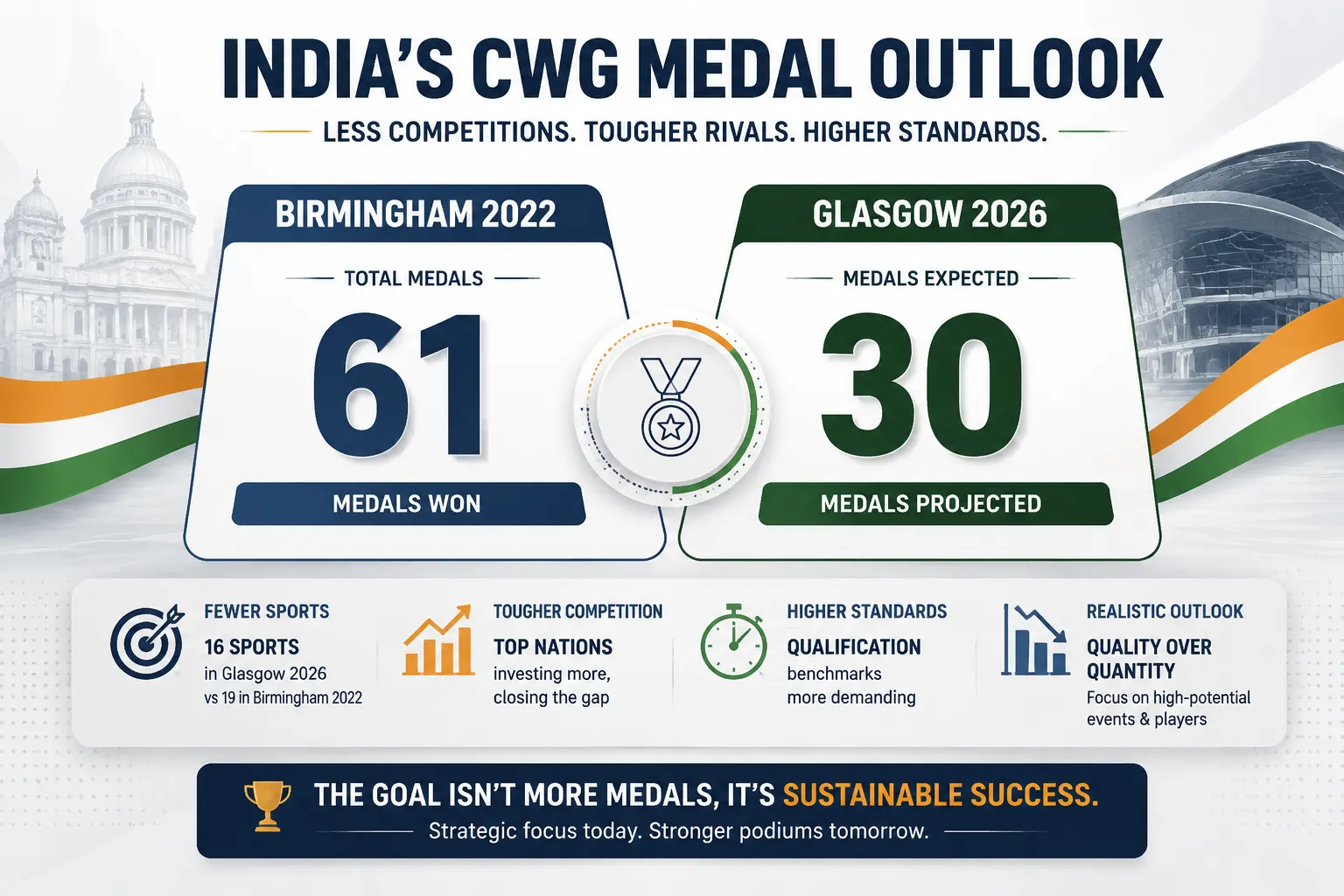
A simple comparison between 61 medals in Birmingham and approximately 30 in Glasgow can create the wrong impression.
India won 30 Birmingham medals in sports that do not appear in the Glasgow programme. Removing those medals leaves India with 31 medals from the other sports contested in 2022.
Therefore, a Glasgow total close to 30 would not automatically represent a 50% decline in Indian sporting performance.
It could indicate that India performed at roughly the same level in the opportunities available to it.
A more meaningful analysis should consider:
The total number will matter, but it will not tell the complete story.
Fewer than 25 medals
This would probably be viewed as a disappointing campaign, especially if India underperforms in athletics, weightlifting and boxing.
Between 25 and 29 medals
This would be a respectable result under the reduced programme, although several major medal opportunities may have been missed.
Around 30 medals
This is the most reasonable pre-Games benchmark. It would broadly match India’s Birmingham performance after medals from the absent sports are removed.
Between 31 and 35 medals
This would represent a very strong campaign, particularly if India receives valuable contributions from judo, lawn bowls and Para sports.
More than 35 medals
This would be an excellent result. India would likely need strong performances across all its main sports, along with unexpected medals in cycling, swimming or gymnastics.
These ranges are editorial benchmarks, not official predictions.
India finished fourth at Birmingham 2022, but maintaining that position may be more challenging in Glasgow.
The smaller programme favours nations with considerable strength in swimming, athletics, track cycling and gymnastics. Australia, England and Canada have traditionally possessed strong depth across these disciplines.
The medal table is also ranked by gold medals before silver and bronze medals. India could win a respectable number of total medals but move lower in the standings if it does not convert enough opportunities into gold.
India’s position will therefore depend not only on how many medals it wins, but also on the type of medals earned.
India is unlikely to repeat its 61-medal performance from Birmingham, but that does not automatically mean Indian athletes have become less competitive.
The structure of the Commonwealth Games has changed.
Six sports responsible for 30 Indian medals in 2022 are absent. India is also competing with a smaller contingent in an event built around only ten sports.
Against that background, a total of around 30 medals would be a realistic and respectable result.
Athletics, weightlifting and boxing should form the foundation of India’s campaign. Judo, lawn bowls and the expanded Para programme could determine whether the country finishes below or above that mark.
The real question is not whether India can match the 61 medals won in Birmingham.
It is whether India can make the most of the much smaller number of medal opportunities available in Glasgow.
How many medals is India expected to win at CWG 2026?
Around 30 medals is a reasonable editorial estimate based on the smaller sports programme and India’s results at Birmingham 2022. It is not an official or guaranteed prediction.
Why might India win fewer medals in Glasgow?
Wrestling, badminton, table tennis, hockey, squash and cricket are absent from Glasgow 2026. These sports produced 30 of India’s 61 medals at Birmingham 2022.
How many medals did India win at CWG 2022?
India won 61 medals: 22 gold, 16 silver and 23 bronze. The country finished fourth in the overall medal standings.
How many Indian competitors are participating at CWG 2026?
The Indian Olympic Association announced a contingent of 124 competitors, including able-bodied and Para athletes.
Which sports offer India its best medal opportunities?
Athletics, weightlifting and boxing are expected to be the main contributors. Judo, lawn bowls and Para sports could also add valuable medals.
When will Commonwealth Games 2026 take place?
The Glasgow Commonwealth Games take place from July 23 to August 2, 2026.
Is the 30-medal prediction official?
No. It is an editorial benchmark based on India’s past results and the sports available in Glasgow. Actual results may be higher or lower.

Log in to support this story.
New here? Create an account


Discussion · 0 Comments
No comments yet — be the first to share your thoughts.