
Startup Business Tactics: Strategies for Sustaining Growth
29
0


For many Indian sports fans, the Glasgow 2026 programme looks incomplete.
There is no cricket. No hockey. No badminton or wrestling. Table tennis and squash are missing too.
These are not minor omissions from an Indian perspective. They include some of the country’s most popular sports and, more importantly, some of its most dependable sources of Commonwealth Games medals.
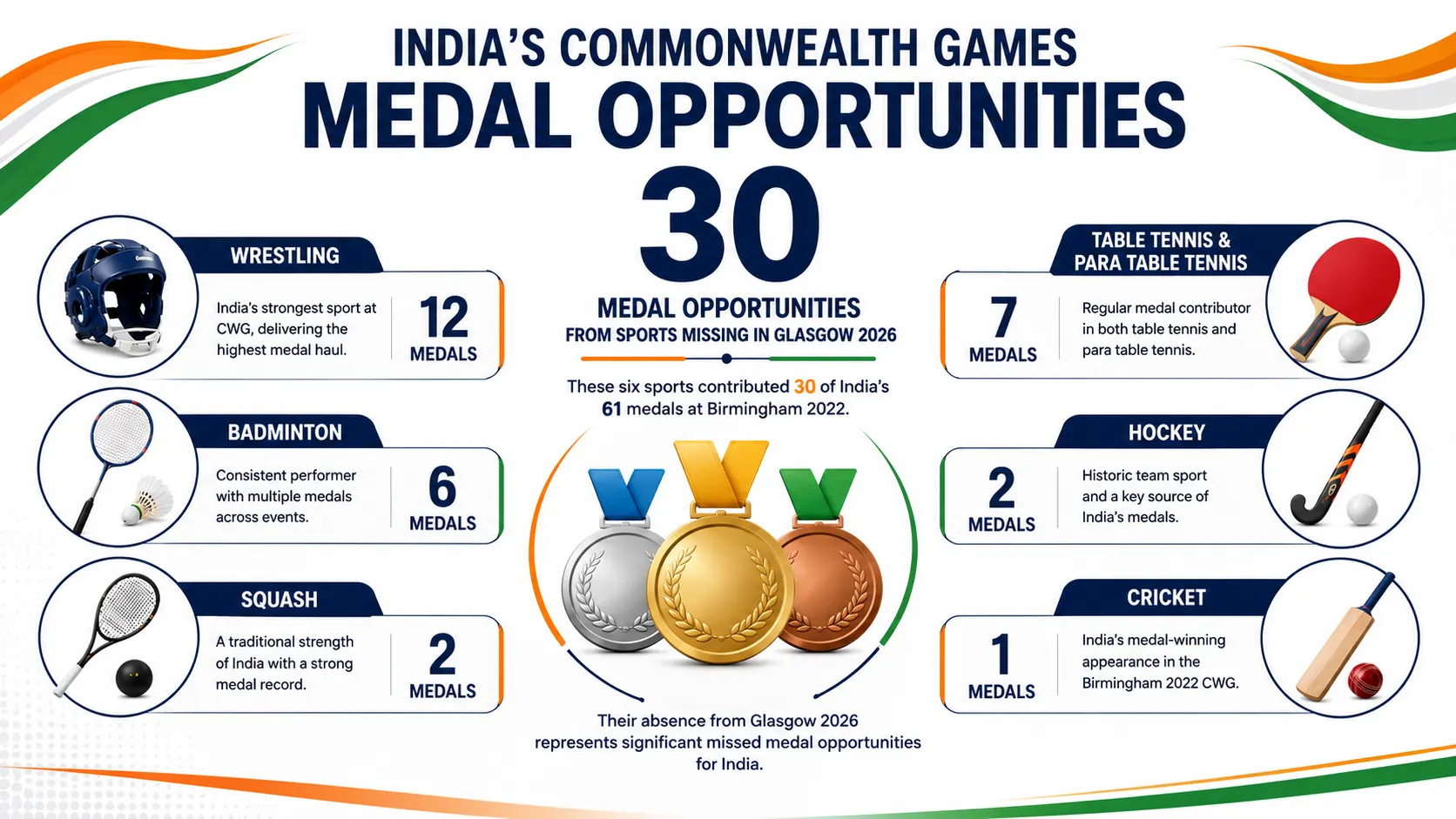
At Birmingham 2022, India won 61 medals. Exactly 30 of them came from sports that are not being contested in Glasgow.
So, why were so many major sports left out?
The answer is not that the Commonwealth Games suddenly consider cricket, badminton or hockey unimportant. Glasgow inherited an event that had lost its original host and had very little time to prepare. The organisers responded by creating a smaller Games that could be delivered through existing venues, fewer athletes and a tightly controlled budget.
In practical terms, Glasgow 2026 is not a normal edition of the Commonwealth Games. It is a rescue operation as much as a sporting event.
Cricket, hockey, badminton and wrestling are missing from Commonwealth Games 2026 because Glasgow adopted a reduced ten-sport programme built around four existing venue sites. Cost, venue availability, athlete numbers and the short preparation period shaped the final selection.
Glasgow 2026 will feature ten sports and six integrated Para sports. Around 3,000 athletes from 74 nations and territories are expected to compete for 215 gold medals.
The Games run from July 23 to August 2, 2026, with sporting competition beginning on July 24.
The official Glasgow 2026 programme includes:
| Sport | Para programme |
|---|---|
| Athletics | Para athletics |
| Swimming | Para swimming |
| Track cycling | Para track cycling |
| Bowls | Para bowls |
| Weightlifting | Para powerlifting |
| 3×3 basketball | 3×3 wheelchair basketball |
| Boxing | Not included |
| Judo | Not included |
| Netball | Not included |
| Artistic gymnastics | Not included |
Athletics and swimming are compulsory Commonwealth Games sports. The host has more flexibility when choosing the rest of the programme.
That flexibility has become central to the future of the event. Instead of asking every host to stage a huge list of sports, Commonwealth Sport now allows cities to develop a programme that works with their venues, finances and local audience.
In Glasgow’s case, that meant keeping the programme unusually small.
The list of missing sports is substantial.
| Sport missing from Glasgow 2026 | Why its absence matters |
|---|---|
| Wrestling | India won 12 medals at Birmingham 2022 |
| Badminton | India won six medals, including three golds |
| Table tennis and Para table tennis | India won seven medals |
| Hockey | India’s men and women both reached the podium |
| Cricket | India won silver in the women’s T20 competition |
| Squash | India won two bronze medals |
| Rugby sevens | A long-standing Commonwealth team sport |
| Triathlon | Offered individual and mixed-team medal events |
| Diving | A major medal sport for Australia, England and Canada |
| Beach volleyball | Featured at Birmingham 2022 |
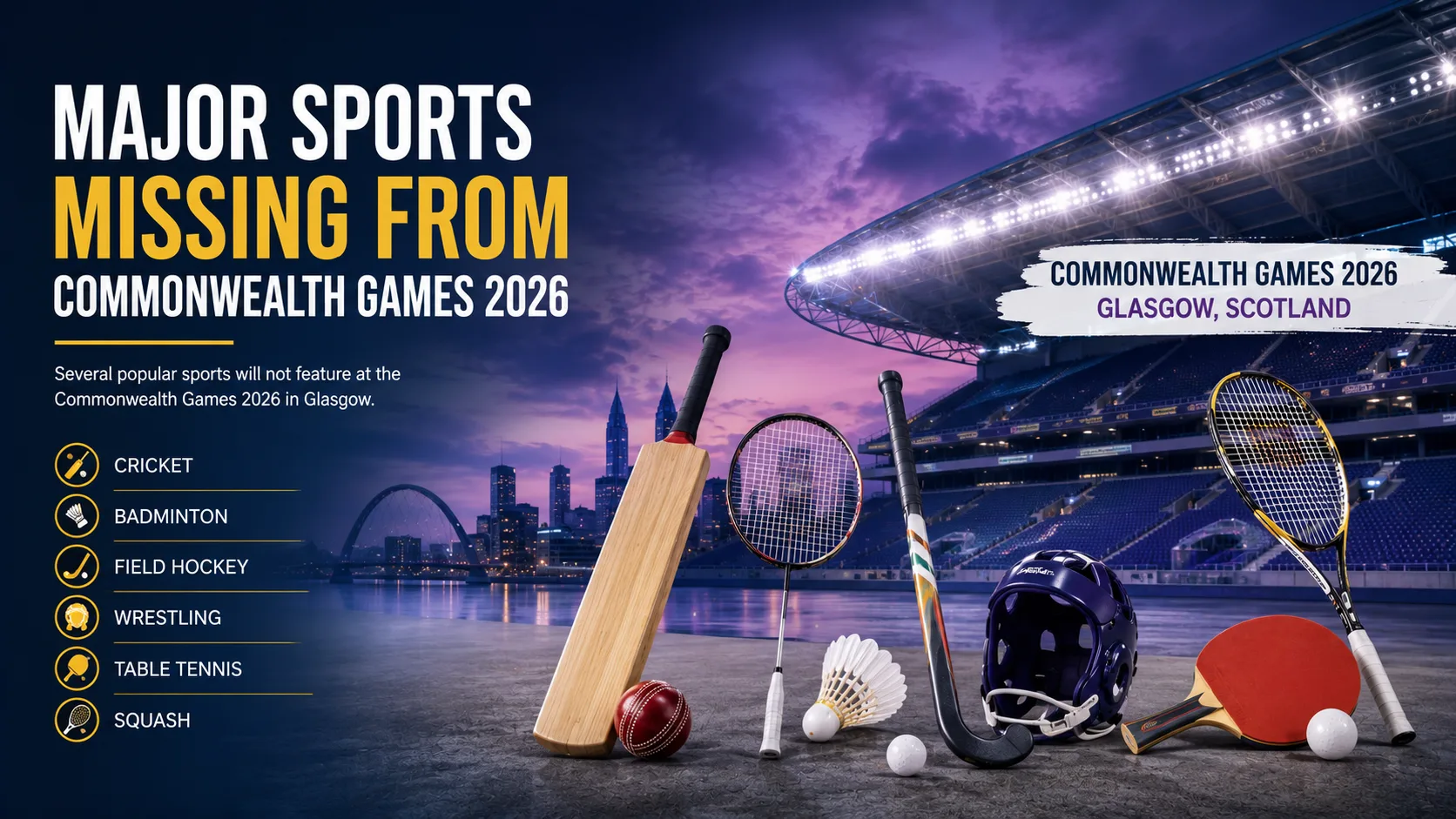
Some cycling events have also disappeared. Track cycling remains, but road cycling and mountain biking are not part of the Glasgow programme.
Shooting is absent too, although it should be treated separately. It was already missing from Birmingham 2022, which means Glasgow did not remove it from the previous edition.
That distinction matters when calculating India’s lost medal opportunities. Shooting is historically India’s most successful Commonwealth Games sport, but it did not contribute to the country’s 61 medals in Birmingham.
Why were so many sports removed from Commonwealth Games 2026?
There was no single dramatic decision to remove cricket, hockey or badminton.
The programme became smaller because Glasgow had to solve several problems at once.
The 2026 Games were originally awarded to the Australian state of Victoria.
Unlike a traditional single-city Games, Victoria planned to spread events across several regional centres. The state government later withdrew, citing the increasing cost of delivering the event.
That decision left the Commonwealth Games without a host and created serious doubts about whether the 2026 edition would take place at all.
Glasgow eventually stepped in, but it did not have the normal preparation period available to a host city. Major international events are usually planned many years in advance. Glasgow had to create a workable Games in a fraction of that time.
Reusing infrastructure from the 2014 Commonwealth Games made that possible, but only if the scale of the event was reduced.
The 2026 Games are concentrated around four main venue sites:
Using existing venues saves money and reduces the risk of construction delays. It also limits what the host can include.
A cricket competition, for example, needs a suitable stadium and practice grounds. Hockey requires a competition pitch and training facilities. Adding another venue does not simply involve renting the ground for a few days.
It also creates additional costs for:
This is why popularity alone could not guarantee a sport’s inclusion.
Cricket may bring a large television audience, but that does not make it easy or inexpensive to fit into a four-site Games.
The Glasgow programme has also been designed around approximately 3,000 athletes.
Team sports can increase that number quickly. A men’s and women’s hockey competition requires several full squads, along with coaches, medical teams and other officials.
Individual sports can create similar pressure. Wrestling includes numerous weight categories. Badminton can include singles, doubles, mixed doubles and a team competition. Table tennis offers several individual and team medal events.
Each addition affects accommodation, catering, transport, training schedules and staffing.
Glasgow therefore had to judge sports as pieces of a complete event rather than as individual attractions.
No separate public explanation has been given for every missing sport.
There is no official statement saying badminton was dropped for one exact reason, wrestling for another and squash for something else.
Instead, the programme was assessed using broader criteria such as cost, venue availability, international participation, local interest, athlete numbers and operational complexity.
It is reasonable to conclude that some sports would have required additional facilities or increased the size of the Games. However, assigning a precise reason to every exclusion would involve speculation.
The safest conclusion is that these sports did not fit Glasgow’s final compact model.
Cricket returned to the Commonwealth Games at Birmingham 2022 after an absence of more than two decades.
The competition used the women’s T20 format. India reached the final and won silver after losing to Australia.
Its return was widely considered a success, particularly in cricket-following countries. Even so, it did not survive the reduction to ten sports in Glasgow.
None of Glasgow’s four selected venue sites is a cricket ground. Including the sport would also require training facilities and accommodation for multiple national squads.
The organisers have not said that these were the only reasons for cricket’s absence, but they illustrate why the sport would have been difficult to fit into the chosen model.
Cricket has not been permanently removed from the Commonwealth Games. T20 cricket is among the sports being considered for the 2030 edition in India.
Hockey had appeared at every Commonwealth Games since 1998.
Its omission ends a run of almost three decades and has a direct effect on India. At Birmingham 2022, the Indian men’s team won silver while the women’s team won bronze.
Glasgow does have hockey facilities from the 2014 Games, but those facilities are not part of the four-site plan for 2026.
That decision shows how tightly the programme has been organised. Even the presence of an existing venue was not enough if including it meant expanding the operating footprint of the Games.
Hockey is also being considered for a return in 2030.
Few exclusions hurt India as much as badminton.
India won six badminton medals in Birmingham:
| Medal | Athlete or team |
|---|---|
| Gold | PV Sindhu, women’s singles |
| Gold | Lakshya Sen, men’s singles |
| Gold | Satwiksairaj Rankireddy and Chirag Shetty, men’s doubles |
| Silver | Indian mixed team |
| Bronze | Kidambi Srikanth, men’s singles |
| Bronze | Treesa Jolly and Gayatri Gopichand, women’s doubles |
Badminton produced three of India’s 22 gold medals.
Its absence does not simply lower India’s possible overall total. It removes several realistic gold-medal opportunities, which could also affect the country’s position in the final medal table.
Badminton organisations expressed disappointment when the Glasgow programme was announced. However, there is no evidence that its exclusion was based on the quality or popularity of the sport.
It was part of the wider reduction required to keep the Games within Glasgow’s chosen scale.
Wrestling is the biggest loss for India in pure medal terms.
India sent 12 wrestlers to Birmingham 2022. Every one of them returned with a medal.
The team won:
Wrestling alone contributed 12 of India’s 61 medals.
It also gave India opportunities across multiple men’s and women’s weight categories. Removing the sport therefore takes away an entire group of reliable podium contenders rather than one or two isolated medal chances.
No wrestling-specific explanation has been issued by Glasgow. It was one of several sports that did not make the reduced programme.
India won five medals in table tennis and another two in Para table tennis at Birmingham.
Those medals came from singles, doubles, team and mixed-doubles events. Like wrestling and badminton, table tennis offered India several different routes to the podium.
India also won two bronze medals in squash.
The absence of these two sports may attract less attention than the loss of cricket or hockey, but their combined impact on the medal tally is considerable.
Table tennis and Para table tennis have already been included in the reviewed group of sports for Amdavad 2030. Squash remains under consideration.
The impact becomes clear when India’s Birmingham medals are broken down by sport.
According to the Olympics.com breakdown of India’s 2022 medal winners, India finished with 22 gold, 16 silver and 23 bronze medals.
Thirty of those 61 medals came from sports absent in Glasgow.
| Missing sport | Gold | Silver | Bronze | Total |
|---|---|---|---|---|
| Wrestling | 6 | 1 | 5 | 12 |
| Badminton | 3 | 1 | 2 | 6 |
| Table tennis | 3 | 1 | 1 | 5 |
| Para table tennis | 1 | 0 | 1 | 2 |
| Hockey | 0 | 1 | 1 | 2 |
| Squash | 0 | 0 | 2 | 2 |
| Cricket | 0 | 1 | 0 | 1 |
| Total | 13 | 5 | 12 | 30 |
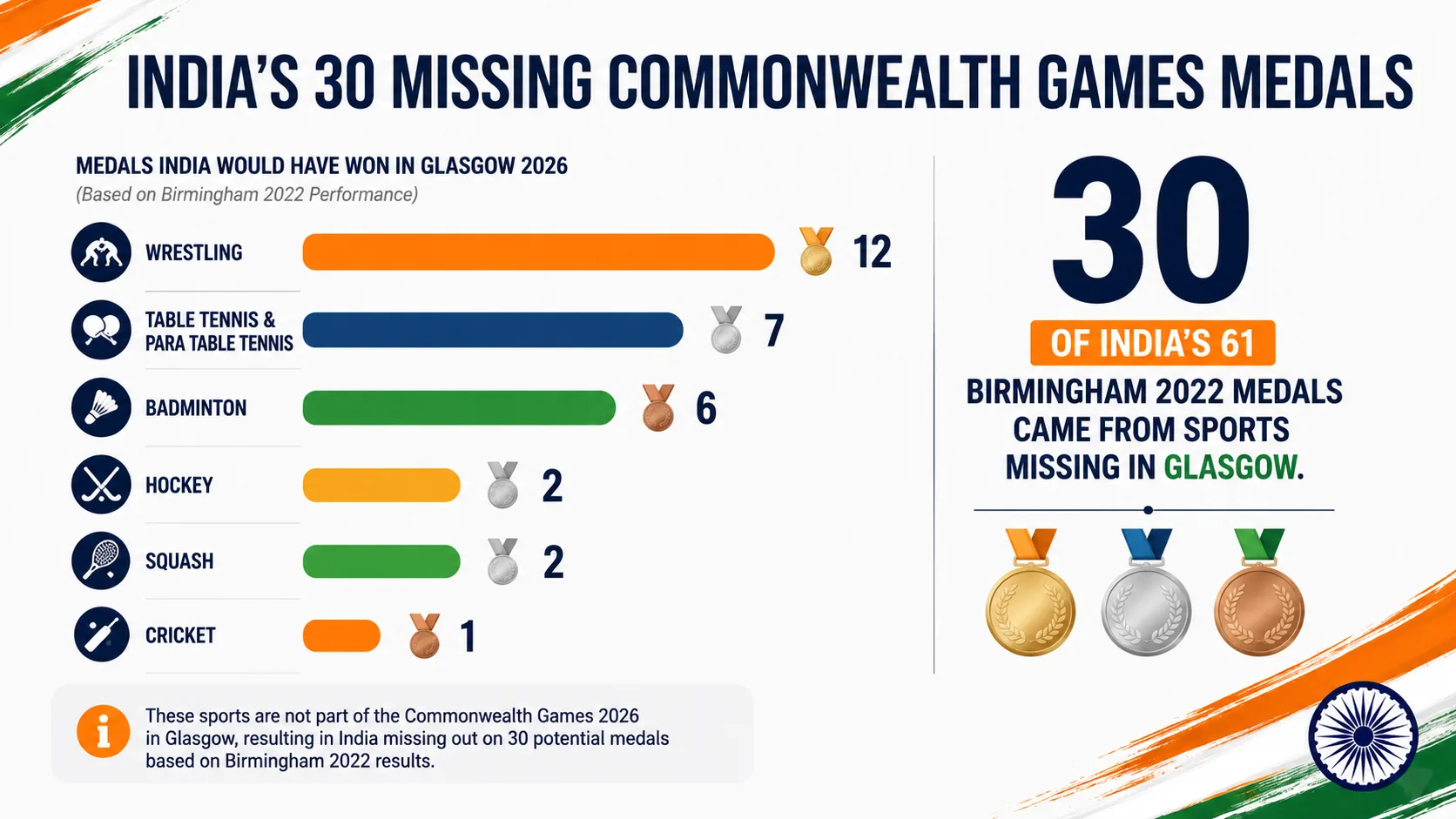
If India wins around 30 medals in Glasgow, the result may look like a steep decline from 61. In reality, it would be close to India’s Birmingham performance in the sports and disciplines still available in 2026.
A smaller total would not automatically mean that Indian athletes performed poorly. It could simply mean that they had far fewer medal opportunities.
There is no evidence that Glasgow deliberately designed the programme to reduce India’s medal tally.
The published selection criteria focused on practical questions: which sports could fit the venues, how many athletes the city could host and how the event could be delivered without creating unacceptable financial risk.
Still, the outcome clearly affects some countries more than others.
India’s traditional strengths include wrestling, badminton, table tennis, hockey, squash and shooting. Most of those sports are missing.
Meanwhile, swimming, athletics, track cycling and artistic gymnastics remain central to the programme. Countries such as Australia, England and Canada have historically had greater depth in several of those areas.
That may give them an advantage, but an advantage created by the programme is not the same as evidence of deliberate bias.
That depends on what the event is trying to achieve.
For fans, the disadvantages are easy to see. Fewer sports mean fewer well-known athletes, less variety and less interest in countries whose strongest disciplines have been left out.
It also makes historical comparisons less meaningful. A country cannot defend medals in events that no longer exist.
On the other hand, the reduced model may be the reason the Games are happening at all.
Glasgow stepped in after the original host withdrew. It avoided a building programme, reused existing venues and created an event that could be organised within a much shorter timeframe.
The 2026 Games will therefore test an important idea: can the Commonwealth Games survive by becoming smaller, more flexible and less expensive?
A successful event could make hosting more attractive to other cities. A poorly received one could show that cutting too many popular sports damages the value of the Games themselves.
Glasgow’s ten-sport programme is not permanent.
Amdavad, also known as Ahmedabad, will host the Centenary Commonwealth Games in 2030. The programme is expected to include between 15 and 17 sports.
According to the official Amdavad 2030 programme information, the reviewed group already includes athletics, swimming, table tennis, bowls, weightlifting, artistic gymnastics, netball and boxing, along with their applicable Para disciplines.
Sports under consideration for the remaining places include:
| Sport | Sport |
|---|---|
| Badminton | T20 cricket |
| Hockey | Wrestling |
| Shooting | Squash |
| Archery | Cycling |
| Diving | Judo |
| Rugby sevens | Triathlon |
| 3×3 basketball | Beach volleyball |
| Rhythmic gymnastics | — |
As of July 24, 2026, these additional sports remain under consideration. They should not be described as confirmed until the final Amdavad 2030 programme is officially announced.
As of July 24, 2026, these additional sports are still under consideration. They should not be described as confirmed until the final programme is announced.
Because India is the host, sports with strong domestic audiences and suitable facilities are likely to receive serious attention. That gives cricket, badminton, hockey, wrestling, shooting and squash a realistic route back into the Games.
The debate over the missing sports is about more than India’s medal tally.
It reflects the difficult position of the Commonwealth Games itself.
The event needs to remain large enough to feel important but affordable enough for cities to host. Glasgow has chosen affordability, speed and existing infrastructure, even though that meant losing several popular sports.
For India, the result is a programme that removes 30 medals from its previous total before the competition even begins.
That does not make the Games unfair, but it does make comparisons with Birmingham misleading.
India should be judged on what its athletes achieve in the events available to them—not on whether they repeat a medal total built from a completely different programme.
Why is cricket not included in Commonwealth Games 2026?
Cricket did not make Glasgow’s reduced ten-sport programme. The Games have been built around four existing venue sites and approximately 3,000 athletes. T20 cricket is under consideration for Amdavad 2030.
Why is badminton missing from Glasgow 2026?
Badminton was omitted as part of the wider reduction in sports. Organisers considered cost, venue availability, athlete numbers and operational requirements when selecting the programme.
Why was wrestling removed from Commonwealth Games 2026?
Glasgow has not published a separate wrestling-specific reason. The sport was one of several left out of the compact programme.
Why is hockey not included in Glasgow 2026?
Hockey is not part of the four-site event model selected by Glasgow. The sport is absent from the Commonwealth Games for the first time since its introduction in 1998.
How many Indian medals came from sports missing in 2026?
India won 30 Birmingham 2022 medals in wrestling, badminton, table tennis, Para table tennis, hockey, squash and cricket.
Is shooting included in Commonwealth Games 2026?
No. Shooting was also absent from Birmingham 2022, so it was not newly removed from the previous programme.
Were these sports removed to disadvantage India?
There is no evidence of deliberate targeting. The official selection process focused on practical factors such as budget, venue availability, athlete numbers and operational complexity.

Log in to support this story.
New here? Create an account


Discussion · 0 Comments
No comments yet — be the first to share your thoughts.