
AI is changing the way people work, and it is normal to ask: what jobs are safe from AI? The honest answer is that no job is 100% safe, but some careers are much harder for AI to replace because they require human judgment, emotional intelligence, physical presence, creativity, trust, or complex decision-making.
AI can write, calculate, summarize, design, code, and answer questions. But it still struggles with work that involves real-world movement, human care, ethical responsibility, unpredictable environments, and deep personal relationships. The World Economic Forum says technology and AI will reshape many jobs by 2030, but it also expects new roles and skill needs to grow alongside disruption.
The Better Question: What Makes a Job Safe From AI?
Instead of asking only which jobs are safe from AI, ask what parts of a job are difficult to automate.
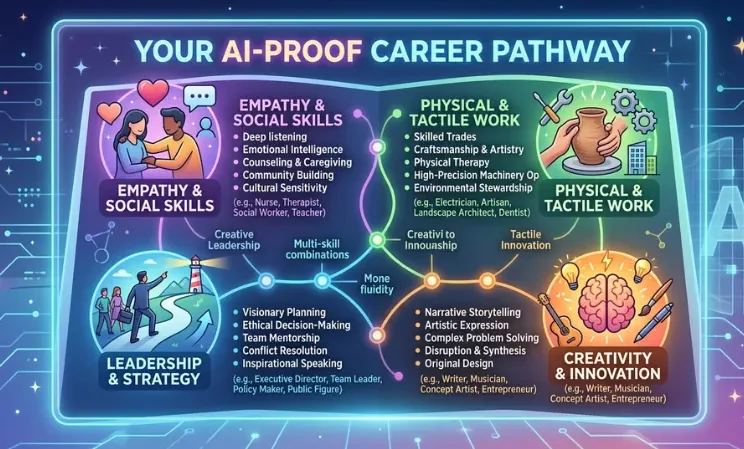
The safest careers usually include at least one of these qualities:
They require face-to-face human interaction. They involve hands-on physical work. They need empathy, leadership, negotiation, or trust. They happen in unpredictable real-world settings. They require accountability, licensing, or ethical judgment. They combine technical knowledge with human decision-making.
This is why many AI proof jobs are not always the highest-tech jobs. In many cases, the safer careers are the ones where people need another human being, not just an answer from a machine.
1. Healthcare Jobs
Healthcare is one of the strongest areas for future job security. Nurses, doctors, physical therapists, occupational therapists, dentists, mental health counselors, and medical technicians all work directly with people.
AI can help with diagnosis, paperwork, imaging, and patient records, but it cannot fully replace bedside care, emotional support, physical examination, or patient trust. The U.S. Bureau of Labor Statistics projects overall employment growth from 2024 to 2034, with much of the growth driven by healthcare and social assistance.
Healthcare careers are among the best jobs safe from AI because they mix science, responsibility, empathy, and real human care.
2. Skilled Trades
Electricians, plumbers, HVAC technicians, mechanics, welders, carpenters, and construction workers are difficult to replace with AI because their work happens in different physical environments every day.
A plumber may deal with old pipes, tight spaces, water damage, customer concerns, and unexpected repairs in one visit. AI can support scheduling or troubleshooting, but the actual work needs human hands and real-world problem-solving.
For people looking for practical careers safe from automation, skilled trades are a strong option.
3. Education and Training
Teachers, tutors, special education professionals, coaches, and corporate trainers are not easily replaced because learning is emotional and personal. AI can explain a topic, but a teacher motivates students, understands behavior, adapts to learning styles, handles classroom challenges, and builds confidence.
Education jobs may change because of AI tools, but the human role remains important. The best educators will use AI to save time while focusing more on mentoring, feedback, and student support.
4. Mental Health and Social Work
Therapists, counselors, social workers, addiction specialists, and family support workers rely heavily on trust and emotional intelligence. AI chatbots may offer basic support, but sensitive human situations require empathy, ethics, privacy, and professional judgment.
People in crisis often need a trained human who can listen, understand context, and respond responsibly. That makes mental health and social work some of the most human-centered jobs AI can’t replace easily.
5. Leadership and Management Roles
Good managers do more than assign tasks. They resolve conflict, motivate teams, make decisions under pressure, manage relationships, and build culture.
AI can provide reports, performance data, and planning support. But leadership depends on trust, communication, accountability, and judgment. Managers who understand AI will become more valuable because they can use technology while still leading people effectively.
6. Creative Strategy Jobs
AI can generate text, images, music, and video ideas. But creative strategy still needs human taste, brand understanding, cultural awareness, storytelling, and emotional connection.
Creative directors, brand strategists, content leads, campaign planners, filmmakers, and senior marketers can use AI as a tool rather than fear it as a replacement. The safer creative jobs are not only about producing content; they are about deciding what should be created and why.
7. Legal and Compliance Careers
Lawyers, judges, mediators, compliance officers, and legal advisors handle interpretation, negotiation, risk, ethics, and accountability. AI can help with research and document review, but legal decisions often depend on context, human consequences, and professional responsibility.
These jobs may become more efficient with AI, but the final judgment still requires human expertise.
8. Emergency and Protective Services
Firefighters, police officers, paramedics, emergency responders, and disaster response workers operate in unpredictable, high-pressure environments. These roles require physical action, fast judgment, teamwork, courage, and direct public interaction.
AI may help with dispatch, mapping, surveillance, or reporting, but emergency response still depends heavily on trained humans.
9. Entrepreneurship and Client-Based Work
Small business owners, consultants, coaches, real estate agents, financial advisors, and agency owners can be safer from AI when they build strong relationships and offer personalized service.
AI may automate parts of their workflow, but clients still value trust, experience, communication, and personal guidance.
How to Future-Proof Your Career
The safest approach is not to avoid AI. It is to become the person who knows how to use it. Learn AI tools in your industry, improve communication skills, build emotional intelligence, and develop problem-solving ability.
The OECD notes that AI can automate repetitive tasks while also helping workers focus on higher-level and creative work.
FAQs
What jobs are safe from AI?
Jobs in healthcare, skilled trades, education, mental health, emergency services, leadership, law, and client-based work are generally safer because they require human judgment, trust, physical presence, or empathy.
Are any jobs completely AI-proof?
No job is completely AI-proof. However, some jobs are much harder to automate because they involve complex human interaction, real-world problem-solving, and ethical responsibility.
What jobs will AI replace first?
Jobs based heavily on repetitive digital tasks, basic data entry, simple content production, routine customer support, and predictable admin work are more exposed to automation.
Are skilled trades safe from AI?
Yes, skilled trades are among the safer career paths because they require hands-on work in unpredictable environments.
How can I protect my job from AI?
Learn how to use AI, improve human skills, build industry expertise, and focus on work that requires judgment, creativity, communication, and trust.
Final Thoughts
So, what jobs are safe from AI? The safest jobs are not always the ones that avoid technology. They are the jobs that combine human skills with useful technology. Careers in healthcare, trades, education, mental health, leadership, law, emergency services, and personalized client work are likely to remain valuable because they depend on people, not just information.
AI will change work, but it will not remove the need for human care, trust, judgment, and real-world action.