
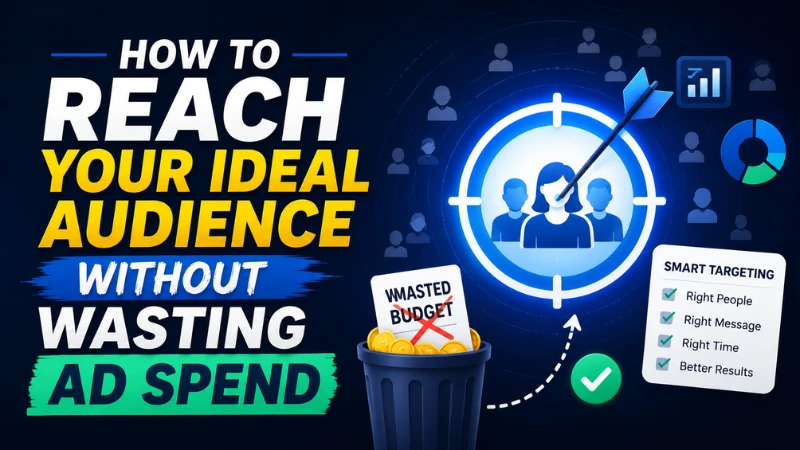
A moment too familiar to all of us is when that uncanny silence settles in right after the mid-campaign ad dashboard is displayed. You can see the budget line depleting, your Click-Through Rate (CTR) looks defensible on paper but the conversions are rather thin. In the back of your mind, you are well aware of what happened. You are well aware that you paid to reach the people that just weren’t going to buy. It’s like you took a month’s budget and scattered it across the internet’s ambient noise, hoping it would echo back at you.
All of us marketers have been there, what is even more unsettling is a truth that some, continue to be there, campaign after campaign. It’s not like they lack intelligence or the resources, but a default logic of digital advertising is structurally tilted toward reach over relevance. It’s not a secret that platforms earn more when you spend more. Broader targeting feels safer when a campaign launches. And the vanity metrics such as impressions, reach, and clicks are designed to look like progress even when they aren’t producing outcomes.
What follows isn’t a listicle of quick hacks. It’s a closer examination of why ad spend leaks, what the behavioral and mechanical systems underneath that bleeding look like, and how the marketers who’ve stopped haemorrhaging budget are thinking about audiences differently, not as a demographic to capture, but as a pattern of intent to recognize.
The Illusion of Reach
Somewhere in the early 2010s, digital advertising sold itself on a promise that felt almost utopian: you could reach anyone, anywhere, with surgical precision. The internet had data. Platforms had profiles. Targeting had arrived. The era of guessing was over.
It was, in retrospect, a more complicated story. What platforms actually offered wasn’t precision, it was scale. Reach became the primary currency, and cheap reach felt like a bargain. Marketers optimized for impressions. CMOs reported on awareness. And the feedback loop between spending and acquiring actual buyers grew longer, murkier, harder to trace.
The researcher Nico Neumann, whose work on digital ad effectiveness has been quietly unsettling to the industry for years, found in multiple studies that even sophisticated audience targeting often performs only marginally better than random targeting at scale. The problem isn’t the technology. It’s the assumption that visibility equals relevance — that showing up in someone’s feed is meaningfully different from showing up in their intent.
I read a piece from decentriq that said something along the lines of a cheap reach does not equal cheap advertising. What you’re actually buying when you optimize for impressions is the probability of being ignored at scale.
This is the foundational tension that every media buying decision lives inside: the algorithmic economy rewards volume, but volume and value are rarely the same thing. And the gap between those two things is where ad budgets go to disappear.
Your Existing Data Is the Map You’re Not Reading
Most marketers, when launching a new campaign, treat audience building like a blank page. They open the targeting interface, select a few interests, adjust an age range, layer in a behavior or two, and then release the campaign into the algorithmic wild, trusting that the platform’s optimization engine will do the rest.
What they’re overlooking is that they already have a document written in the behavioral language of real buyers that sits inside their CRM and website analytics. Their existing customers aren’t just revenue, they’re a diagnostic. They encode patterns: how people found the product, what they read before converting, which channels they came from, what language they used in support tickets and reviews when they described their problem before they knew a solution existed.
This is the most underleveraged move in audience strategy. Mining your own customer data, not for demographics, but for behavioral signatures gives you something no targeting interface can manufacture: evidence.
When you look at the exact phrases your customers used in reviews or support conversations, you’re essentially reading the pre-purchase internal monologue of your buyer. Feed that language back into your ad copy and your audience targeting, and the match rate between ad and attention shifts noticeably.
Job titles, geography, buying frequency, the specific feature that tipped someone from consideration to conversion, all of this lives in data that most marketing teams treat as a reporting artifact rather than a strategic asset.
01 Mine Your CRM Before You Touch a Targeting Interface.
Pull your top 10–15% of customers by Lifetime Value (LTV). Identify what they share, not just demographically, but behaviorally. Map the language they used to describe their problem before they found you. That vocabulary is your targeting brief. It belongs in your ad copy before it belongs in an interest category.
The Exclusion Nobody Talks About
Ad targeting conversations almost always focus on who to include. The question that tends to be quieter, but is often worth significantly more in recovered budget, is who to exclude.
Showing acquisition ads to recent buyers is one of the most common and quietly expensive mistakes in digital advertising. A customer who purchased three weeks ago doesn’t need to be converted. They need onboarding content, cross-sell messaging, and a reason to stay loyal. But if your top-of-funnel campaign isn’t excluding them; if your suppression lists are outdated or nonexistent; you’re spending acquisition budget on people who’ve already crossed the finish line.
The same logic applies to searcher intent on the paid search side. Negative keyword lists are one of those operational disciplines that feels tedious and gets neglected precisely because the damage is invisible, you never see the irrelevant clicks as individual waste, only as a slightly lower Return on Ad Spend (ROAS) at the campaign level. But the math is unambiguous: budget spent on the wrong search intent is budget that cannot be spent on the right one.
Consistently maintaining and expanding your negative keyword lists, separating, for instance, searchers looking for a free alternative from searchers ready to pay for a premium solution, is one of the highest-ROI activities a Pay-Per-Click (PPC) manager can do on any given week.
02 Build Suppression Infrastructure Before Campaign Launch
Create a custom audience of recent buyers typically 30–90 days depending on your purchase cycle and exclude them from every top-of-funnel acquisition campaign. Audit your negative keyword lists quarterly at minimum. Think of exclusions not as a filter but as the structural frame that gives your targeting actual shape.
How to Find People Online Without Guessing Who They Are
There’s a version of audience building that treats the internet like a demographic census, you define a person by their age, their apparent interests, their geography, and then you try to buy access to that person in the brief window when they’re scrolling. This version of targeting is familiar, intuitive, and increasingly imprecise.
The better version starts from a different question. Not who they are? but where do they already signal intent?
Understanding how to find people online, really find them, not just reach them, means following behavioral signals rather than demographic profiles. It means thinking about what a potential buyer is actively doing in the moments before they realize they need your product. What are they searching for? What content are they consuming? Which communities are they moving through? These signals are observable. They leave traces in search queries, in page-visit behavior, in the content engagement patterns that retargeting audiences are built from.
Retargeting is the most direct expression of this logic. When someone visits your product page and doesn’t convert, they’ve already self-selected as relevant. They showed up and read something. They left without buying, which is not rejection, it’s a research behavior. The majority of high-intent buyers don’t convert on their first touch. They investigate, compare, step away, and return. Serving a retargeting ad to that person, a different creative than your top-of-funnel, one that speaks to hesitation rather than discovery, is not a second chance at the same pitch. It’s a different conversation happening at a different stage of someone’s decision architecture.
Audience Targeting Framework, by Tinuiti states “The click that didn’t convert isn’t a failed impression. It’s the beginning of a consideration cycle that your retargeting campaign now has the opportunity to close.”
And then there are lookalike audiences, perhaps the most algorithmically interesting tool in modern media buying. The mechanic is conceptually simple: you feed a platform your best customers, and its machine learning infrastructure goes looking for new people who behave like them. What’s interesting is what “behave like them” actually means at scale. Platforms aren’t matching demographics. They’re matching behavioral patterns: click sequences, content affinities, engagement rhythms, purchase signals across their broader ecosystem. The quality of your lookalike is entirely downstream of the quality of the seed audience you provide. Feed it all customers and you get a mediocre approximation. Feed it only your highest-value buyers, the ones with the best retention, the highest LTV, the lowest support burden, and the signal tightens considerably.
03 Stack Retargeting and Lookalikes as a Two-Layer System
Retargeting closes warm intent. Lookalikes manufacture new intent from existing behavioral proof. Run them in parallel, not in competition. Your retargeting creative should speak to hesitation; your lookalike creative should speak to discovery. They’re different conversations with different people at different distances from conversion.
Where Traffic Lands Is Half the Strategy
There’s a specific kind of campaign failure that’s easy to misattribute. Targeting looks fine. CTR is acceptable. But conversion rate is anemic, and you end up optimizing the wrong variable, adjusting bids, refreshing creative, narrowing audiences, when the actual problem is sitting at the other end of the click.
Sending paid traffic to a generic homepage is structurally similar to inviting someone to a carefully orchestrated meeting and then pointing them toward an empty room and telling them to wander around. The promise made in the ad, the specific pain point addressed, and the particular offer foregrounded should be the exact language that greets them when they arrive. Every additional step between click and conversion is a dropout point. Every distraction be it navigation menus, unrelated content, or multiple competing calls to action, is a conversion killer dressed up as design.
The landing page isn’t a technical afterthought. It’s the closing argument of the entire campaign. And it should be built around one goal, one decision, one path forward. The marketers who understand this tend to build landing pages that feel almost uncomfortably focused, stripped of everything except what the arriving visitor needs to make the next decision. That restraint is not minimalism for its own sake. It’s the elimination of friction at the exact moment when intent is highest.
04 Match Landing Page Language to Ad Language, Exactly
The headline a visitor reads first should be the logical continuation of the ad they just clicked. One goal. One CTA. Remove navigation that leads away. Remove content that competes. The page should feel like the ad never ended, just deepened.
The Attention Economy’s Quiet Contradiction
It’s worth sitting with a quietly uncomfortable truth about where all of this lives. The strategies described above such as behavioral targeting, suppression audiences, retargeting sequences, and lookalike modeling are not loopholes or clever workarounds. They are the designed architecture of the platforms themselves, offered as premium features and celebrated as efficiency tools. And they work, up to a point.
But they work inside a system that is fundamentally ambivalent about relevance. Platforms earn when you spend. Algorithms optimize for the engagement signals that keep users on platform, which are not always the same signals that predict purchase intent. The tools that help you reach your ideal audience exist alongside tools that, at scale, encourage waste; broader targeting, expanded audiences, automated bidding strategies that optimize for objectives the platform can measure, which are not always the objectives that matter to your business.
The marketers who navigate this most effectively are the ones who hold that tension consciously. They use platform tools without fully trusting platform defaults. They treat algorithmic recommendations as hypotheses rather than verdicts. The measure outcomes at the level of business results, revenue, customer LTV, acquisition cost against lifetime value, rather than at the level of platform metrics that can look healthy while hiding structural waste.
The internet is very good at simulating precision while delivering approximation. It’s very good at showing you metrics that feel like a signal while burying the noise several layers below the dashboard. The marketers who stop wasting budget are, in the end, the ones who’ve learned to be slightly skeptical of the tools they depend on, using them with clear eyes, first-party data as their north star, and enough analytical distance to tell the difference between activity and outcome.
And perhaps that’s the unresolved tension that sits underneath all of it: the very platforms that enable precision targeting are also structurally incentivized to keep you spending broadly. The tools exist. The discipline to use them correctly is rarer. And in that gap, between algorithmic recommendation and strategic restraint, is where most ad budgets either hold or hemorrhage. Nobody tells you which side you’re on until the campaign is over.