
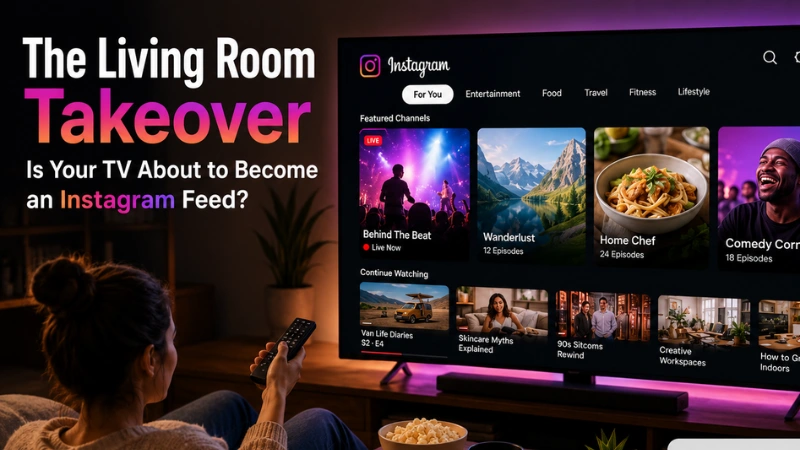
Remember when the TV was just for watching movies and that one show your parents had to watch? It was just a big, clunky box in the middle of the room. You sat on the couch, grabbed the remote, and accepted your fate.
Then came the era (honestly, the one we’re all still trapped in) of the phone, where we devolved into doomscrolling gremlins (you know the ones, hunched over in the dark at two in the morning).
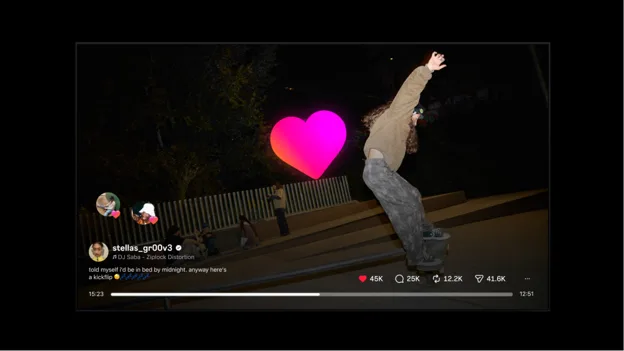
Well, Meta has decided those two worlds should not be apart anymore. With the recent expansion of Instagram for TV to Samsung Smart TVs, the platform is making a power play for your living room. The speculation is running wild. First, Instagram copied TikTok to capture the short-form crown. Then, it nudged its way into X territory with the Threads integration.
Now? It looks like they have their sights set on the ultimate prize: the YouTube-dominated landscape of long-form video.
The reality is actually simple: YouTube will no longer be the only social media platform for long-form content. The tides are shifting, and the big screen is officially the new battleground.
When YouTube Broke The Treaty
To understand why Instagram is making this move, we have to talk about how we got here. For years, the digital ecosystem was cleanly divided. Instagram was for the curated, the square, and the aesthetic. YouTube was for the deep, the educational, and the long-form content. It was a beautiful, balanced ecosystem.
Then, YouTube got itchy. They saw the astronomical growth of TikTok and realized that people were not just watching thirty minute video essays. They were obsessed with thirty second dopamine hits. So, YouTube launched Shorts.
It was a brilliant move to protect their turf. By integrating vertical, short-form content directly into their platform, they effectively stopped users from leaving the app. They turned a search heavy engine into a scrolling machine. They proved that a long-form giant could easily become a short-form player.
But that move did not just expand YouTube’s footprint. It broke the unspoken treaty. It signaled that no category of content is off limits for any platform. If YouTube could move into Instagram’s backyard, why could Instagram not walk right into the living room?
Getting The TV Experience Right
We have seen this dance before. Remember when Instagram tried to force feed us IGTV as a standalone app? It was like that one friend who tries to make a niche hobby happen at a party. It just felt a little awkward. The original Instagram TV experiment was a noble attempt, but the user experience was essentially a vertical video struggle bus on a horizontal world.
Fast forward to 2026, and they are finally reading the room. Literally.
The new Instagram for TV update is not just about dumping your phone feed onto a 65 inch display. They are testing channels organized by interest, casting capabilities, and horizontal video formats. So they are not trying to force you to tilt your TV sideways anymore. They are finally acknowledging that human beings like to sit back and relax without getting a crick in their neck.

Why This Matters And Why YouTube Should Sweat a Little
YouTube has held the keys to the long-form social video castle for years. It is where you go to learn how to fix your leaky sink, watch a three-hour video essay on the fall of a niche toy brand, or catch up on your favorite creators.
But here is the kicker: Instagram has the social graph.
Think about your behavior. You probably spend hours in the app and already know which creators you vibe with. Your Saved folder is likely full of recipes, comedy skits, and deep-dive explainers. By bringing those into your living room, Meta is turning your TV into a personalized entertainment network, rather than a giant list of videos you have to search for.
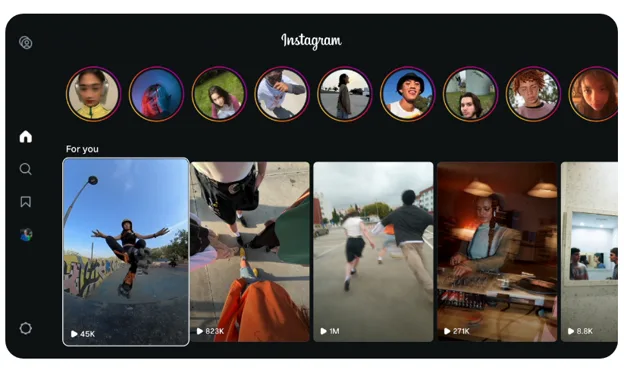
When you can cast those curated Reels directly from your phone to the big screen without losing the quality, the friction of watching long-form content drops to near zero. You are not just watching a video. You are watching a feed that already knows exactly what you like. That is a dangerous, sticky advantage.
A New Path For Creators
This is not just a win for us couch potatoes. It is a seismic shift for creators.
For years, creators have been trapped in the short-form funnel. You make a 15-second hook, you hope for the algorithm gods to smile upon you, and you move on to the next one. It is exhausting. It turns content into a commodity and is fast, cheap, and easily forgotten.
But by pushing longer-form, episodic content and Live on TV, Instagram is giving creators permission to slow down. Imagine watching an episodic docuseries from your favorite creator directly on your TV, right after you finish your nightly Netflix session. It bridges the gap between social media creator and streaming service star.
If they pull this off, the thin line between a YouTuber and an Instagram influencer is going to get blurrier than a low-resolution video from 2007.
Will YouTube Lose To Instagram?
Not exactly. Let us not get ahead of ourselves. YouTube is a search engine, an archive, a music player, and a community hub all rolled into one. It is hard to beat that kind of utility.
However, Instagram is betting on something else: community connection. They are leaning into the idea that watching is better when it is a group sport. With features meant to help friends share and watch together, they are trying to reclaim the watercooler moment. They want to own whatever is going viral in the group chat.
We do not just watch videos anymore. We want to talk about them, share them, and laugh at them with people we actually like. If Instagram can capture that social pulse on the big screen, they do not have to kill YouTube. They just have to carve out their own, very cozy, very addictive doomscrolling corner of the living room.
Meta’s Secret Strategy
Look at how the platform has changed. Instagram went from a simple photo-sharing app to a video-first powerhouse. Now, this massive hub is moving into your living room.
The move to Instagram for TV is a masterclass in behavioral architecture. They know we have subscription fatigue. We have too many apps, too many logins, and too much content to choose from. By turning your existing social app into a TV-viewing experience, they eliminate the need to go browse for something new. Your feed is the curation. Your friends are the recommenders.
It is a low effort, high reward model. Why spend twenty minutes scrolling through Netflix’s “Recommended for You” list when you can just open your Instagram TV app and watch the exact type of content you have been training the algorithm to show you for months?
What This Actually Means
YouTube changed the rules when they forced the vertical, short-form game on us. It made the internet feel smaller and more immediate. Instagram, by bringing long-form content to the living room, is doing the opposite. They are making the social experience feel grander and more cinematic.
We are entering an era where the destination does not define the content. The user does. Whether you are doomscrolling in the bathroom or chilling on your couch at home, the platform should follow you.
Will this kill YouTube? Probably not. As YouTube is stuck in our daily search habits.
But will it force YouTube to innovate again? Absolutely.
The battle for the living room is not just about screen size anymore. It is about attention span and social equity. And right now, Instagram is making a very compelling case that your TV belongs to them.
Keep your remote handy, folks. The feed is coming for your living room, and it might just be the most addictive thing you watch all year. So, the next time you settle in for a night of mindless entertainment, look closely at what is on the screen. It might not be a streaming giant at all, but the same platform you used to check who liked your lunch photo five minutes ago. And honestly? I am kind of here for it.
Frequently Asked Questions (FAQs)
1. Is Instagram on TV actually good for group viewing?
Yes, users are finding it works well for shared experiences. Unlike mobile browsing, which is solitary, the TV app is being used by families and friends to watch and discuss Reels, sports, or music content together in the living room.
2. Can I watch my saved posts on the big screen?
Absolutely. One of the most practical features users are seeking is the ability to cast saved content directly from their phone to their TV. This allows you to curate your watch list on mobile and view it on the big screen without manual searching.
3. Can I watch Stories on my TV?
Yes, the latest updates include the ability to view Stories on the big screen. This allows you to catch up on what friends and creators are posting without needing to crowd around a small phone screen.
4. How do I find something to watch without scrolling forever?
The new interest-based channels, organized by topics like comedy, sports, and music, are designed to solve the decision fatigue users often feel. Instead of scrolling an endless, undifferentiated feed, you can jump into categories that match your mood.
5. Does the app support multiple users in my house?
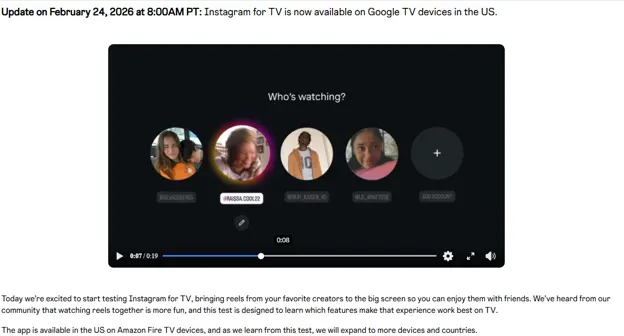
Yes, the TV app supports multiple account logins. This means different household members can switch to their own personalized feed on the same TV, ensuring their specific interests are front and center.
6. Is this the same as the old IGTV?
No. IGTV was a failed standalone app that tried to force creators to make long-form content. The new TV experience is different. It focuses on layering features like series and live broadcasts over the existing Reels ecosystem, which is already popular.
7. Can I watch live streams from creators on my TV?
Meta is currently exploring “Live on TV” as a future feature. While not every creator broadcast is optimized for TV yet, the platform is working on ways to bring these live, interactive creator experiences to the living room.