
Black Resistance: Fight Against Oppression on this Black History Month
0
0


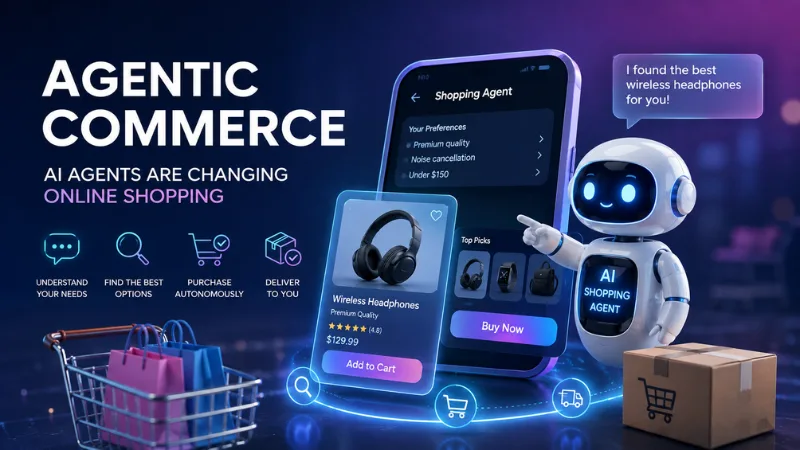
For more than two decades, online shopping has followed the same basic model: consumers search, compare products, read reviews, add items to carts, and complete purchases themselves.
But the next major shift in ecommerce may remove many of these steps.
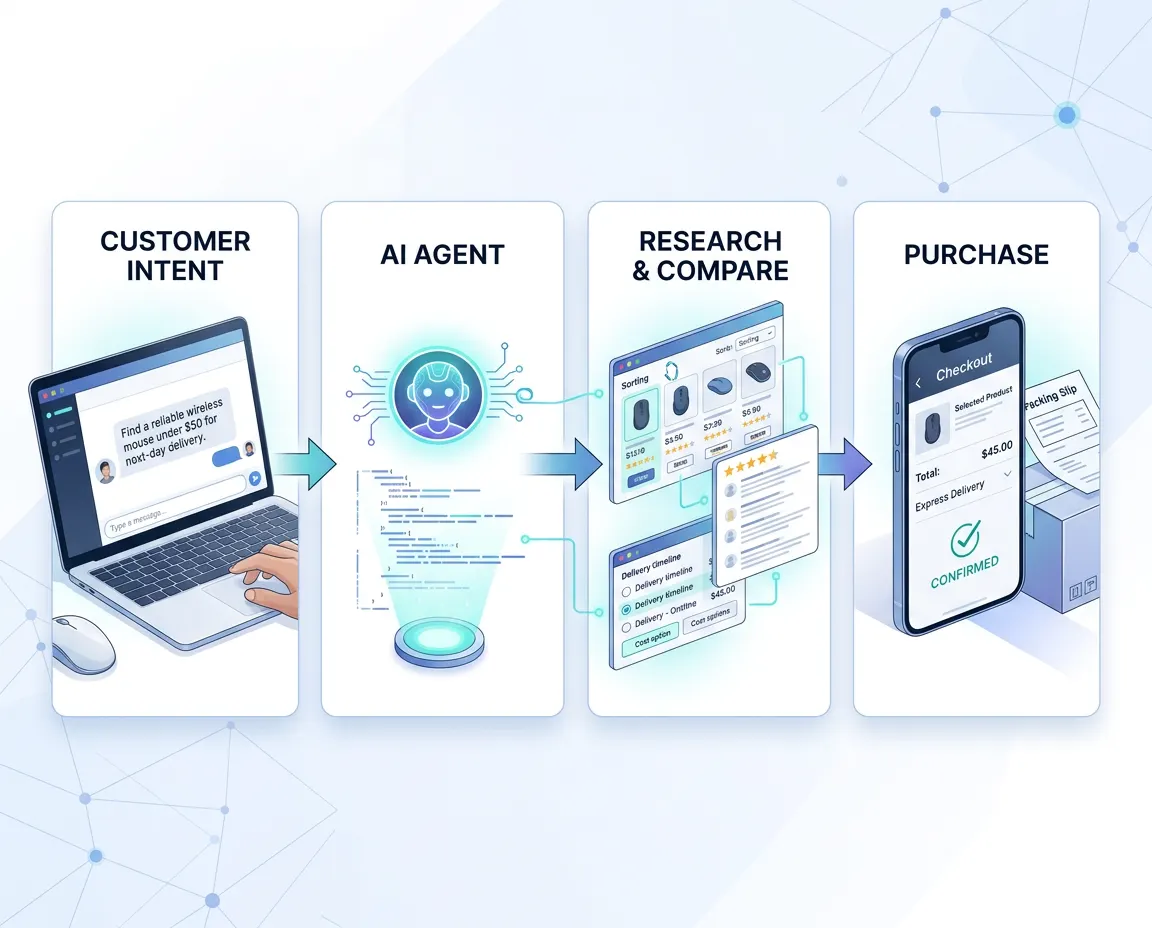
Imagine telling an AI assistant:
“Find me a laptop under ₹80,000 with strong battery life, good performance for video editing, and delivery before Friday.”
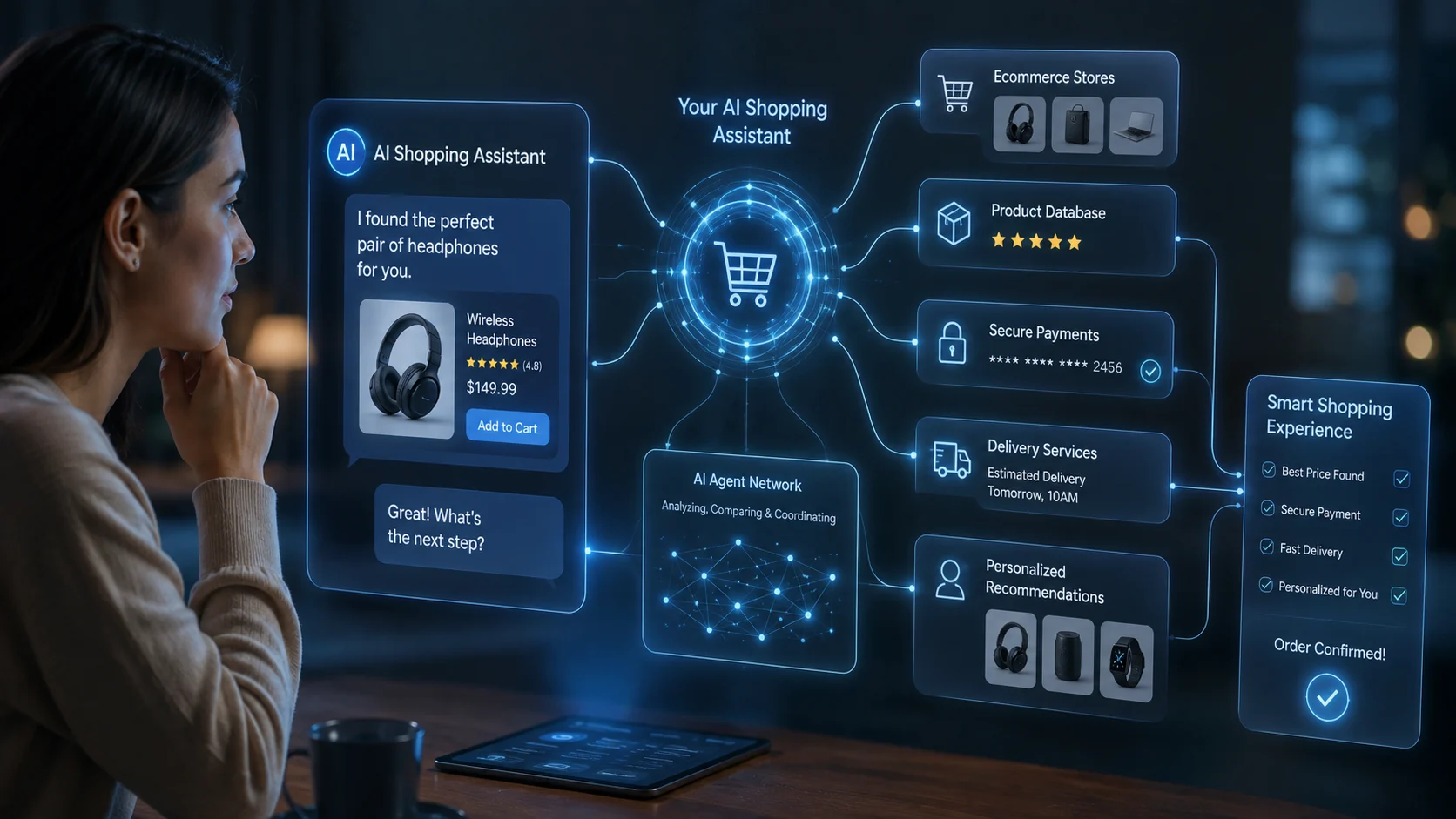
Instead of showing you hundreds of results, the AI agent researches options, compares specifications, checks reviews, evaluates prices, and may even complete the purchase on your behalf.
This emerging model is called agentic commerce.
Agentic commerce represents a shift from traditional ecommerce platforms where humans actively search and buy products, toward an environment where AI agents can understand customer needs, make decisions, and complete shopping tasks autonomously.
As artificial intelligence becomes more capable, online shopping is moving from a search-based experience to an intent-based experience.
The question is no longer only:
“What product are you looking for?”
The future question may become:
“What outcome do you want to achieve?”
Agentic commerce is a new ecommerce model where AI agents act on behalf of consumers to discover, evaluate, recommend, and purchase products or services.
Unlike traditional shopping assistants that simply provide recommendations, AI agents can perform multi-step tasks with limited human involvement.
A traditional ecommerce journey looks like this:
Customer → Search Engine → Ecommerce Website → Product Selection → Checkout
Agentic commerce changes this into:
Customer Intent → AI Agent → Research → Comparison → Decision → Purchase
The AI agent becomes an intelligent layer between consumers and businesses.
Instead of customers spending time navigating websites, AI agents can handle complex shopping activities based on preferences, budgets, and personal requirements.
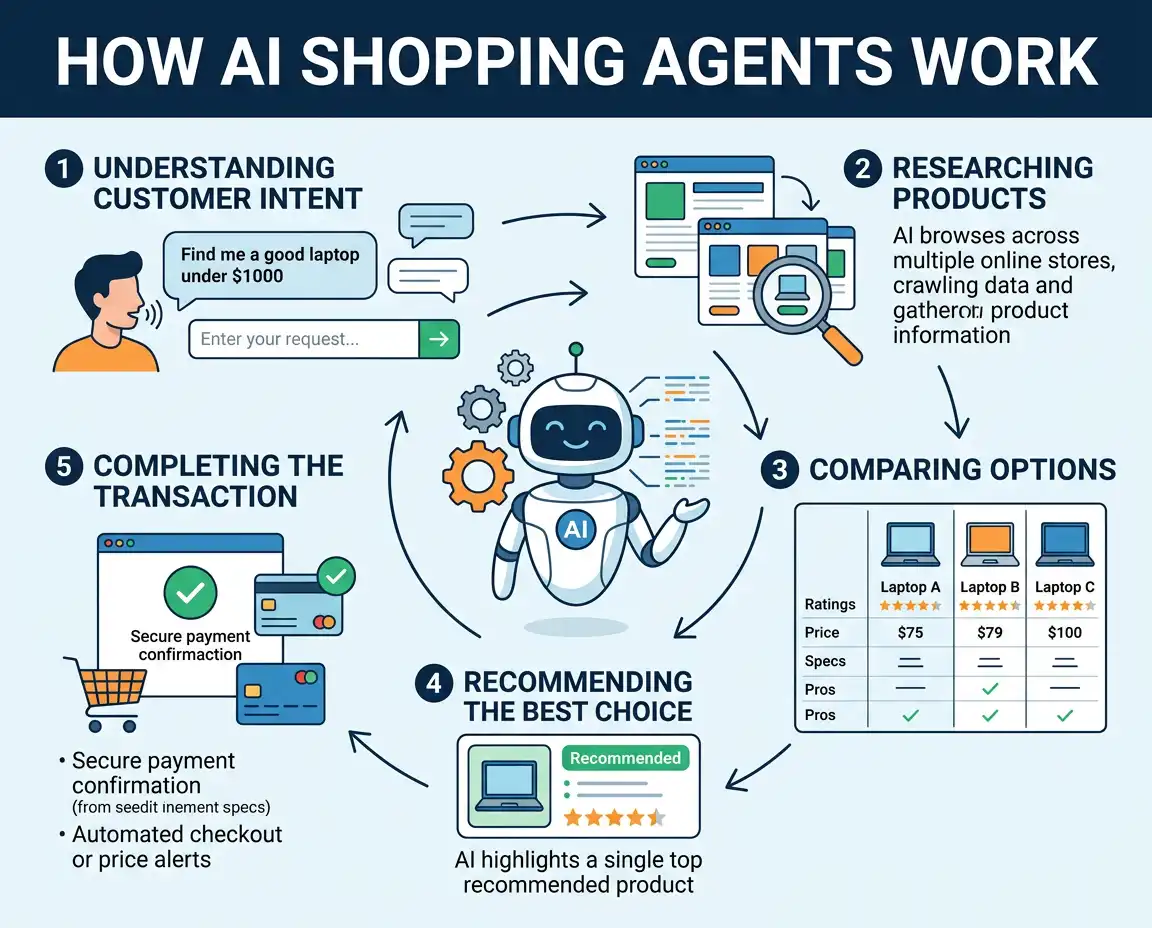
AI shopping agents combine multiple technologies, including:
The process usually involves five major steps.
The first step is understanding what the customer actually wants.
A customer may not say:
“I need running shoes.”
They might say:
“I run five kilometres every morning, have knee problems, and need comfortable shoes under ₹10,000.”
An AI agent can understand context, preferences, and constraints rather than matching only keywords.
Instead of displaying thousands of search results, AI agents can:
This reduces the time customers spend researching products.
AI agents can rank products based on personal relevance.
For example, two customers searching for smartphones may receive completely different recommendations.
One user may prioritize:
Another may prioritize:
The AI recommendation is personalized rather than generic.
The biggest difference between traditional shopping assistants and agentic commerce is the ability to take action.
Future AI agents may be able to:
The customer moves from manually completing every step to approving decisions made by the AI.
AI agents become smarter over time.
They can learn:
This creates a continuously improving shopping experience.
| Traditional Ecommerce | Agentic Commerce |
|---|---|
| Customer searches products | Customer expresses intent |
| Customer compares options | AI agent compares options |
| Customer reads reviews | AI summarizes reviews |
| Customer completes checkout | AI may complete transactions |
| Same experience for many users | Personalized experience |
| Website-focused journey | AI-agent-focused journey |
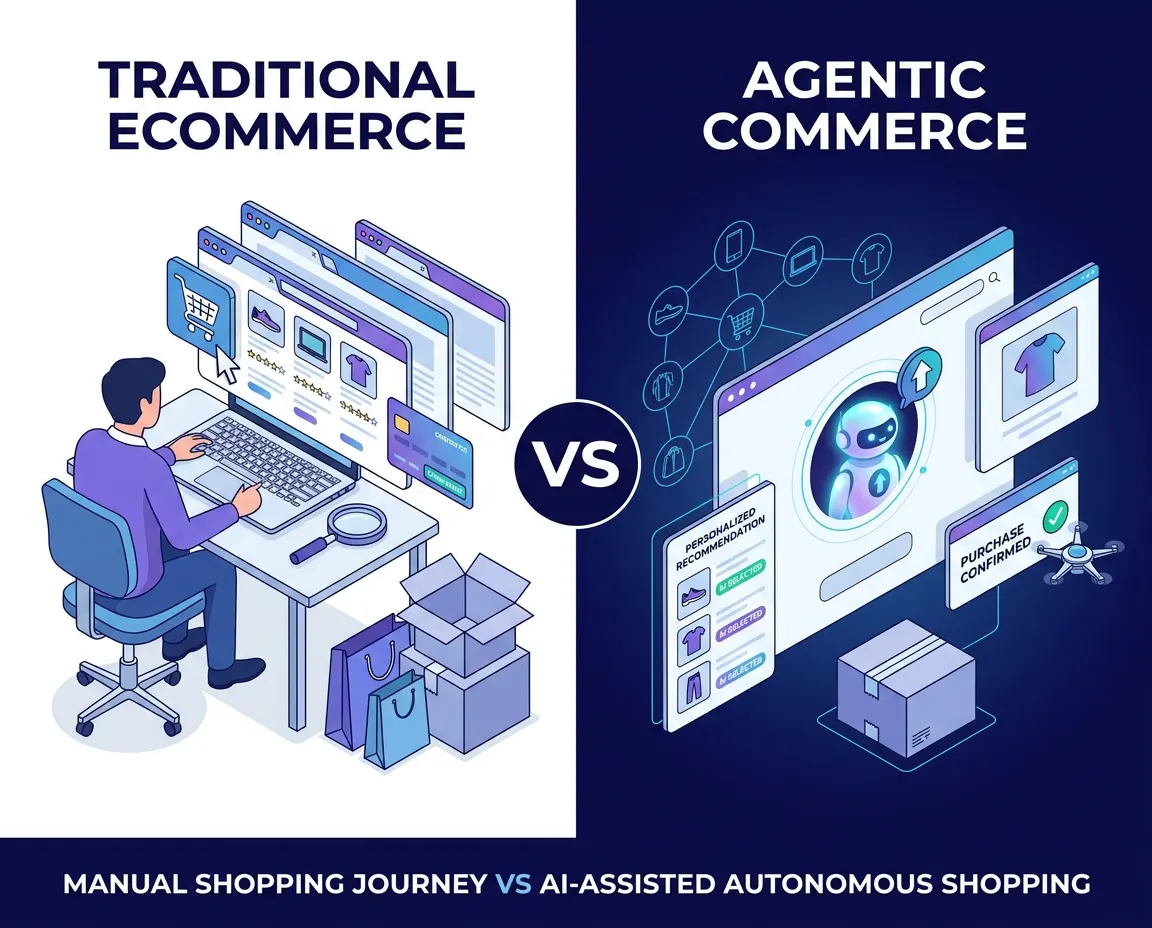
Traditional ecommerce is built around websites.
Agentic commerce is built around intelligent decision-making systems.
Several major technology trends are pushing ecommerce toward AI-driven shopping.
Modern ecommerce has created a discovery problem.
Millions of products are available across thousands of platforms.
The challenge is no longer finding products.
The challenge is finding the right product quickly.
AI agents solve this by filtering information and presenting relevant choices.
Consumers increasingly expect convenience.
From one-click payments to same-day delivery, ecommerce has continuously removed friction.
Agentic commerce is the next step:
Reducing the effort required to make purchasing decisions.
Earlier AI systems could answer questions.
Modern AI agents can:
This creates the foundation for autonomous shopping experiences.
Brands are competing for attention in crowded markets.
AI agents can help companies provide:
Agentic commerce is still developing, but several examples show where the industry is heading.
AI-powered shopping assistants can already help users:
The future evolution is moving from recommendation toward action.
Imagine an AI agent monitoring household products.
It notices that:
The agent can recommend or automatically reorder based on your permission.
Instead of searching multiple websites, users could tell an AI:
“Plan a five-day family trip to Japan under ₹2 lakh.”
The AI agent could:
Companies may use AI agents for procurement tasks.
For example:
“Order 100 office chairs under our approved budget.”
The AI agent could compare suppliers, negotiate options, and complete purchasing workflows.
Agentic commerce will create major changes for brands, retailers, and marketers.
Today, businesses optimize for:
In the future, brands may need to optimize for AI agents.
Products will need:
AI agents will not only consider price.
They may evaluate:
Businesses with strong trust signals may gain an advantage.
Traditional SEO focuses on ranking webpages.
The future may involve making information understandable for AI systems.
Businesses may need to focus on:
Currently, brands own the customer relationship through websites and apps.
With AI agents acting as intermediaries, businesses may need new strategies to remain visible and preferred.
The challenge will become:
“How do we become the brand an AI agent recommends?”
Companies should start preparing before AI-driven shopping becomes mainstream.
AI systems need accurate information.
Businesses should maintain:
AI systems are likely to trust brands with:
Understanding customers will become increasingly valuable.
Businesses should focus on:
Content should answer real customer questions.
Instead of only creating promotional pages, brands should publish:
Probably not completely.
Instead, ecommerce will likely become a combination of:
Websites will still matter because they provide:
However, AI agents may become the primary way many consumers discover products.
Despite its potential, agentic commerce also faces important challenges.
Privacy Concerns
AI agents require access to customer preferences and personal information.
Companies will need strong privacy protections.
Trust and Decision-Making
Consumers may hesitate to allow AI systems to make expensive purchases.
Transparency will be essential.
Errors and Accountability
If an AI agent selects the wrong product or makes an incorrect purchase, businesses and technology providers will need clear responsibility frameworks.
Brand Competition
If AI agents become shopping gatekeepers, smaller brands may struggle to gain visibility unless they build strong digital authority.
The future of ecommerce may not be about customers searching harder.
It may be about AI understanding better.
The shopping experience could move from:
Search → Click → Compare → Buy
to:
Intent → AI Understanding → Recommendation → Action
Agentic commerce represents one of the biggest possible changes in how people interact with online businesses.
The companies that prepare early by improving data quality, customer trust, and AI visibility will be better positioned for this next generation of ecommerce.
What is agentic commerce?
Agentic commerce is an ecommerce model where AI agents help consumers discover, evaluate, and purchase products by acting on their behalf.
How are AI shopping agents different from chatbots?
Traditional chatbots answer questions. AI shopping agents can understand goals, perform research, make recommendations, and potentially complete transactions.
Will AI agents replace online shopping websites?
AI agents are unlikely to completely replace websites but may become a new layer through which customers discover and purchase products.
Why is agentic commerce important for businesses?
Agentic commerce may change how customers discover brands, making product data, reputation, and AI visibility increasingly important.
How can businesses prepare for AI shopping?
Businesses should improve product information, invest in structured data, build brand authority, and create content that answers customer questions.

Log in to support this story.
New here? Create an account


Discussion · 0 Comments
No comments yet — be the first to share your thoughts.