How Does Shopify Work? Discover the Power of eCommerce
0
0


That $199 pair of headphones is suddenly marked down to $79. The website says you’re saving 60%, the countdown timer is ticking, and the deal looks too good to ignore.
But what if those headphones were selling for $85 just two weeks ago?
Black Friday discounts can be genuine, but the percentage displayed on a sale banner doesn’t always tell you how much money you’re actually saving. Some products regularly go on sale, while others have prices that fluctuate throughout the year.
The best way to tell if a Black Friday deal is good is to check the product’s price history, compare the exact item across retailers, and calculate the final cost before buying. A big discount means little if the same product was cheaper recently or costs less somewhere else.
Here’s how to verify a Black Friday deal in minutes rather than relying on the advertised savings.
Sometimes, yes. Retailers offer genuine promotions during Black Friday, particularly on electronics, appliances, clothing, and holiday gifts.
However, a product advertised at 50% off isn’t necessarily 50% cheaper than its usual selling price.
A November 2025 investigation by the US nonprofit Consumers’ Checkbook tracked prices at 25 national retail chains over 24 weeks. Its researchers found that many retailers advertised products at sale prices they offered frequently throughout the tracking period.
More recently, a November 2026 study by Groundwork Collaborative examined 351 Amazon deals advertised during the 2024 and 2025 Black Friday/Cyber Monday events. The researchers reported that 29.1% were available for the same price or less during the preceding 30 days. Amazon challenged the study’s methods and disputed its conclusions.
These findings don’t mean every Black Friday sale is misleading. They demonstrate why the actual price history matters more than the size of the advertised discount.
Start by finding out what the product cost before Black Friday promotions began.
A price-history chart can help you see whether today’s offer is unusually low, a familiar sale price, or higher than an earlier discount.
For US shoppers, Google Shopping provides a useful starting point.
Google’s price insights feature can show how a product’s price changed in recent months. The feature isn’t available for every listing, and it doesn’t predict future prices.
If the item is regularly discounted to approximately the same amount, you may have less reason to buy immediately.
Check that the price history applies to the correct product variant, including size, color, storage capacity, or model.
Finding a lower price at one store doesn’t automatically make it the best deal.
Search for the exact product name and model number across several established retailers.
For example, two televisions may have almost identical names but different refresh rates, displays, or model years. A discounted older model isn’t necessarily equivalent to a newer version.
Compare the same specifications before evaluating the price difference.
Pay attention to whether the item is new, refurbished, open-box, or sold by a third-party marketplace seller.
Also compare delivery times. A cheaper product that arrives after you need it may not be the better purchase.
The goal isn’t to spend hours checking every store. It’s to establish whether the advertised offer is competitive for the exact product you want.
A large percentage can make an offer feel impressive even when the actual savings are modest.
Consider this hypothetical example:
| Price reference | Amount |
|---|---|
| Advertised original price | $200 |
| Black Friday sale price | $120 |
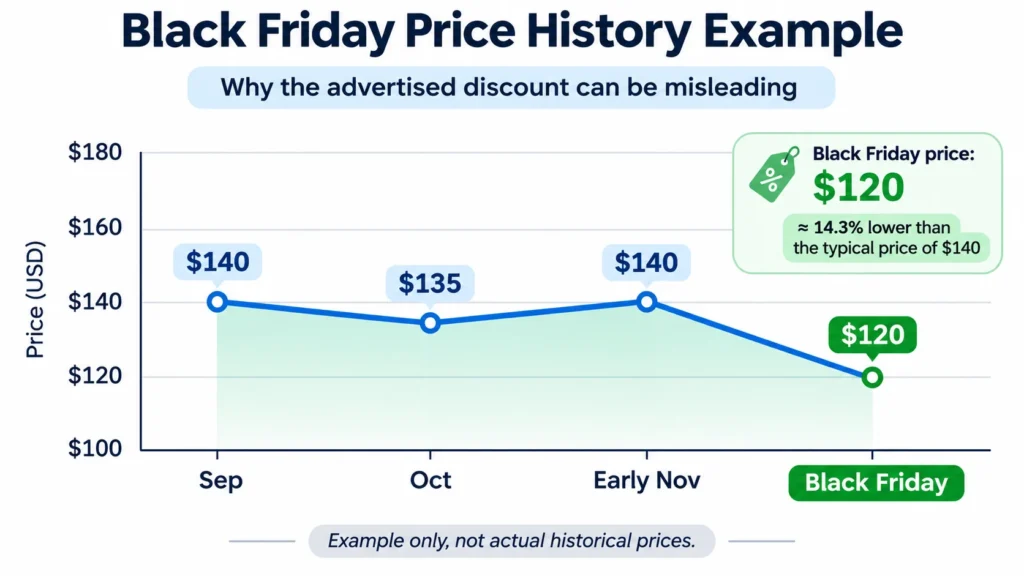
| Previous typical selling price | $140 |
The retailer’s displayed discount is 40% compared with the advertised $200 price.
But compared with the hypothetical typical price of $140, the saving is only $20, or approximately 14.3%.
That’s still a discount. It’s simply smaller than the promotional percentage suggests.
To calculate your savings, subtract the current price from a meaningful historical comparison price, then divide by that historical price.
Choose a reference price based on credible recent price history, not automatically the crossed-out amount on the product listing.
If the product has frequently sold for $120, today’s $120 sale may not offer any unusual savings.
Even a genuine price reduction can become less attractive once additional costs appear at checkout.
Consider shipping charges, taxes, required memberships, handling fees, and accessories you might need to purchase separately.
Imagine two retailers offering the same headphones:
| Cost | Retailer A | Retailer B |
|---|---|---|
| Item price | $79 | $85 |
| Shipping | $12 | Free |
| Total before applicable taxes | $91 | $85 |
In this example, Retailer B is actually cheaper despite advertising a higher product price.
The Federal Trade Commission’s online shopping guidance recommends comparing the complete purchase cost, including shipping, handling, taxes, and additional fees.
Don’t assume the biggest discount banner identifies the lowest final price.
A bargain becomes less valuable if you’re stuck with the wrong product.
Before purchasing, check how long you have to return the item, whether sale merchandise is eligible for refunds, and who pays return shipping.
Some products may have restocking fees, especially if opened or returned outside certain conditions.
Also check whether the offer applies to a new product or a refurbished, open-box, or older model.
The FTC advises shoppers to review sale-item return policies carefully because they can differ from a retailer’s usual policies.
If the product is expensive or intended as a holiday gift, return flexibility may be worth paying slightly more.
A countdown timer can create the impression that you must buy immediately.
But if the product isn’t urgently needed, tracking its price may be a better option.
Google offers price tracking for eligible products in the United States. When the feature is available, you can select Track price, choose applicable options, and receive notifications about price drops.
Some experiences also let you set a target price.
For example, if headphones currently cost $120 but your budget is $95, you could set an alert rather than making an impulse purchase.
Notifications and supported features vary by device, account, product, and location.
A price alert doesn’t guarantee that an item will become cheaper. It simply gives you another way to follow an offer without constantly checking the listing.
Even a genuine 60% discount doesn’t save you money if it convinces you to buy something you wouldn’t otherwise purchase.
Before checkout, ask yourself whether the item was already on your shopping list, whether it fits your budget, and whether you’re choosing it for its features or its advertised discount.
For more expensive purchases, compare product reviews and specifications rather than relying on the deal’s popularity.
A practical buying rule is to establish the maximum amount you’re comfortable spending before reviewing promotional offers.
If the product meets your needs, the final price is competitive, and the purchase fits your budget, it may be a worthwhile deal.
If you’re buying mainly because the discount might disappear, reconsider.
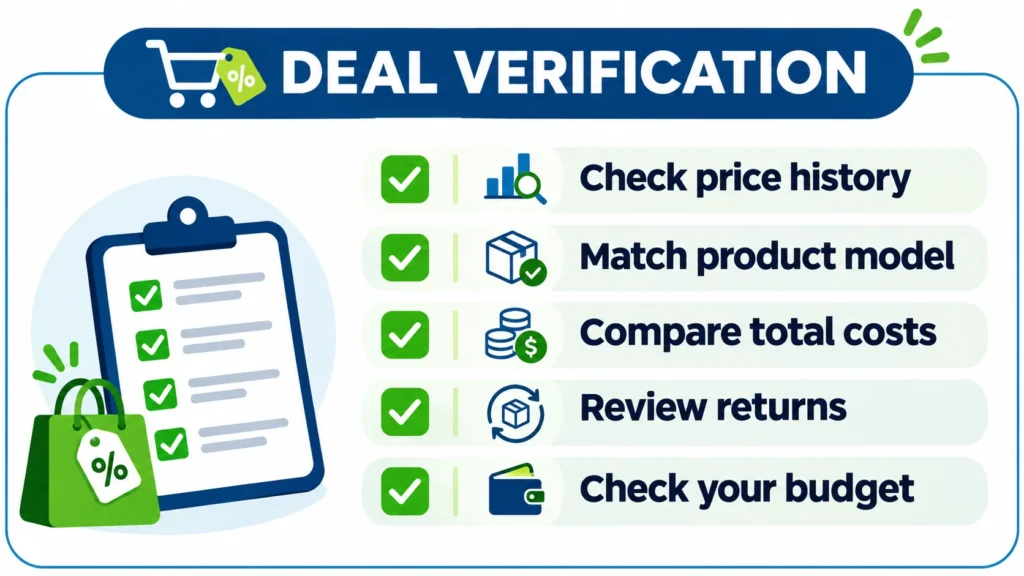
Before checking out, run through these questions.
| Check | Question to answer |
|---|---|
| Price history | Was the item available for the same price or less recently? |
| Product match | Am I comparing the exact model, version, and condition? |
| Competitor prices | Is another reputable retailer offering a better total price? |
| Final cost | Have I included delivery, taxes, and required extras? |
| Return policy | Can I return the item if it doesn’t meet my needs? |
| Budget | Would I still want the product without the discount banner? |
You don’t need to find the lowest price ever recorded to make a sensible purchase. You need enough information to recognize a fair offer and avoid unnecessary spending.
If you’re considering an unfamiliar online retailer, also verify the seller independently. A convincing discount doesn’t establish that the store is legitimate.
Black Friday falls on November 27 in 2026, followed by Cyber Monday on November 30.
Some retailers may offer different promotions across the weekend, but there’s no reliable rule that Cyber Monday is always cheaper.
If the current price is already below the product’s recent historical range and fits your budget, waiting could mean losing an acceptable offer or encountering stock limitations.
If the discount is ordinary, the product is widely available, and you’re not in a hurry, tracking the price for a little longer may be reasonable.
Make the decision based on the specific product and available evidence, not assumptions about which shopping day always offers the best deals.
Black Friday deals can offer meaningful savings, but a discount percentage alone isn’t enough to evaluate them.
The smartest approach is to check price history, compare identical products, calculate the total cost, and review the purchase conditions before paying.
Google Shopping price insights and price alerts can make this process easier, but no single tool can guarantee the lowest possible price.
A good Black Friday deal isn’t necessarily the one with the biggest advertised discount. It’s the one offering the right product at a genuinely competitive price you can afford.
Check the product’s recent price history and compare its current price across multiple retailers. If today’s price is lower than its usual selling price and competitive elsewhere, the offer may represent genuine savings.
Retail prices can change before promotional events. An advertised discount may therefore be less impressive than it appears when compared with earlier selling prices. Reviewing price history is more useful than assuming the crossed-out price represents what most shoppers recently paid.
Google Shopping price insights and price tracking are practical starting points for US shoppers. Availability varies by product and device. Compare the exact model across retailers and confirm the final checkout price.
Neither shopping day is guaranteed to have the lowest price for every product. Promotions vary by retailer and item, so compare current offers with recent prices rather than relying on the event name.
No. The advertised percentage depends on the reference price. A product marked 50% off might have been sold for a similar amount recently. Evaluate its typical price, condition, final cost, and whether you actually need it.

Log in to support this story.
New here? Create an account


Discussion · 0 Comments
No comments yet — be the first to share your thoughts.