
Top 10 all time goats of sports history
0
0


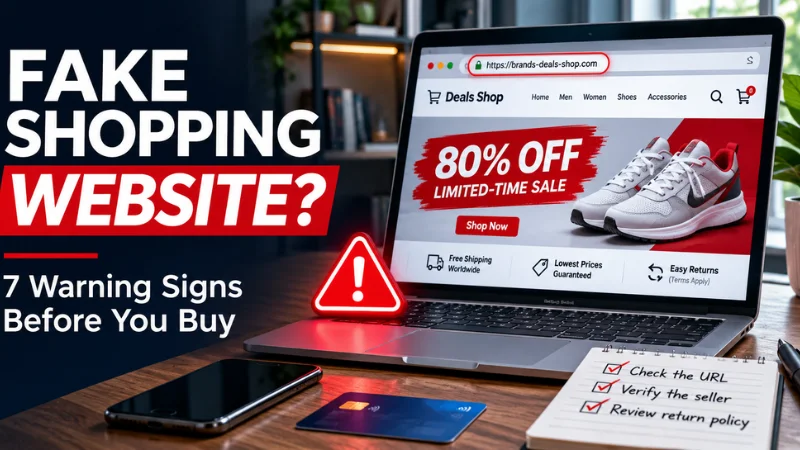
Imagine finding a pair of sneakers you’ve wanted for months. The regular price is $180, but an unfamiliar online store offers them for just $39. The product photos look professional, customer reviews are glowing, and a countdown timer says the deal ends in ten minutes.
Would you trust it?
Fake shopping websites can look surprisingly convincing. Scammers copy recognizable brand logos, product images, and checkout designs to make fraudulent stores appear legitimate. Some collect payments without delivering products, while others sell counterfeit goods or attempt to steal sensitive information.
To spot a fake shopping website, check its web address, research the seller independently, compare prices, review its return policy, and choose a payment method with buyer protections. A single warning sign doesn’t necessarily prove fraud, but several suspicious details together should make you reconsider purchasing.
Here’s how to determine whether an online store is trustworthy before spending your money.
A fake shopping website is an online storefront designed or misrepresented to deceive consumers. It may impersonate an established retailer, advertise products it doesn’t intend to deliver, or collect personal and payment information under false pretenses.
These websites often contain familiar ecommerce features, including shopping carts, product descriptions, discount banners, customer testimonials, and shipping policies.
In a November 25, 2025 consumer warning, the US Federal Trade Commission (FTC) explained that scammers sometimes impersonate legitimate companies through social media advertisements. Shoppers following those ads may receive counterfeit merchandise, products different from those advertised, or nothing at all.
The important lesson is that a professional-looking website isn’t necessarily trustworthy. Likewise, a small business with a simple website isn’t automatically suspicious.
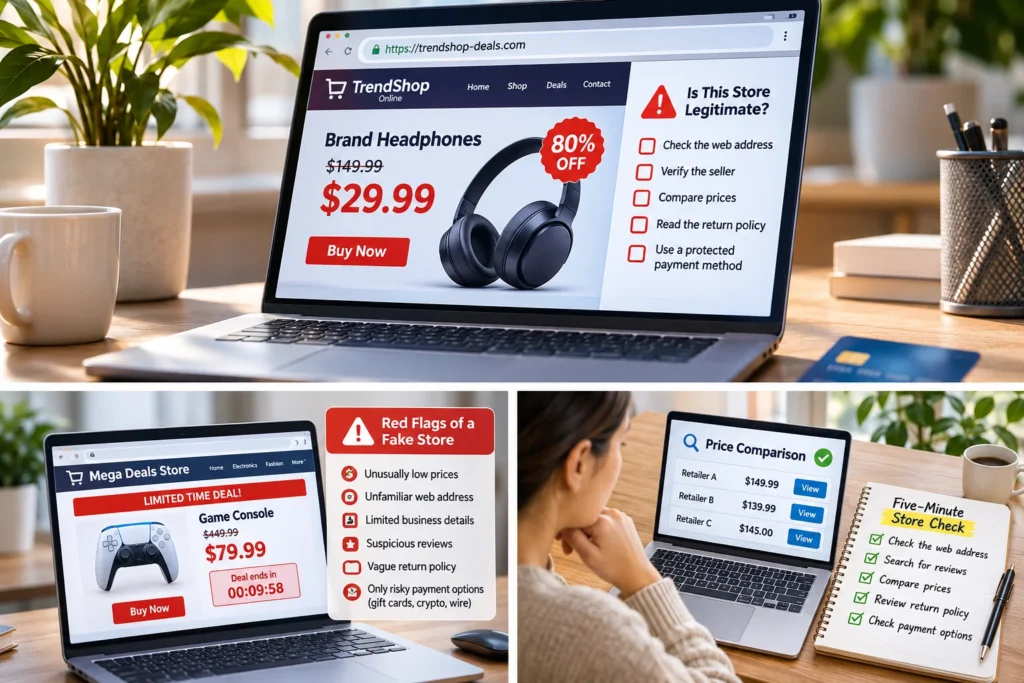
Start by checking the domain name in your browser’s address bar. Fraudulent shopping websites sometimes use misspelled brand names, additional words, or unfamiliar domains to imitate established retailers.
For example, a fictional address such as famous brand clearance could appear to represent an official brand outlet without actually belonging to that company.
If you’re shopping for products from a recognizable brand, visit its official website independently rather than trusting a link from an advertisement or unexpected message.
Remember that HTTPS encryption doesn’t guarantee a store is legitimate. Fraudulent websites can use encrypted connections, too.
Everyone appreciates a discount, but extremely low prices deserve investigation.
Imagine a gaming console normally selling for $450 appearing on an unfamiliar website for $79. Before ordering, compare the price with established retailers and check whether the item is new, refurbished, or subject to special conditions.
The FTC specifically warns consumers about suspiciously cheap offers for recognizable brands.
A low price alone doesn’t prove fraud. Genuine clearance sales and promotions exist, but the offer should make sense when compared with independent information.
Before buying, look for the business name, customer service details, delivery information, and a clear way to resolve problems.
Then independently check whether those details appear consistent.
A website providing only an anonymous contact form or vague email address may deserve additional scrutiny. However, a listed telephone number or physical address doesn’t establish legitimacy by itself because scammers can copy those details.
A website displaying hundreds of five-star reviews might appear trustworthy, but ratings and testimonials can be manipulated.
Look beyond reviews featured on the seller’s own website. Search for independent customer experiences and complaints about refunds, product quality, and missing deliveries.
Be cautious of repetitive testimonials, unusually similar wording, or reviews that provide little information about actual purchases.
A new retailer may have few reviews without being fraudulent. Evaluate several indicators rather than using review counts as your only test.
Before checkout, find the seller’s return, refund, and delivery policies.
Check how long customers have to request a return, whether return shipping is charged, and whether restocking fees apply. Review the total price, including taxes and delivery charges.
Strict return policies aren’t automatically suspicious, particularly for personalized or clearance items. However, the conditions should be clearly presented before purchase.
Contradictory or missing terms are a reason to reconsider the transaction.
Pay attention to how the retailer asks you to pay.
Be particularly cautious if an unfamiliar store insists on payment exclusively through gift cards, wire transfers, cryptocurrency, or certain payment apps.
Those methods may offer limited recovery options when something goes wrong.
The FTC recommends paying by credit card when possible because US consumers have important dispute protections for eligible transactions.
A credit card doesn’t guarantee a legitimate purchase, but it can provide valuable options if merchandise never arrives or a charge is incorrect.
Fraudulent shopping sites may attract visitors through advertisements promoting enormous discounts and limited-time offers.
Countdown timers, claims that only two products remain, and messages suggesting a sale will disappear in minutes can discourage careful decision-making.
These techniques aren’t inherently fraudulent, but you shouldn’t let them prevent you from researching an unfamiliar business.
When an advertisement appears to represent a well-known retailer, visit the retailer’s official website directly and confirm whether the promotion exists.
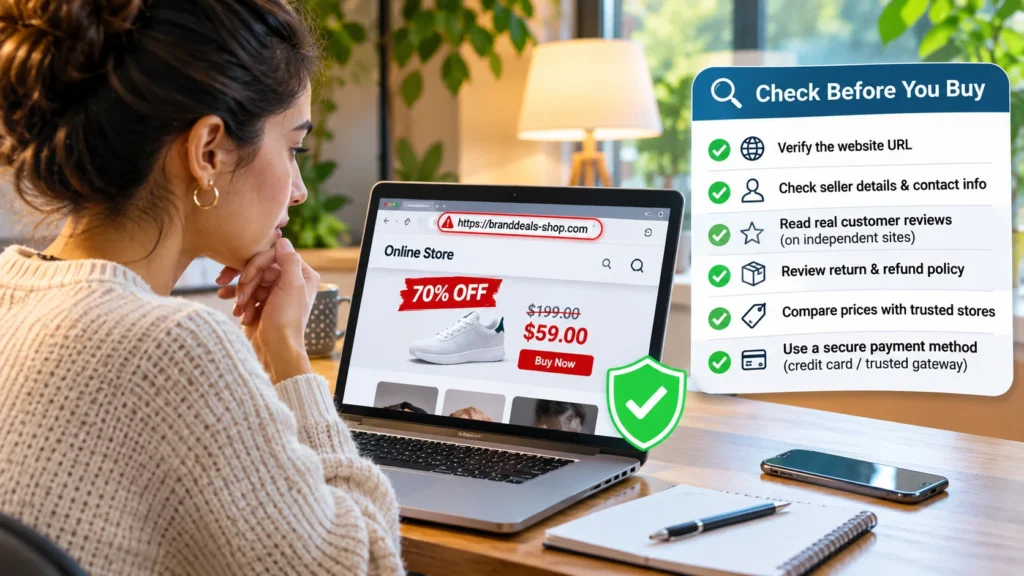
You don’t need advanced cybersecurity knowledge to investigate an unfamiliar shopping website.
Use this five-step verification process before checkout.
| Step | What to check | Why it matters |
|---|---|---|
| 1 | Examine the full website address | Helps identify misleading or impersonation domains |
| 2 | Search the seller’s name with “scam,” “review,” or “complaint” | Helps uncover reported customer problems |
| 3 | Compare prices with established retailers | Identifies unusually unrealistic offers |
| 4 | Check contact, delivery, and refund information | Reveals whether purchase conditions are transparent |
| 5 | Review payment options | Helps identify payment demands with poor buyer protections |
Consider an example: a new website advertises $120 headphones for $25, has no independent customer reviews, provides unclear return instructions, and accepts only cryptocurrency.
These signs don’t establish criminal wrongdoing, but they provide enough reason to avoid purchasing until you can independently verify the business.
If you cannot establish who you’re buying from or how you’d resolve a problem, it’s safer not to proceed.
Yes. HTTPS means that the connection between your browser and the website is encrypted. It doesn’t prove that the website operator is legitimate.
Scammers can obtain security certificates and display the same padlock symbol seen on genuine ecommerce websites.
Therefore, treat HTTPS as a connection-security feature, not proof that a seller is trustworthy.
The same principle applies to other online threats. In RethinkTrends’ guide to fake QR code scams, a seemingly convenient link can redirect users to a fraudulent payment website.
If you’ve already placed an order and suspect the seller is fraudulent, act promptly.
Save your purchase records. Keep your receipt, order confirmation, payment details, product listing, screenshots, and correspondence with the seller.
Contact your payment provider. Explain what happened and ask whether you can dispute the charge or take other protective steps. Use your financial institution’s official contact channels.
Secure your accounts. If you created an account using a password you’ve reused elsewhere, change that password on other accounts immediately. Enable multifactor authentication wherever possible.
Monitor your transactions. Check for unauthorized charges and notify your financial institution about suspicious activity.
Report the incident. US consumers can report suspected shopping scams at ReportFraud.ftc.gov. If your identity may have been stolen, visit IdentityTheft.gov for recovery guidance.
The appropriate response depends on what information you shared, how you paid, and whether the retailer has fulfilled the order.
US consumers have certain protections when an online seller fails to deliver a purchase.
Under the FTC’s applicable Mail, Internet, or Telephone Order Merchandise Rule, sellers generally must ship within the timeframe they promised. If no shipping time was specified, the general requirement is shipment within 30 days, subject to the rule’s conditions and exceptions.
When a seller cannot meet the applicable deadline, requirements may include notifying the customer, obtaining consent to a delay, or issuing a refund.
The FTC explains these protections in its official online shopping guidance.
If you paid by credit card and the product never arrives, contact your card issuer promptly. Federal billing dispute protections have specific requirements and deadlines, including a 60-day written-dispute deadline in applicable billing-error situations.
Don’t wait indefinitely for a questionable seller to respond.
Shopping online doesn’t have to be stressful. Most preventive steps involve verifying a few important details before entering your payment information.
Choose sellers you can independently identify, compare prices across reputable websites, and read the complete purchase terms.
Don’t assume an advertisement is trustworthy simply because it appears on a familiar social media platform.
Use unique passwords for shopping accounts, avoid saving payment information on unfamiliar websites, and keep your purchase confirmations.
If you receive an unexpected call from someone claiming to represent a retailer or payment provider, verify the request independently. RethinkTrends’ article on how voice phishing works explains how scammers use impersonation to obtain sensitive information.
Learning how to spot a fake shopping website can help you avoid losing money, receiving counterfeit products, or exposing your personal information.
Before purchasing from an unfamiliar store, examine the domain name, research the seller, compare prices, review its policies, and choose a payment method with appropriate protections.
A professional design, secure connection, or positive customer rating isn’t enough to establish trustworthiness. Look for consistent information from independent sources.
A few minutes of research before checkout could save you from a much bigger problem afterward.
Check the domain name, independent reviews, business details, pricing, return policies, and payment methods. Several suspicious signs together are a strong reason to avoid purchasing until you’ve verified the seller.
Yes. Fraudsters can copy recognizable logos, product images, and website layouts to impersonate legitimate companies. Visit the official retailer’s website independently rather than relying on unfamiliar advertisement links.
A lack of reviews doesn’t automatically mean fraud, especially for a newly launched business. However, you should verify the seller through other sources and review its policies before ordering.
Possibly. Your options depend on the payment method, transaction details, and applicable consumer protections. Contact your card issuer or payment provider promptly and keep documentation supporting your claim.

Log in to support this story.
New here? Create an account


Discussion · 0 Comments
No comments yet — be the first to share your thoughts.