
Complete Breakdown of Silicon Valley Bank Collapse
0
0


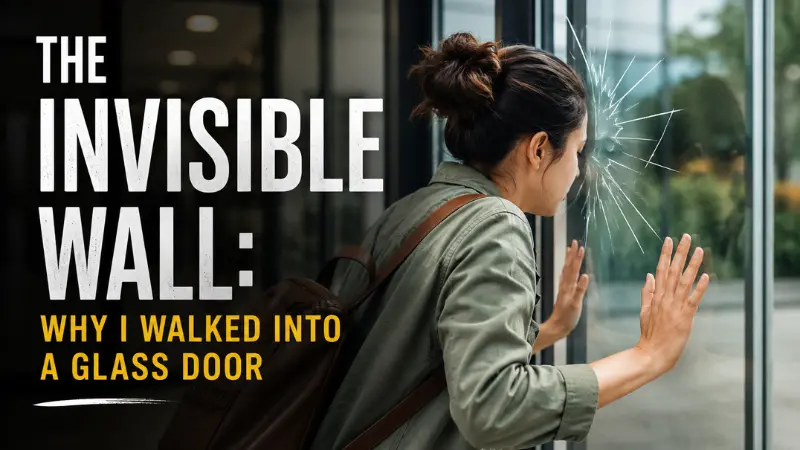
How two dead architects are still giving people headaches in 2025.
I am currently typing this while holding an ice pack to my face.
Just a few minutes ago, I was walking confidently into a room, minding my own business, when, BAM. I face-planted directly into a perfectly clean, completely invisible glass office door. As I stood there rubbing my head in front of my deeply amused coworkers, my embarrassment quickly turned into pure, unadulterated spite.
Who decided this was a good idea? Who looked at a solid, perfectly functional wooden door and thought, “No, let’s make it look like thin air so people can smash their head into it?
As it turns out, I have two specific men to blame for my current headache: Walter Gropius and Ludwig Mies van der Rohe.
Back in the mid-20th century, these two legendary German architects decided that heavy walls were out, and total transparency was in. They championed the “less is more” philosophy, filling the corporate world with sleek steel, open floor plans, and the curse of the seamless glass door. They wanted to flood our workspaces with natural light and break down visual barriers.
Well, Walter and Mies, congratulations. Your architectural masterpieces have successfully broken down my visual barriers and very nearly broke my head.
While these guys were busy designing the futuristic, minimalist offices we work in today, they clearly forgot to account for two major things: ultra-effective modern glass cleaners and distracted human beings.
Before we litigate the sins of Bauhaus, a little context helps. The all-glass office aesthetic did not appear overnight. It evolved over nearly a century, and its architects genuinely believed they were improving human life.
Walter Gropius founded the Bauhaus school in 1919 in Germany, a movement that fused fine art with functional design and became one of the most influential design philosophies of the 20th century. His 1925 Bauhaus building in Dessau featured massive glass curtain walls, an almost theatrical statement that buildings did not need to hide behind brick.
Mies van der Rohe took it further. His famous Barcelona Pavilion (1929) and later the Seagram Building in New York (1958) established the glass-and-steel tower as the definitive symbol of corporate modernity. “Less is more” was not a slogan, it was a manifesto.
By the 1960s and 70s, every serious corporation wanted a glass tower. By the 1990s, even the interior offices had gone transparent. And by the 2000s, the all-glass open-plan office was simply “how offices look.”
No one stopped to ask whether human beings, distracted and caffeinated, were neurologically equipped to navigate walls made of nothing.
Architects do not design glass offices just to watch employees bump into things. There are genuine, research-backed psychological and spatial benefits to all this transparency.
The intentions were noble. The execution? That is where it gets complicated.
So why does your perfectly functional brain fail to detect a massive sheet of glass that is right in front of your face?
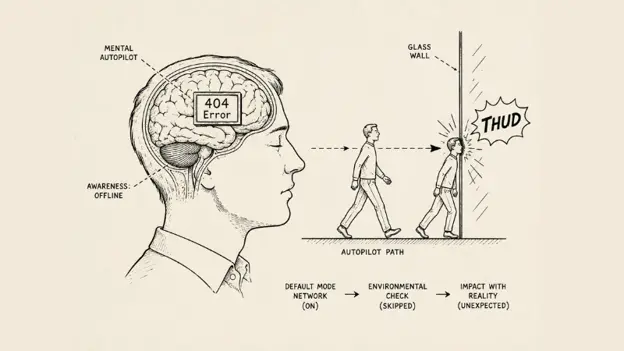
The short answer: your brain is running on autopilot, and autopilot does not check for glass.
Your visual system does not record everything it sees. It takes shortcuts. When you scan a path ahead and detect no visual interruption, no shadow, no frame, no texture, your brain concludes the path is clear and signals your legs to keep moving. This is called predictive coding, a neurological efficiency strategy where the brain anticipates the world based on prior experience rather than processing every stimulus fresh.
Clean glass defeats predictive coding. It offers no visual data to process. Your brain sees “clear path” and commits.
Add to this the phenomenon of inattentional blindness, the well-documented tendency for humans to miss obvious stimuli when their attention is focused elsewhere. If you are glancing at your phone, mid-conversation, or simply thinking about your next meeting, your attentional resources are already allocated. The glass door does not compete.
It is not a vision problem. It is a resource allocation problem. Your brain decided the path was clear and spent its processing budget elsewhere. The glass had no lobbyist.
This is also why glass collisions are not evenly distributed across the population. Extroverts, people in conversations, and anyone multitasking are disproportionately at risk. The more your brain is engaged elsewhere, the more it relies on shortcuts. And shortcuts do not account for Mies van der Rohe.
If you think humans have it bad, spare a thought for birds.
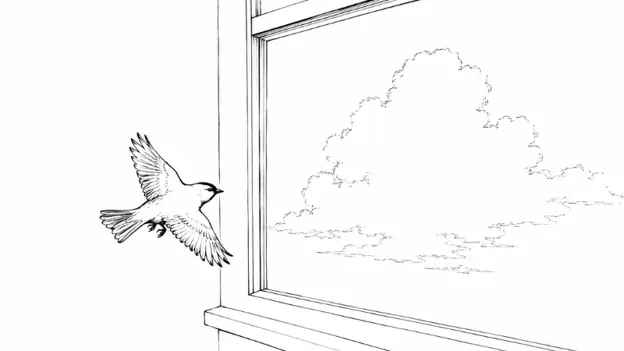
The American Bird Conservancy estimates that between 600 million and 1 billion birds are killed annually in the United States alone by colliding with glass. It is one of the leading human-caused sources of bird mortality, behind only habitat loss.
Birds do not see glass as a barrier. They either see a reflection of sky and vegetation, which looks like somewhere safe to fly, or they see straight through the glass to a plant or tree on the other side, and aim directly at it.
This has led to the rise of bird-safe glass design, including UV-reflective coatings, fritted patterns, and external screens. Many cities, including New York and San Francisco, have passed bird-safe building legislation that mandates these features for new construction.
The lesson here is uncomfortable: when glass kills enough birds to become a legislative issue, maybe the human face-plants are not just an embarrassing fluke. They are part of a broader design failure.
Here is the part your facilities manager needs to read.
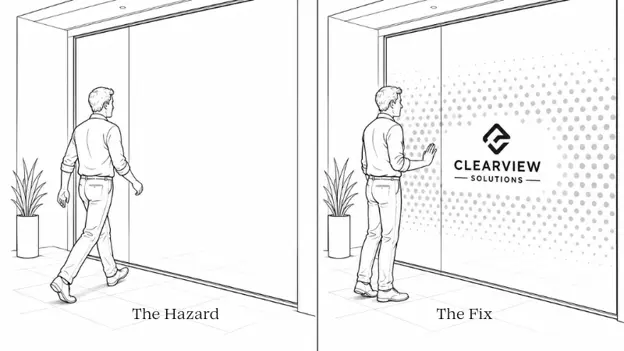
In most countries, making transparent glass visible in public and workplace environments is not optional. It is a legal requirement. In the UK, Building Regulations Document N (2013) requires that transparent glazing in critical locations be made apparent to building occupants through permanent markings at two specific height bands.
In the US, the Americans with Disabilities Act (ADA) and many state-level codes contain similar provisions, particularly in commercial occupancies. The International Building Code (IBC) addresses hazardous glazing locations and the requirement for manifestation features.
Glass manifestation is the process of applying permanent visual markers to transparent glass to make it visible. If your office is a hazard zone, here is what needs to happen immediately:
My head aside, the glass office debate touches a genuinely contested question in workplace design: does radical transparency actually improve how people work?
The data is mixed. A frequently cited 2018 Harvard study found that open-plan offices, rather than increasing collaboration, actually reduced face-to-face interaction by 70%, as employees turned to headphones and screens to create private space. Transparency, paradoxically, can drive people further inward.
On the other hand, research from Leesman, which surveys over 900,000 employees globally on workplace effectiveness, consistently shows that access to natural light is among the strongest predictors of workplace satisfaction. The glass lets the light in. That part is worth keeping.
The conclusion most workplace designers now reach is that transparency needs to be intentional, not total. Glass where it brings light and connection. Opacity where people need focus and privacy. Not every wall needs to be a window, and not every window needs to be a wall you can walk through.
The best offices are not the most transparent. They are the most honest about how people actually work.
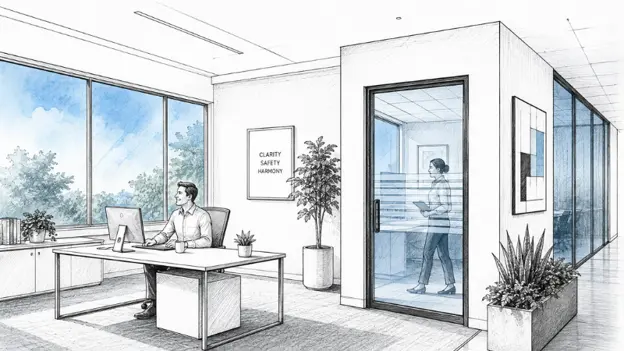
Transparent offices are beautiful, and the architects who popularized them were genuine visionaries. They brought natural light into spaces that used to feel like bunkers, and they made workplaces feel less like institutions.
But beauty without legibility is a hazard. Glass that cannot be seen is not a feature, it is a design oversight dressed up in modernist rhetoric.
If you just walked into a glass wall, do not be embarrassed. Tell your facilities manager that your office is missing its legally required glass manifestation. Cite the building code. Print this article if you have to.
And if anyone gives you grief about it, hand them the ice pack.

Log in to support this story.
New here? Create an account

Discussion · 0 Comments
No comments yet — be the first to share your thoughts.