
Oscar 2023 Winners to Watch
0
0


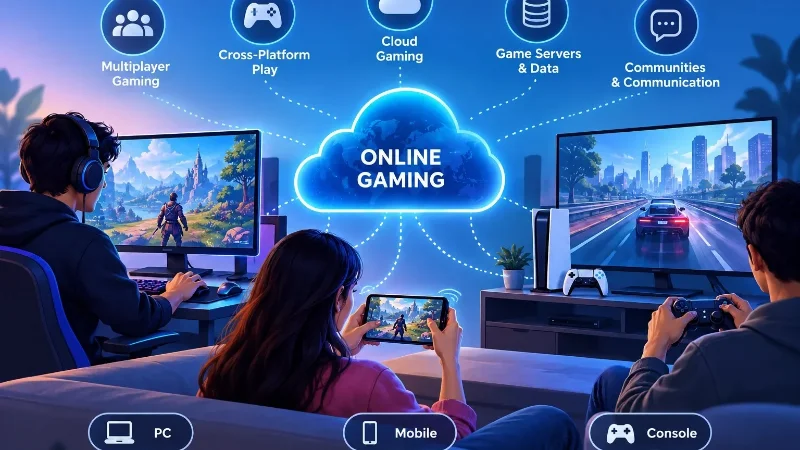
A video game once existed mainly on the device in front of you. Today, many games connect to remote servers, cloud infrastructure, other players, live updates and digital communities. That shift has turned gaming from a mostly standalone activity into a connected form of digital entertainment.
Online gaming refers to playing or using a video game through an internet-connected device. The connection may enable multiplayer interaction, synchronize game data, deliver updates, maintain persistent environments or connect a player account across devices. It is defined less by a particular genre and more by the role the network plays in the experience.
The simplest definition of online gaming is a digital game experience that depends partly or primarily on an internet connection.
That can include competitive multiplayer sessions, cooperative play, persistent virtual worlds or mostly solo experiences that still rely on remote services for account data, content or updates. Online gaming can take place on computers, consoles, smartphones, tablets and other connected devices.
Online gaming and multiplayer gaming are not exactly the same. Multiplayer describes an experience involving more than one player. Online gaming is broader because connectivity can support many features beyond direct player-to-player competition.
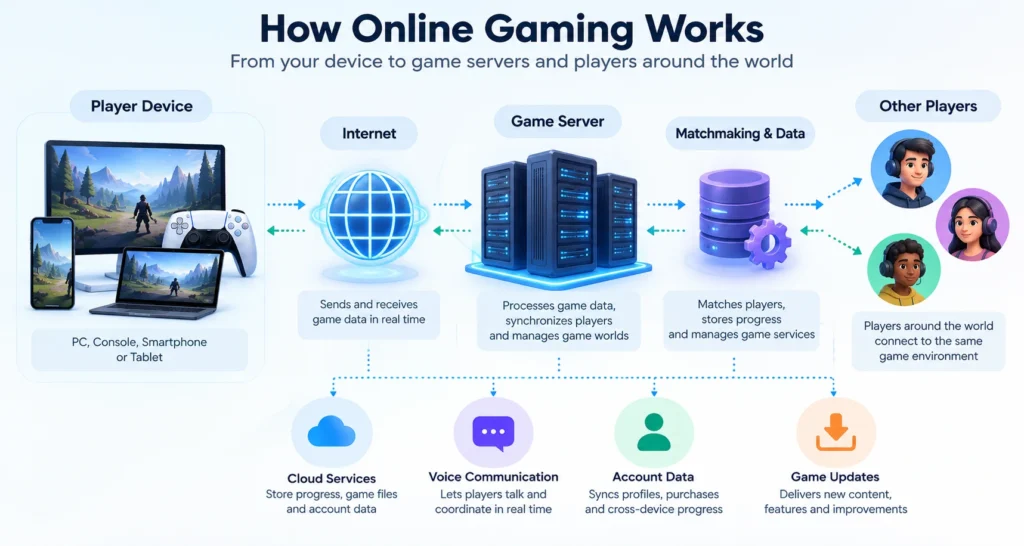
Behind a seemingly simple game session is a network of devices and services.
A player uses a game client on a phone, computer, console or another compatible device. That client connects through the internet to remote servers. Depending on the experience, those servers can handle authentication, matchmaking, movement, scores, inventories, shared environments or communication.
When several people share a session, information moves continuously between their devices and the server. Connection quality therefore matters. Latency, for example, describes the delay between an action and the corresponding response moving through the network.
Cloud infrastructure can add another layer. It can store progress remotely, synchronize accounts and, in some cases, perform processing on remote hardware before streaming the experience to the user’s device.
Online gaming is better understood by looking at how connectivity is used rather than simply listing game genres.
Multiplayer experiences connect people so they can compete, cooperate or interact in a shared environment.
Persistent online worlds remain active as users enter and leave, allowing communities, environments or events to continue over time.
Browser and mobile games use internet-connected browsers or applications to make gaming available across everyday devices.
Cloud gaming moves more computing to remote data centres instead of requiring all processing to happen locally.
Cross-platform gaming can allow people using different types of devices to participate in the same connected experience.
Together, these formats show why online gaming now means much more than simply playing against someone over the internet.
The biggest change is not just the number of games available. It is the number of digital systems surrounding them.
Modern online gaming can combine entertainment, communication, live content, digital identities, creator communities, software updates and shared virtual spaces. A player may return to the same connected environment repeatedly rather than treating a game as something that is completed once.
That makes online gaming increasingly similar to other connected digital platforms.
Gaming now competes for attention not only with other games but also with streaming, social media, short-form video and other forms of interactive entertainment. Many digital platforms rely on carefully designed digital engagement mechanics to encourage users to return and continue interacting.
The experience around a game can now be almost as significant as the software itself.
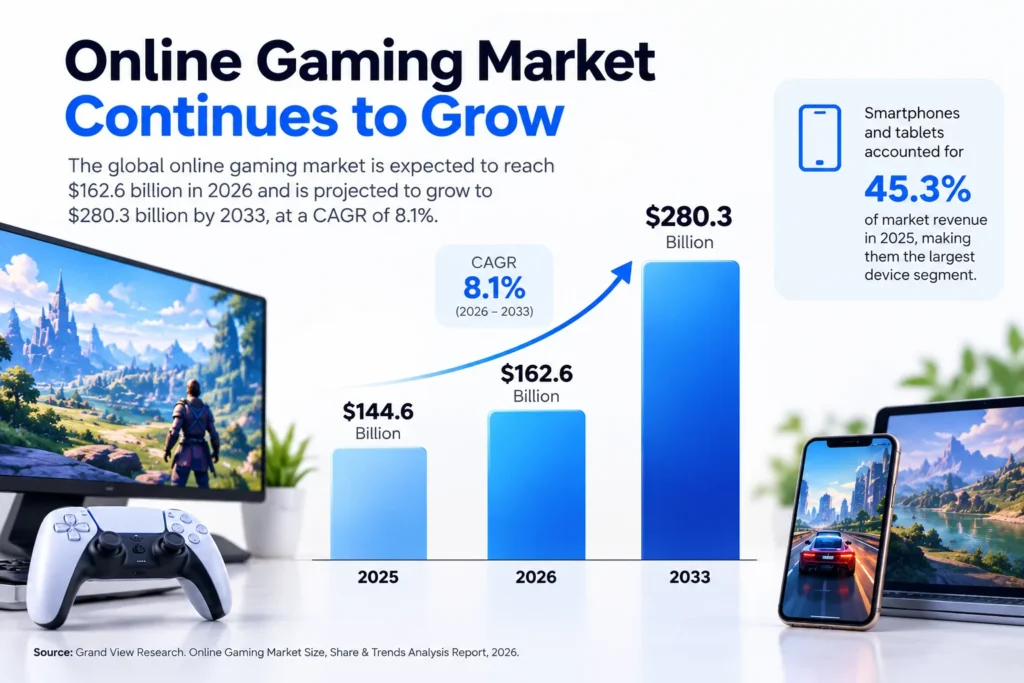
The scale of this transition can also be seen in market data.
Grand View Research estimates the global online gaming market at $162.6 billion in 2026, compared with $144.6 billion in 2025. Its current forecast puts the market at $280.3 billion by 2033, representing a compound annual growth rate of 8.1% between 2026 and 2033.
Mobile access is particularly important. Smartphones and tablets represented 45.3% of online gaming market revenue in 2025, making them the largest device segment in the same research.
These figures point to a broader trend: online gaming growth is increasingly connected to accessibility and infrastructure. Faster networks, cloud computing and widespread smartphone adoption are reducing some of the technical boundaries that traditionally separated mobile, computer and console experiences.
Several technologies are changing how connected games are delivered and experienced.
Cloud gaming can reduce dependence on powerful local hardware because more processing can take place remotely.
5G and faster broadband can improve responsiveness and support more data-intensive connected experiences.
Cross-platform systems reduce boundaries between devices by allowing accounts, progress or multiplayer features to operate across different hardware.
Artificial intelligence is increasingly being used behind the scenes in areas such as personalization, matchmaking, moderation and development.
Virtual and augmented reality could also make some connected environments more immersive, although adoption and practical applications still vary.
The wider trend is convergence. Mobile, console, computer and cloud gaming are becoming less isolated from one another a pattern also visible across other emerging technologies in 2026.
Greater connectivity also introduces risks that are less common in completely offline games.
The UK government’s Kids Online Safety guidance identifies issues including unwanted contact, inappropriate communication, in-game purchases and online scams. Privacy and account security also become more important when connected experiences involve profiles, communication tools or payment information.
These risks come largely from the connected environment surrounding gaming rather than connectivity alone. Strong privacy settings, age-appropriate controls and basic account-security practices can help reduce exposure to common problems.
For the industry, this means safety, moderation and privacy are becoming part of the overall product experience rather than secondary features.
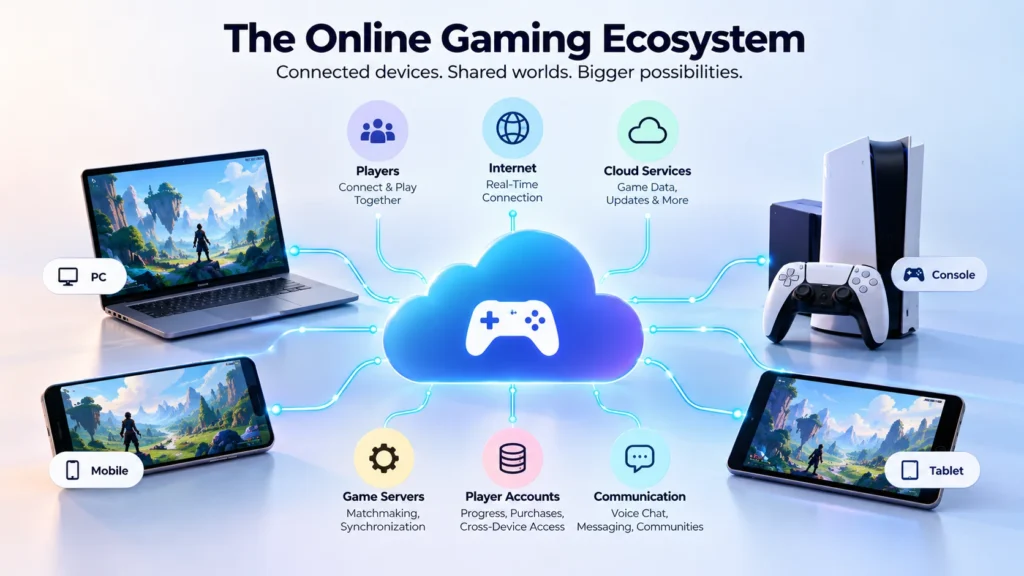
Online gaming is moving toward a future that is less dependent on one particular device and more dependent on connected infrastructure.
Cloud delivery, cross-platform access, faster networks, persistent environments and digital communities are making gaming part of a wider interactive entertainment ecosystem.
The important shift is therefore not simply that more games are online. It is that the boundaries between a game, a digital service and an online community are becoming harder to separate.
Understanding what online gaming means in 2026 requires looking beyond the screen. It means understanding the servers and cloud systems running underneath the experience, the communities forming around it and the technologies gradually connecting different devices.
That transformation from standalone software to a connected digital ecosystem is likely to define the next stage of online gaming.

Log in to support this story.
New here? Create an account


Discussion · 0 Comments
No comments yet — be the first to share your thoughts.