
How Self-Love Is Rewriting Valentine’s Week Culture
0
0



Choosing a business idea is easy. Choosing one people will actually pay for is harder. The best small business ideas match three things: a real customer problem, skills you can deliver consistently, and a cost structure you can afford while testing demand. You do not need a revolutionary invention; a reliable service for a specific audience can be a stronger starting point than a complicated new product.
The opportunity is substantial, but competition is real. The U.S. Small Business Administration’s 2026 FAQ reports 36,207,130 small businesses, employing 62.3 million people. Those figures describe the size of the sector, not your likelihood of success. Source: SBA Office of Advocacy, February 2026 .
The most practical options include local cleaning, bookkeeping, tutoring, web design, social media support, pet care, mobile car detailing, and niche digital products. Their appeal is not guaranteed profit: many can be tested with a small pilot before committing to expensive equipment, staff, or inventory. Select based on customer demand and your ability to deliver.
| Idea | First customer to target | Main cost or risk to validate |
| Residential cleaning | Busy households | Insurance, supplies, travel |
| Bookkeeping support | Freelancers and local firms | Competence, data privacy |
| Tutoring | Parents or adult learners | Qualifications, scheduling |
| Website maintenance | Small service firms | Technical support time |
| Short-form video editing | Local brands and creators | Revision workload |
| Mobile car detailing | Vehicle owners and fleets | Water access, equipment |
| Pet sitting | Pet owners | Insurance, trust, local rules |
| Home organization | Movers and households | Travel, customer acquisition |
These are opportunity examples, not a verified profitability ranking.
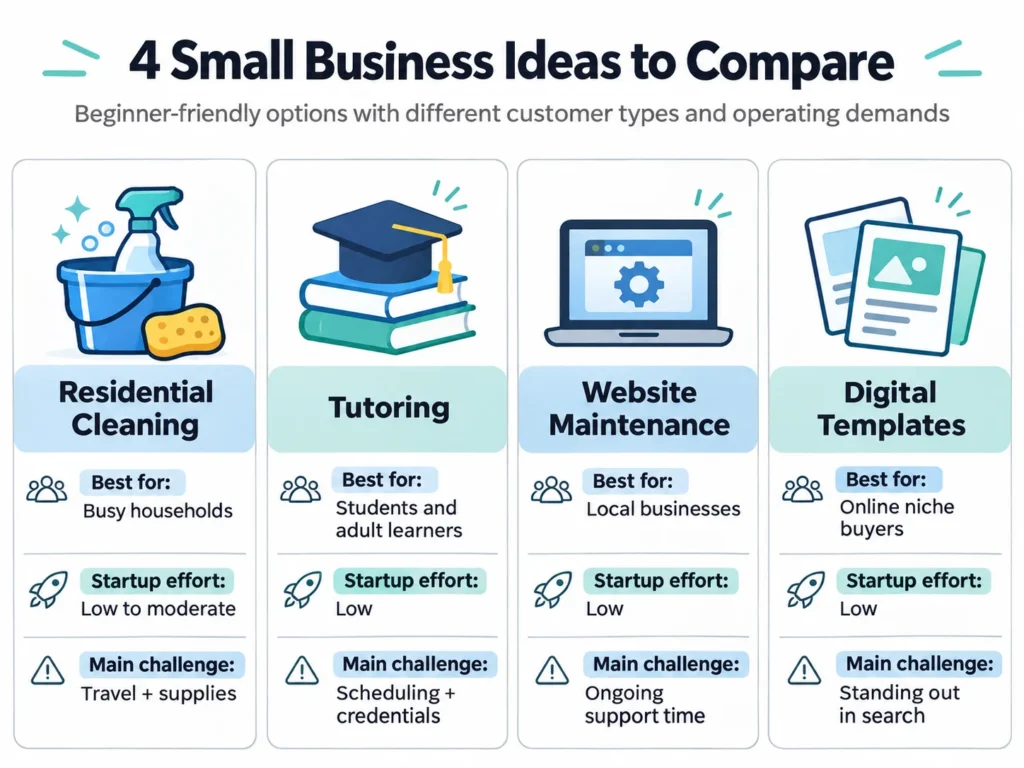
Low-cost service businesses are often easier to validate because you can sell your time and skills before investing in inventory. However, “low-cost” does not mean free: marketing, transport, software, taxes, permits, and insurance can still apply. Start with a narrowly defined offer and measure whether strangers—not only friends—will pay.
Choose a tight service area and clear packages, such as a move-out clean or a two-hour closet reset. Ask prospective customers what they currently pay, which tasks frustrate them, and what would make them switch. Before taking bookings, check local licenses, liability coverage, and safe product handling.
If you can teach math, language, music, or software skills, offer one specific outcome: exam preparation, a beginner course, or a small-group workshop. A paid trial lesson is stronger evidence than social media likes. Be transparent about credentials, and follow applicable requirements when working with children.
Small firms need help organizing receipts, invoices, schedules, and records. Begin with a defined administrative scope; do not present yourself as a licensed accountant or offer regulated tax advice without qualifications. Data security and confidentiality are as important as accuracy.
Offer a convenient cleaning service at a customer’s home or workplace, where allowed. Calculate travel, setup, consumables, and weather-related downtime. A compact service radius may be more economical than taking every booking across a city.
Online ideas can reach customers beyond one neighborhood, but they still require a reliable acquisition channel. Good choices include website maintenance, video editing, digital templates, virtual assistance, and niche educational content. The advantage is flexible delivery; the challenge is proving a differentiated service in a crowded market.
Many owners need small changes, backups, technical updates, and broken-form checks more than they need a full redesign. Sell a monthly service with a written scope, response times, and clear exclusions. Avoid promising traffic or leads you cannot control.
Create short videos, captions, or content calendars for one niche—for example, independent cafés. Show two or three original sample assets, then pitch a small pilot. Report on meaningful outcomes such as inquiries and qualified website visits, not follower count alone.
A specialist offer, such as appointment scheduling for consultants or inbox administration for real estate teams, is easier to explain than “I can help with anything.” Use secure access methods and agree on operating hours, confidentiality, and decision authority.
Sell useful planners, checklists, or spreadsheets that solve a narrow problem. Make the deliverable more useful than a free search result through examples, practical instructions, and careful testing. Remember that platform fees, customer support, and refunds affect margins.
Each is potentially suitable for a local market, but demand and regulation vary. Pet care depends on trust and dependable scheduling. Lawn services require equipment and weather planning. Event support may cluster on weekends. Helping older adults set up devices is useful if you communicate patiently, respect privacy, and avoid handling financial credentials.
Photography can serve professional headshots or product listings, but gear and editing time matter. Resume editing relies on strong writing and realistic positioning, not guarantees of employment. Repair coordination can connect homeowners with qualified providers, but you must make responsibility, licensing, and fees clear.
There is no universal startup-cost figure. A sole proprietor offering remote editing may need little beyond equipment and software already owned; a mobile detailing business may need tools, transport, permits, and insurance. Avoid comparing only launch purchases. Include recurring expenses and a cash buffer before deciding an idea is affordable.
The SBA recommends separating one-time costs from monthly expenses and using these to estimate a break-even point. Its formula is fixed costs divided by contribution per sale. For example, if monthly fixed costs are $600 and each job contributes $60 after variable expenses, break-even is 10 jobs per month. This is an illustrative calculation, not an industry benchmark. Source: SBA, plan your business.
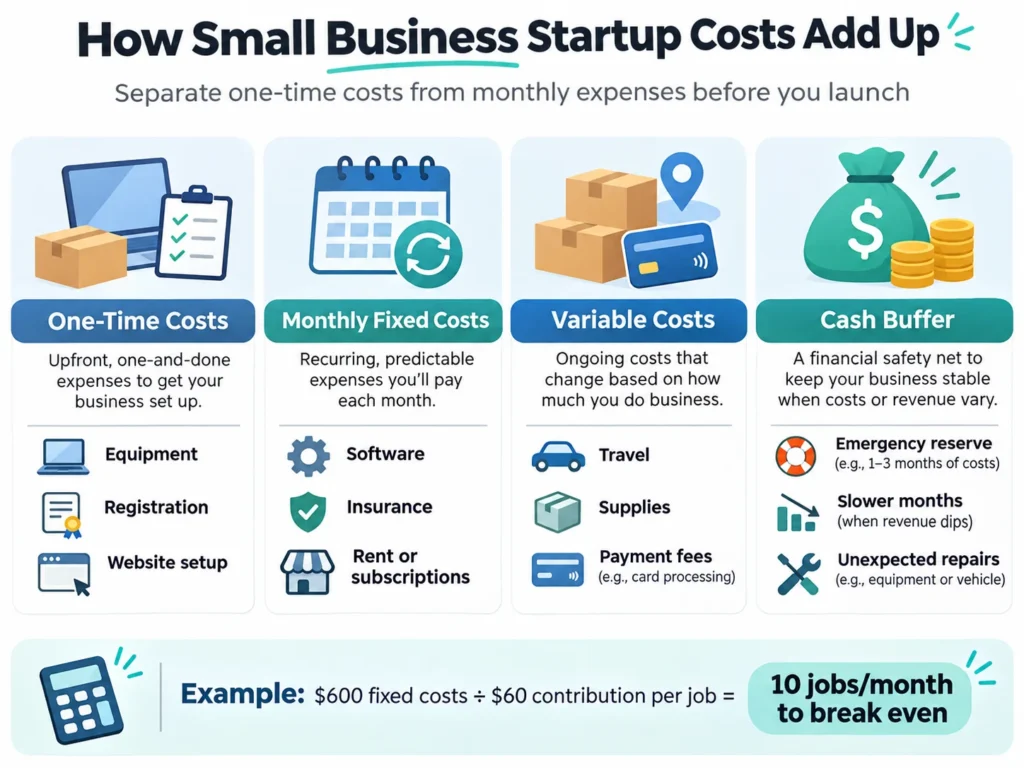
The best choice is the idea you can test affordably with clear evidence of customer willingness to pay. Look for repeat problems, reachable buyers, manageable delivery, and a margin that remains viable after labor and overhead. A simple, paid experiment is usually more informative than months of guessing.
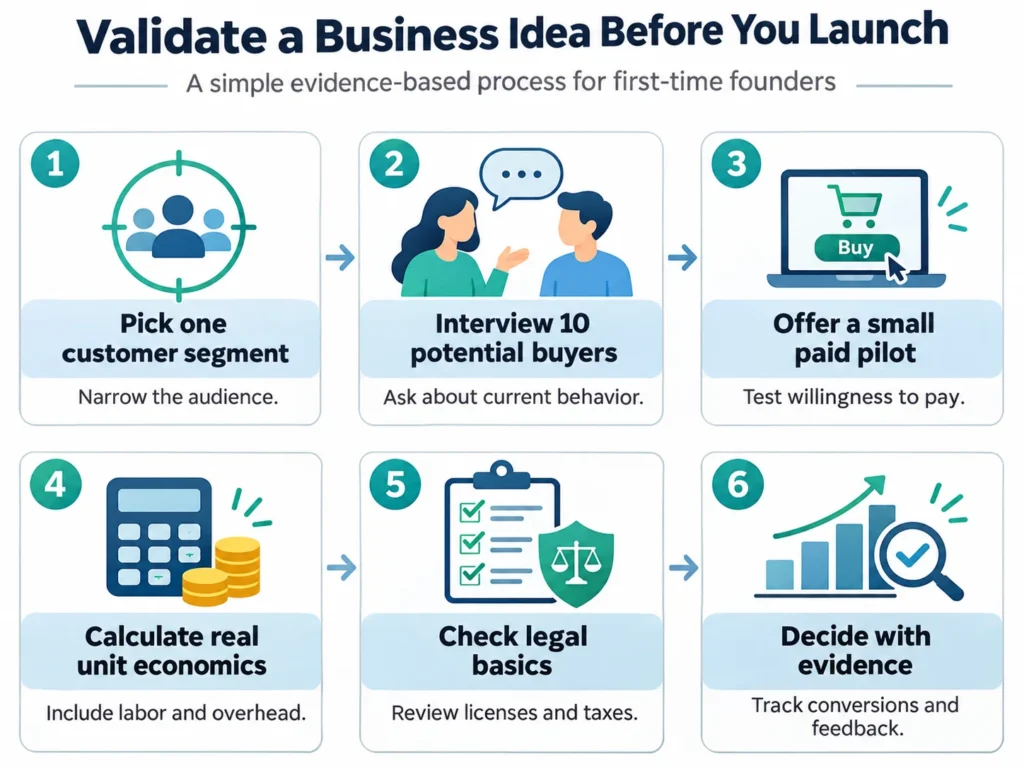
The costliest mistakes often happen before the first sale: buying equipment without validation, choosing a broad market, assuming revenue is profit, and trusting unrealistic earnings claims. The Federal Trade Commission advises readers to demand evidence behind business-opportunity income promises. Treat any “guaranteed passive income” pitch with caution.
It is also easy to build a polished brand before testing the offer. A basic landing page, a clear price, and a reliable service process can validate demand first. Once customers consistently buy, invest in stronger positioning, automation, and expansion.
The best small business ideas are not necessarily the trendiest. They are the ones you can deliver well, sell to a reachable audience, and improve with real feedback. Choose one idea, speak with potential buyers this week, and test a paid offer before investing heavily. If you are deciding between a startup and a traditional small business, read Startup vs. Small Business
What is the easiest small business to start? A skill-based service with low equipment needs can be easier to test, but the best fit depends on your experience, location, and customers.
Can you start a small business with little money? Often, yes, especially with a remote service. Still budget for software, permits, insurance, and customer acquisition where relevant.
What is the most profitable small business? There is no universally most profitable option. Compare contribution margin, demand, competition, and the cost of delivering each sale.
How do I know whether people want my business idea? Interview potential customers and test a small paid offer. Real purchases provide stronger evidence than survey enthusiasm.

Log in to support this story.
New here? Create an account


Discussion · 0 Comments
No comments yet — be the first to share your thoughts.