

Open Instagram in April and you already know what you’re about to see. A perfectly set brunch table catching golden morning light. Someone’s floral nails. A lavender latte held up to a sun-drenched window. A flowy dress that looks like spring itself decided to wear it.
That is Easter now, not exclusively in churches or scripture, but in square frames, curated feeds, and 15-second reels that rack up millions of views before you’ve even finished your coffee.
But here’s the thing nobody talks about: these colours have a history that predates Instagram by about nine centuries. Understanding where the Easter colour palette actually comes from and how it quietly conquered social media turns out to be one of the more interesting stories sitting at the intersection of faith, psychology, and modern marketing.
What Are the Easter Colours, Really?
Most people, if asked “what are the Easter colours?”, will instinctively reach for the pastels, soft pink, mint green, baby yellow, lilac. And they’d be right, but only partially. The full answer is layered in a way that most spring brunch posts on TikTok don’t quite capture.
The three liturgical colours of Easter, the ones used in churches across Catholic, Lutheran, Anglican, and many Protestant traditions are purple, white, and gold. Each carries a specific theological weight that has been carefully maintained for hundreds of years.
Purple arrives first. During Lent, the forty days of preparation and reflection leading to Easter, purple vestments fill churches as a symbol of penance, royalty, and the solemnity of what is coming.
In the Catholic tradition, as the United States Conference of Catholic Bishops notes, purple is the designated colour for Lent, carrying the weight of mourning and spiritual preparation.
It is not a decorative choice, it is a liturgical instruction, first systematised by Pope Innocent III around the 12th century, when he codified the Catholic Church’s colour system into what would become the foundation of liturgical colour use across Western Christianity.
Then, on Easter Sunday itself, everything changes. White and gold replace purple on the altar. According to the EWTN Liturgical Vestments Guide, white and gold signify “rejoicing and purity of soul” and are worn specifically during the Easter and Christmas seasons to mark the resurrection of Christ. White, with its roots in early Christian baptismal practice, candidates for baptism traditionally wore white to symbolise new life. Gold amplifies it, representing divine glory, eternal riches, and the luminosity of resurrection.
So the ‘official’ Easter colours are serious, ancient, and intentional. They tell a story moving from grief to glory.
The pastels, though? Those came from somewhere else entirely.

Where the Easter Colour Palette Comes From
The shift to soft, candy-bright pastels is the result of a centuries-long blending of Christian observance with pre-Christian spring traditions.
Many historians believe Easter itself absorbed elements from pagan spring equinox celebrations, with some pointing to the Anglo-Saxon goddess Eostre, a figure associated with fertility, renewal, and the turning of winter into spring, as a cultural influence on the holiday. With that absorption came the visual vocabulary of spring: eggs symbolising new life, flowers representing rebirth, and the tender, washed-out colours of the natural world waking up from winter.
As interior designer and colour expert Diana Hathaway has noted, traditional Easter colours have religious origins dating back to the Christian faith as early as the 11th century, but the emergence of Easter as a commercial holiday layered new, softer shades over those older foundations. The result is a palette that straddles two worlds, the liturgical and the seasonal with each colour carrying its own meaning.
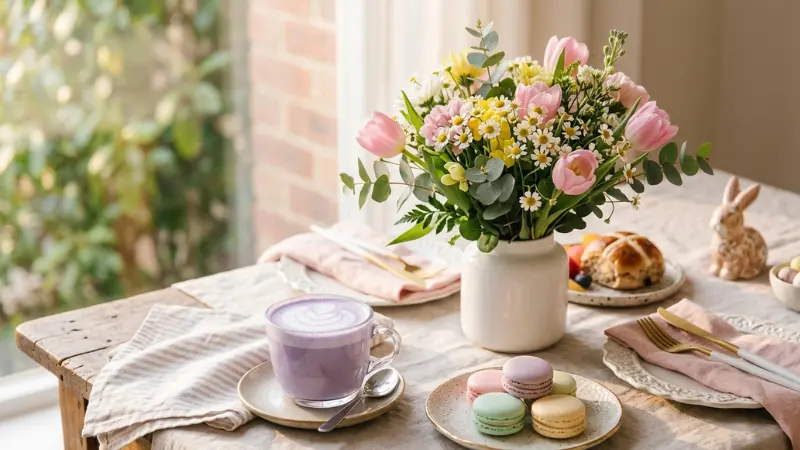
- Lavender speaks to purity and spiritual renewal, a softer echo of the deep purple used during Lent.
- Pale pink reflects the first blush of tulips and cherry blossoms, what colour experts describe as the visual language of new beginnings.
- Mint green, as Samuel Charmetant of the Artmajeur art gallery has observed, represents the literal new growth of spring, whether you read that metaphorically or biologically.
- Baby yellow carries the warmth of sunlight returning after months of grey.
- Baby blue mirrors the clear sky of a cool spring morning, evoking the serenity that Easter’s narrative of resurrection promises.
What is striking about this Easter colour palette is that it wasn’t designed by a branding team. It was accumulated, through centuries of seasonal association, religious symbolism, and the simple fact that these are the colours the world turns when it comes back to life each April.
The Psychology Behind Why This Palette Works So Well Online
There is a reason the Easter aesthetic travels so effectively across social media, and it has as much to do with neuroscience as it does with nostalgia.
Pastel colours, as a category, are specifically calibrated to reduce visual stress. They sit in the lighter, less saturated range of the colour spectrum, which means they trigger a calmer psychological response than bold or high-contrast hues.
When someone is scrolling through a feed full of noise and information, a soft lavender flat lay or a mint green tablescape acts almost as a visual exhale. The algorithm rewards content that makes people pause, and content that soothes tends to stop thumbs in their tracks.
The timing compounds this effect. Easter arrives at exactly the moment when people in the Northern Hemisphere are psychologically craving a reset. After months of dark mornings, grey skies, and the slow compression of winter, the Easter aesthetic shows up as the chromatic equivalent of opening a window.
It doesn’t just communicate a holiday. It communicates a feeling and that feeling was already building in people before they ever opened the app.
This is what makes the Easter colour palette such a potent marketing asset. It is, as Hathaway has described, “filled with soft and sweet pastels” that inspire nostalgia, but it is also precisely timed to land when people are most emotionally receptive to its promise.
What the Numbers Tell Us About Colour and Commerce
It is worth pondering on the commercial aspect, because the numbers are genuinely staggering.
According to the National Retail Federation (NRF), 81% of Americans planned to celebrate Easter in 2024, with total consumer spending reaching $22.4 billion, the third-highest per-person spend in the survey’s history, at $177.06 per person (NRF, 2024 Easter Survey).
The breakdown reveals where the Easter colour palette does its real work: food accounted for $7.3 billion, clothing for $3.5 billion, gifts for $3.4 billion, candy for $3.1 billion, and flowers for $1.6 billion.
By 2025, that total climbed again to $23.6 billion, even as spending on other goods slowed.
People are not just buying products. They are buying into the vibe. Limited-edition pastel packaging drives impulse purchases.“Spring refresh” messaging lifts conversions in skincare and wellness.
Brands that visually align with the Easter colour palette, even tangentially see stronger seasonal performance, not because the products changed, but because the presentation did.
The aesthetic is the marketing. And the aesthetic, it turns out, is centuries old.
How Social Media Gave the Palette a Stage
Pinterest came first, turning Easter into a Pinterest inspo machine, a place where people could save tablescapes, DIY egg ideas, and outfit mood boards weeks before the actual holiday. That created anticipation, and anticipation made the holiday feel like a project rather than just a date on the calendar.

Instagram polished it into a performance. The brunch table wasn’t just a meal anymore, it was a composition. Flowers became props. Even nail art entered the frame, with pastel florals and glazed finishes generating millions of views every spring.
TikTok added motion and personality: egg hunts, baking videos, get-ready-with-me reels. Suddenly Easter had a content arc, days of build-up, the main event, the aftermath.
Through all of this, what solidified was something marketers rarely manage to manufacture: a visual grammar. Easter developed a set of colour rules that, if followed, signal instantly to anyone scrolling past, this is Easter content.
That kind of immediate recognition is extraordinarily valuable. It is brand equity, built collectively over years by millions of creators who were not thinking about branding at all. They were just trying to make something beautiful, and the algorithm rewarded them for doing it in pastels and golden morning light.
The Colour That Social Media Forgot
There is one Easter colour that almost never appears in a feed, and it is worth naming: Good Friday, the day before the brunch tables and the pastel outfits and the spring walks is traditionally marked in many churches by red and, eventually, the stripping of all colour from the altar. It is about grief, sacrifice, and sitting with something heavy.
It does not fit the feed.
There are no soft edges in grief. No flattering angles on silence. And so the algorithm, which rewards beauty and engagement, skips from Lent’s purple straight to Sunday’s gold. This is not a moral failing of social media, it is simply how platforms work. They do not censor depth; they just do not reward it. And over time, the things that are not rewarded quietly disappear from the cultural surface, even if they endure underneath.
For anyone thinking about seasonal branding: the Easter palette works precisely because it is joyful and frictionless. But the brands that build lasting resonance are usually the ones willing to occasionally go deeper than the highlight reel.
What This Means for Anyone Building a Seasonal Content Strategy
Easter’s transformation into a social media aesthetic is not a cultural accident. It is a masterclass in how a deep emotional need, a distinctive visual language, and precise timing can combine into something that markets itself.
The spring content strategy lesson here is not to copy the Easter aesthetic. It is to understand why it works: the colours arrive at a moment of collective psychological hunger, they carry symbolism that makes them feel meaningful rather than arbitrary, and they are instantly recognisable across contexts.
That is a formula that translates far beyond any single holiday.
Every brand building seasonal relevance should be asking the same set of questions.
- What is the emotional moment we can genuinely own?
- What visual language can we build that is rooted in something real, not manufactured?
- What timing makes our message feel like it arrived at exactly the right moment?
Easter did not succeed because brands pushed it. It succeeded because it tapped into something people already felt, the quiet, collective relief of winter ending and gave it a colour palette precise enough to be instantly recognisable, yet open enough for anyone to make it their own.
That is not just a holiday strategy. That is a content strategy. And it works year-round.