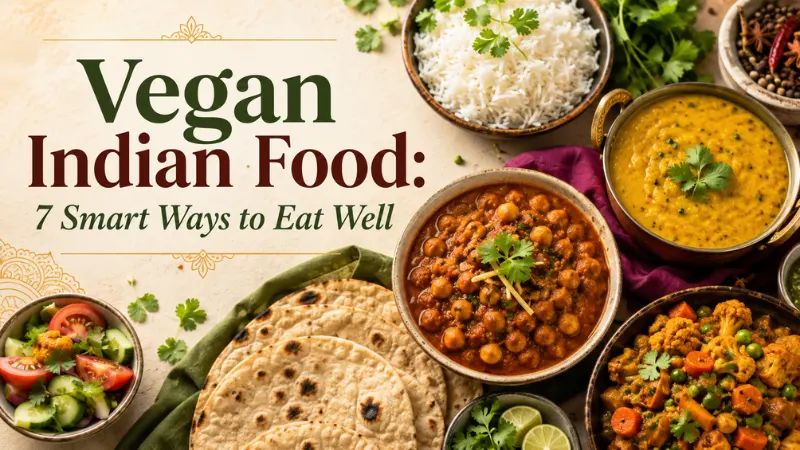
Vegan Indian food is Indian cuisine made without meat, dairy, eggs, ghee, or honey. It matters because many Indian staples—dal, chana, rajma, rice, roti, vegetables, chutneys, and spices—are naturally plant-based, affordable, and nutrient-dense when planned with enough protein, fiber, iron, B12, and healthy fats.
Introduction
In India, 81% of adults limit meat in some way, and 39% identify as vegetarian, according to Pew Research Center (2021). Vegan Indian food appeals to people who want familiar flavors, plant-based meals, and practical nutrition without expensive specialty products.
The market opportunity is also growing. India’s vegan food market is projected to reach about $1.12 billion in 2026, according to Grand View Research. Forecasts show continued growth through 2033. This guide explains what counts as vegan in Indian cuisine, why it matters, how to build a balanced plate, and common mistakes to avoid.
What is vegan Indian food?
Vegan Indian food is Indian cooking that uses only plant-based ingredients: grains, pulses, legumes, vegetables, fruits, nuts, seeds, herbs, spices, and plant oils. It excludes dairy-based ingredients such as ghee, paneer, cream, yogurt, butter, and milk.
Many traditional dishes are already close to vegan: chana masala, sambar, rasam, aloo gobi, baingan bharta, lemon rice, poha, idli, dosa, rajma, and many chutneys. The key is checking hidden dairy, especially in restaurant gravies, naan, sweets, and “tadka” made with ghee. Nutritionally, Indian plant-based meals work best when pulses, beans, soy, nuts, seeds, vegetables, and whole grains are combined across the day. ICMR-NIN’s 2024 dietary guidance recommends variety across food groups and emphasizes vegetables, whole grains, pulses, nuts, and seeds as core parts of a healthy Indian plate.
Why vegan Indian food matters in 2026
Vegan Indian food matters in 2026 because it sits at the intersection of health, affordability, culture, and sustainability.
That distinction matters. Oxford researchers reported in Nature Food that vegan diets had about 30% of the environmental impact of high-meat diets across greenhouse gas emissions, land use, water use, water pollution, and biodiversity loss (Scarborough et al., 2023).
At the same time, the Food Foundation (2024) found that beans and grains were among the healthiest, lowest-cost, and most environmentally beneficial plant-protein choices compared with meat and many processed substitutes. For Indian home cooks, that makes dal-chawal, khichdi, rajma-rice, and chana-roti strategically better than relying only on mock meats.
How to build a balanced plant-based Indian plate — step by step
- Choose one protein-rich base.
Use dal, chana, rajma, tofu, soy chunks, sprouts, or besan. Pulses and beans help make the meal more filling and support protein intake. - Add a whole grain or millet.
Pick brown rice, roti, jowar, bajra, ragi, quinoa, or hand-pounded rice. ICMR-NIN recommends making at least half of cereals and grains whole or minimally polished. - Fill half the plate with vegetables.
Use sabzi, salad, greens, gourds, cauliflower, okra, brinjal, carrots, or beans. ICMR-NIN’s vegetarian “My Plate” model includes 400 g vegetables and 100 g fruit per 2,000 kcal pattern. - Use healthy fats deliberately.
Cook with measured oil, then add nuts, seeds, coconut, peanuts, or sesame chutney for flavor and satiety. - Check the dairy swaps.
Replace ghee with oil, paneer with tofu, cream with cashew paste, and yogurt with unsweetened peanut, coconut, or soy curd.
Common mistakes to avoid
The biggest mistakes are usually hidden dairy, low protein, and over-reliance on refined carbs.
- Assuming every vegetarian dish is vegan: Paneer, ghee, curd, malai, butter, and milk often appear in “veg” dishes.
- Eating only rice and potatoes: Add dal, beans, tofu, sprouts, soy, nuts, or seeds to improve balance.
- Ignoring B12: A fully plant-based diet usually needs fortified foods or a supplement; ask a qualified clinician.
- Overusing oil-heavy restaurant foods: Vegan does not automatically mean light; fried snacks and creamy gravies can still be calorie-dense.
Expert tips for vegan Indian cooking
Use the ICMR-NIN “My Plate for the Day” framework as a planning tool: build meals around vegetables, cereals or millets, pulses, nuts, seeds, and measured fats instead of treating curry as the whole meal.
Batch-cook three components weekly: one dal or bean curry, one dry sabzi, and one chutney. This makes quick meals easier.
Use umami builders—tomato paste, roasted cumin, kasuri methi, tamarind, mushrooms, hing, and browned onions—to replace the richness usually supplied by ghee or cream.
For restaurant ordering, ask: “Is this made with ghee, butter, cream, curd, paneer, or milk?” That one question prevents most accidental dairy.
Conclusion
Vegan Indian food is not a restrictive trend; it is a practical way to use Indian staples for flavorful, affordable, plant-based eating. The strongest approach is simple: combine pulses or beans with whole grains, vegetables, measured fats, and smart dairy swaps. Start today by choosing one familiar dish—chana masala, rajma, sambar, or dal—and making it fully plant-based. Then build a weekly meal plan around three proteins, three vegetables, and two grains or millets.