
AI in Sports: How Teams Use Data, Wearables and Analytics to Win
22
0



YouTube ads don’t have a fixed price. What you pay depends on your ad format, bidding strategy, target audience, competition, and campaign goals. Some YouTube campaigns charge for qualifying video views, while others use impressions or optimize toward conversions.
For US businesses, that means there isn’t one reliable average cost per view that applies to every advertiser. Instead, understanding YouTube’s different pricing models will help you build a budget around what you’re trying to achieve.
Whether you’re promoting a local business, online store, or growing brand, here’s what YouTube advertising actually costs, how the charges work, and how to decide what you should spend.
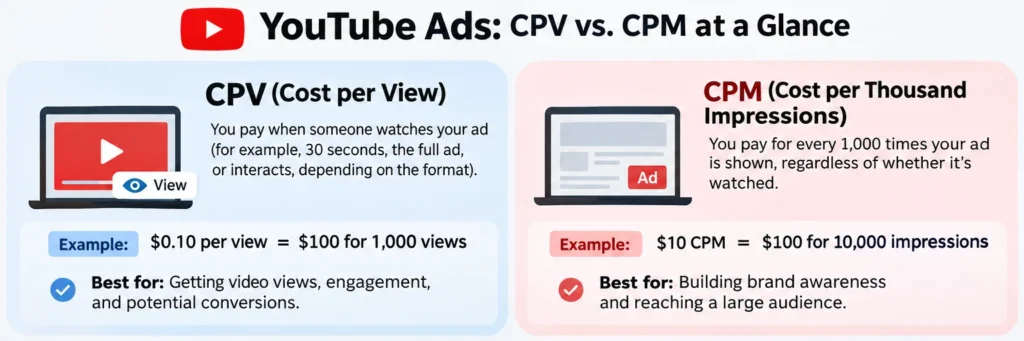
YouTube advertising costs are commonly discussed using two metrics: cost per view (CPV) and cost per thousand impressions (CPM).
Cost per view (CPV) measures the amount paid for a qualifying video view under a CPV bidding model.
Cost per thousand impressions (CPM) measures the cost of showing your ad 1,000 times.
Google Ads uses auction-based pricing, meaning your actual costs depend on competition, audience targeting, bidding, and campaign settings.
To understand how different rates affect your budget, consider these hypothetical examples:
| Pricing model | Example rate | Estimated advertising cost |
|---|---|---|
| CPV | $0.05 | $50 for 1,000 views |
| CPV | $0.10 | $100 for 1,000 views |
| CPV | $0.20 | $200 for 1,000 views |
| CPM | $5 | $50 for 10,000 impressions |
| CPM | $15 | $150 for 10,000 impressions |
| CPM | $25 | $250 for 10,000 impressions |
Note: These are mathematical examples, not verified average YouTube advertising prices for 2026.
For example, if your average CPV is $0.10, purchasing 10,000 qualifying views would cost approximately $1,000.
However, views and impressions aren’t interchangeable. Someone might see an ad impression without watching enough of the video to qualify as a view.
Understanding what you’re paying for is essential before comparing campaign costs.
YouTube advertising operates through Google Ads, which offers different bidding strategies depending on your campaign objective.
With CPV bidding, advertisers pay for qualifying video views or interactions.
According to Google Ads’ official CPV documentation, an in-stream video view generally qualifies when someone watches at least 30 seconds, watches the entire ad if it’s shorter than 30 seconds, or interacts with the ad.
For in-feed ads, a qualifying view may occur when someone clicks the video thumbnail or watches at least 10 seconds of eligible autoplay.
For YouTube Shorts ads, a CPV view generally qualifies after 10 seconds, the full duration of a shorter ad, or a call-to-action click.
Importantly, these rules apply to CPV measurement. Not every YouTube campaign uses CPV billing.
With CPM bidding, advertisers focus on how frequently their ads appear rather than paying directly for each qualifying view.
For example, an illustrative CPM of $10 would mean approximately $100 for 10,000 impressions.
This pricing model is useful for advertisers whose primary objective is brand awareness or reach.
Some Google Ads campaigns optimize toward conversions, such as purchases, inquiries, or lead submissions.
These campaigns may use automated bidding strategies instead of requiring advertisers to pay a fixed price for every view.
The important metric becomes how much you’re spending to generate a meaningful business result.
Different YouTube advertising formats serve different marketing purposes.
| YouTube ad format | Typical buying approach | Primary use |
|---|---|---|
| Skippable in-stream ads | CPV or other campaign-dependent bidding | Views, awareness, conversions |
| Non-skippable in-stream ads | Impression-based buying | Brand messaging and reach |
| Bumper ads | Impression-based buying | Short awareness messages |
| In-feed video ads | CPV in eligible video-view campaigns | Video discovery and engagement |
| YouTube Shorts ads | CPV or other campaign-dependent bidding | Mobile-first video engagement |
Skippable in-stream ads give viewers the option to skip after the initial seconds. In eligible CPV campaigns, an early skip without interaction typically doesn’t generate a chargeable view.
Non-skippable and bumper ads work differently because advertisers generally buy impressions rather than qualifying views.
Shorts ads offer an additional opportunity to reach audiences watching vertical videos.
No single format is automatically the cheapest or most effective. The better choice depends on your audience, video creative, and campaign objective.
You don’t need to start with a massive advertising budget. However, you should spend enough to gather useful performance data without risking money your business cannot afford to lose.
Consider these illustrative daily budgets for a US small business:
| Average daily budget | Monthly spending limit for most campaigns |
|---|---|
| $10 | $304 |
| $25 | $760 |
| $50 | $1,520 |
Google Ads calculates the monthly spending limit for most campaigns using the average daily budget multiplied by 30.4.
For example, Google’s official documentation confirms that a $10 average daily budget corresponds to a $304 monthly spending limit when the budget remains unchanged throughout a full month.
Google also explains that some campaigns can spend up to twice their average daily budget on an individual day while remaining within the applicable limits.
You can review these rules in Google Ads’ spending limits documentation.
A $10–$25 average daily budget may be a reasonable initial testing range for some smaller businesses. This is a planning suggestion, not a Google Ads minimum or a guaranteed amount needed for results.
Businesses with expensive products, narrow target audiences, or longer sales cycles may require different budgets.
Your audience influences advertising competition.
Targeting a broad consumer audience may create different auction conditions than targeting decision-makers interested in specialized business services.
Narrower targeting isn’t automatically more expensive, but audience availability and advertiser demand can affect campaign costs.
Advertising to customers across the United States may produce different results than targeting a particular city or region.
For a local business, geographic relevance can matter more than maximizing nationwide impressions.
Some businesses compete in markets where acquiring one customer is especially valuable.
That can influence what advertisers are willing to bid, although actual YouTube costs still depend on the auction and campaign settings.
Campaigns optimized for views, reach, or conversions are designed to achieve different outcomes.
A campaign delivering inexpensive views may not provide the most cost-effective leads or sales.
Your video’s opening, message, pacing, and call to action influence how people respond.
A video that immediately addresses a customer’s problem may be more relevant than one that begins with a lengthy brand introduction.
Testing different creative approaches can help identify which messages produce useful engagement.
For additional targeting ideas, explore RethinkTrends’ guide to reaching your ideal audience without wasting ad spend.
The cost of views alone doesn’t tell you whether your campaign is successful.
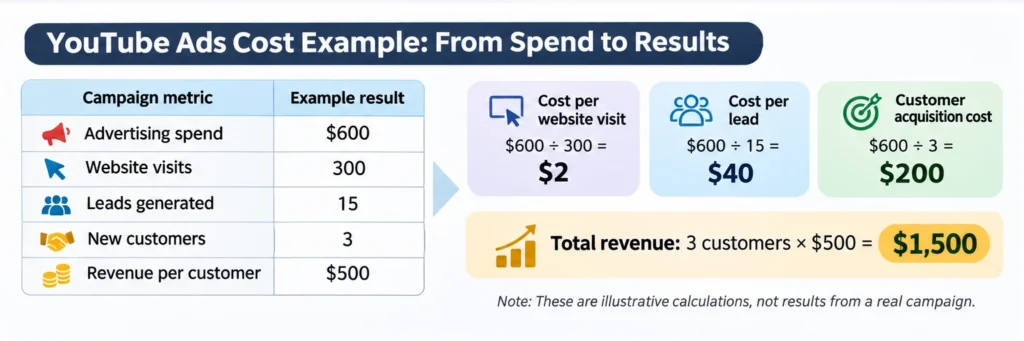
Imagine a US service business runs a YouTube campaign with the following hypothetical results:
| Campaign metric | Example result |
|---|---|
| Advertising spend | $600 |
| Website visits | 300 |
| Leads generated | 15 |
| New customers | 3 |
| Revenue per customer | $500 |
Based on these assumptions:
Cost per website visit: $600 ÷ 300 = $2
Cost per lead: $600 ÷ 15 = $40
Customer acquisition cost: $600 ÷ 3 = $200
Three customers paying $500 each would generate $1,500 in revenue.
However, that doesn’t mean the business earned $900 in profit. The calculation excludes employee time, service delivery costs, production expenses, and other business overhead.
These figures are illustrative calculations, not results from a real advertising campaign.
This example shows why businesses should evaluate YouTube advertising using meaningful outcomes rather than focusing exclusively on low CPV or CPM figures.
Reducing advertising costs doesn’t necessarily mean choosing the lowest bid. It means improving the value generated by your spending.
Start with a clear objective. Decide whether your campaign should increase awareness, generate website visits, or produce leads and sales.
Target relevant audiences. Choose geographic areas and audience signals that make sense for your customers. Avoid unnecessarily broad targeting when your business serves a specific market.
Improve your video’s opening. Communicate the main benefit early and give viewers a reason to continue watching.
Test different advertisements. Compare variations in messaging, visual presentation, and calls to action. Avoid changing every campaign setting simultaneously, since that makes performance comparisons difficult.
Optimize your landing page. If viewers click your ad, the destination should load efficiently, explain the offer clearly, and make the next action easy.
Track conversions accurately. Configure appropriate conversion measurement before evaluating lead generation or sales performance.
A controlled testing process can help you understand which combinations of targeting, creative, and offers produce better results.
For broader campaign planning, see RethinkTrends’ complete guide to digital marketing.
YouTube advertising can be worthwhile when your customers use video content and your business can connect advertising activity to measurable goals.
A local service provider might use YouTube to introduce its services to nearby customers. An online retailer might demonstrate how a product works. A B2B company might use educational video content to reach relevant business audiences.
However, advertising success isn’t guaranteed.
A campaign that generates thousands of views without meaningful customer interest may be less valuable than a smaller campaign producing qualified inquiries.
Before increasing spending, consider your customer acquisition cost, conversion quality, profit margins, and overall return.
If your campaign has limited conversion data, avoid treating early results as conclusive proof of future performance.
Yes, a small campaign can be planned around a $100 total budget, subject to Google Ads’ available campaign settings. However, that amount may not generate enough data to reliably evaluate lead generation or sales performance.
At a hypothetical $0.05 cost per view, 1,000 qualifying views would cost $50. At $0.10 CPV, they would cost $100. Actual prices vary by campaign and auction conditions.
Under eligible CPV-based skippable in-stream campaigns, viewers who skip before reaching the qualifying threshold without interacting generally do not trigger a chargeable view. Other bidding models have different charging rules.
Not necessarily. Shorts and traditional video placements have different viewing experiences and measurement rules. Compare performance using the same business goals before deciding which is more cost-effective.
How much do YouTube ads actually cost in 2026? There is no universal fixed price.
Your advertising spend depends on the format, bidding model, target audience, competition, and campaign objectives.
CPV and CPM help you understand media costs, but metrics such as cost per lead, customer acquisition cost, and return on advertising spend provide a clearer picture of business value.
For US businesses getting started, the most practical approach is to choose an affordable test budget, target a relevant audience, create compelling video advertisements, and measure results before scaling.
The goal isn’t simply to buy cheaper views. It’s to turn advertising spending into meaningful business results.

Log in to support this story.
New here? Create an account


Discussion · 0 Comments
No comments yet — be the first to share your thoughts.