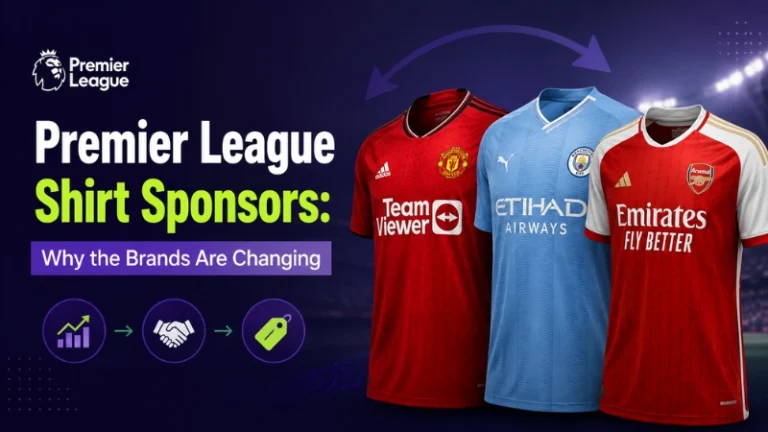
Why Are Premier League Shirts Sponsored by Companies You’ve Never Heard Of?
1
0


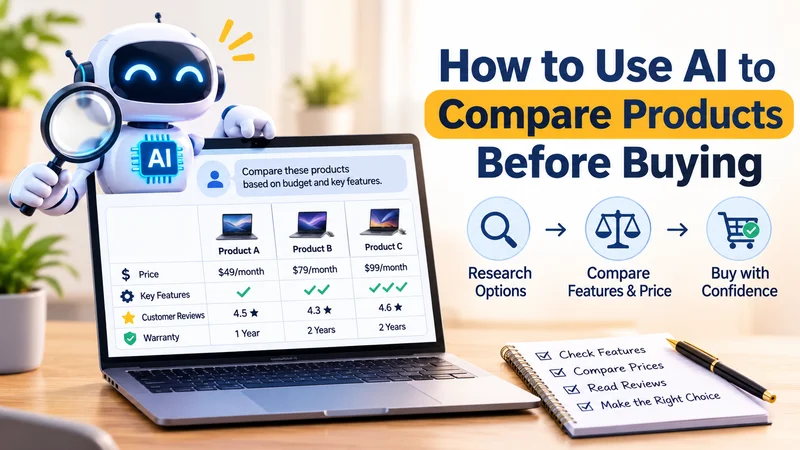
An AI assistant can turn an overwhelming shopping search into a manageable shortlist. Tell it what you need, and it may organize features, explain trade-offs, or suggest questions you had not considered. But it can also cite an outdated price, confuse similar model numbers, or confidently describe a feature that does not exist. The smartest approach is to use AI as a research assistant—not as the final authority on what to buy.
Related reading: What Is Agentic Commerce? How AI Agents Are Changing Online Shopping
Before asking for recommendations, write down your budget, intended use, must-have features, dealbreakers, and location. A shopper choosing headphones for video calls has different priorities from someone choosing them for long flights. Without that context, an AI-generated “best” list may simply favor popular products rather than suitable ones.
Try this prompt: “I’m shopping in the United States for [product]. My total budget, including tax and shipping, is [amount]. I’ll use it for [purpose]. My three priorities are [list]. My dealbreakers are [list]. Ask me up to three clarifying questions before suggesting options.”
Once you have a shortlist, request a table showing model number, key specifications, limitations, warranty, estimated ownership costs, and the source for each claim. Tell the assistant to write “not verified” wherever it lacks reliable evidence. This is more useful than asking which product is “best,” because it makes gaps visible.
For example, compare two laptops by exact processor, memory configuration, display, ports, repairability, battery-test methodology, and return policy. A shared brand name does not guarantee that two retail configurations have the same hardware.
Related reading: Should You Buy an AI Smartphone?
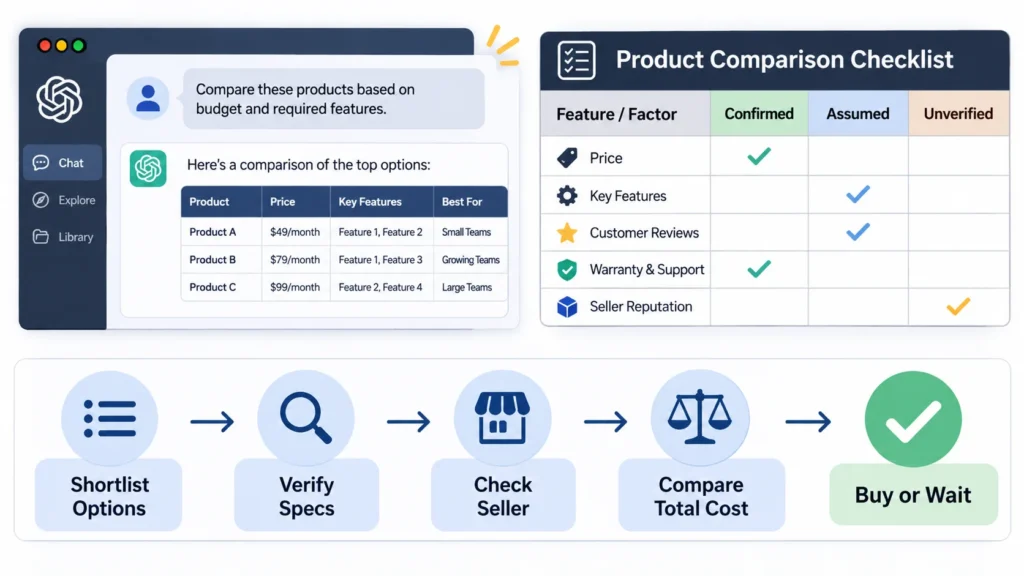
Open the manufacturer’s product page and check the exact model identifier. Confirm dimensions, compatibility, included accessories, warranty terms, and whether a feature is available in the US version. If a claim matters to your decision, do not rely on an AI summary or a reseller’s abbreviated listing. For independent performance claims, look for testing that explains its method and identifies the tested model.
A useful second prompt is: “List the five claims in your comparison that most need independent verification. For each, tell me what document or official page I should check. Do not invent links.”
AI-generated prices can be stale or drawn from different sellers, configurations, or regions. Visit the retailer directly and confirm the current item price, shipping, sales tax estimate, delivery date, and any mandatory fees. Compare like for like: a refurbished item, an open-box product, and a new product may appear side by side but offer different protections.
The Federal Trade Commission advises shoppers to compare model numbers and total costs, read return terms, and investigate sellers across multiple sources. A “deal” is only useful if it is for the right item from a seller you can trust.
The purchase price is not always the whole cost. Printers need ink, appliances use energy, smart devices may require subscriptions, and replacement parts may be expensive. Ask AI to create a total-cost checklist, then verify the figures yourself. Do not treat an estimated five-year cost as a fact unless each input is supported.
Prompt: “For these three models, list potential costs after purchase—consumables, maintenance, subscriptions, accessories, repairs, and warranty exclusions. Separate confirmed facts from assumptions. Explain which costs depend on my usage.”
Related reading: How to Spot Fake Online Reviews Before You Buy (planned companion article)
AI can help group recurring review themes, such as confusing setup or unreliable connectivity. However, it may overstate a pattern or summarize fabricated reviews. Read several detailed reviews from different sources, prioritize verified firsthand testing where possible, and check recent feedback for the exact model. The FTC warns that ratings and reviews can be misleading or manipulated.
Avoid pasting full payment-card numbers, account passwords, order receipts containing personal identifiers, or private financial details into a chatbot. You can describe your budget and preferences without sharing sensitive data. Review the assistant’s privacy settings and the shopping service’s data practices before connecting accounts or granting purchasing permissions.
If the decision involves medical devices, safety-critical equipment, legal requirements, or a major financial commitment, seek appropriately qualified guidance and authoritative documentation. AI may still help you prepare questions, but it should not replace expert assessment.
It may help identify sellers or price-comparison approaches, but it cannot guarantee that a quoted price is current, available, or the lowest. Confirm prices directly before purchasing.
Treat rankings as starting points. Ask how products were selected, what evidence supports the order, and whether sponsored placements or missing information could affect the result.
A prompt that specifies your budget, use case, priorities, exact models, source requirements, and a request to label unverified claims will usually be more useful than “Which one is best?”
AI is most valuable when it helps you ask better questions and organize evidence. Let it build the comparison; let verified specifications, actual prices, trustworthy sellers, and your own priorities determine the purchase.

Log in to support this story.
New here? Create an account


Discussion · 0 Comments
No comments yet — be the first to share your thoughts.