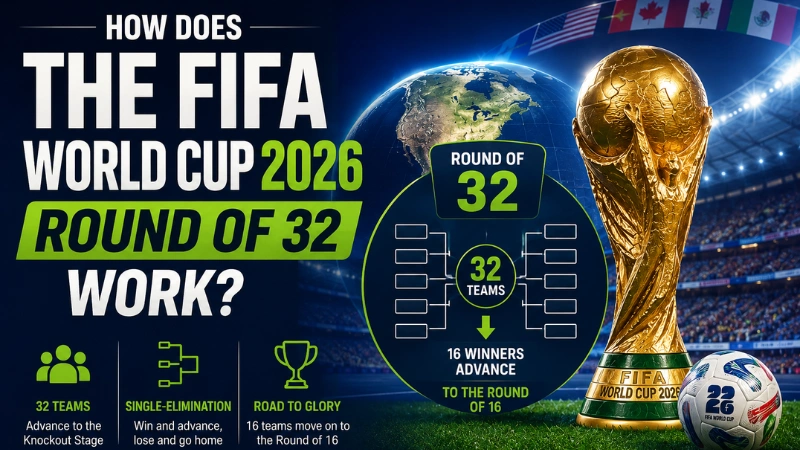
The FIFA World Cup 2026 Round of 32 is the first knockout stage of the tournament. A total of 32 teams qualify after the group stage: the top two teams from each of the 12 groups and the eight best third-placed teams. From this round onward, every match is single elimination.
Quick Answer: FIFA World Cup 2026 Round of 32
- The 2026 World Cup has 48 teams divided into 12 groups of four.
- The top two teams from each group qualify automatically for the Round of 32.
- The eight best third-placed teams also qualify.
- The Round of 32 has 16 knockout matches.
- Winners move to the Round of 16; losing teams are eliminated.
What Is the Round of 32 in FIFA World Cup 2026?
The Round of 32 is the first knockout round of the FIFA World Cup 2026. It begins after all group-stage matches are completed. Unlike the group stage, where teams can still recover after a loss, the Round of 32 is a direct elimination stage.
That means one simple rule applies: win and continue, lose and go home.
This round is especially important in 2026 because it is the first time the men’s FIFA World Cup uses a 48-team format with a 32-team knockout stage. Earlier editions, such as the 2022 World Cup, moved from the group stage directly to the Round of 16. In 2026, the expanded tournament adds one extra knockout round.
Why Does the FIFA World Cup 2026 Have a Round of 32?
The FIFA World Cup 2026 has a Round of 32 because the tournament has expanded from 32 teams to 48 teams. To manage the larger number of teams, FIFA has divided the tournament into 12 groups of four teams each.
After the group stage, 32 teams qualify for the knockout rounds. This creates a longer knockout pathway:
Round of 32 → Round of 16 → Quarter-finals → Semi-finals → Third-place match → Final
The new format gives more teams a chance to participate in the World Cup while also keeping the knockout stage competitive and exciting.
How Do Teams Qualify for the FIFA World Cup 2026 Round of 32?
Teams qualify for the Round of 32 through two routes: automatic qualification from the group standings and qualification as one of the best third-placed teams.
| Qualification Route | Number of Teams | How They Qualify |
|---|---|---|
| Group winners | 12 | Finish 1st in their group |
| Group runners-up | 12 | Finish 2nd in their group |
| Best third-placed teams | 8 | Ranked among the top eight third-place teams |
| Total teams in Round of 32 | 32 | Enter the knockout stage |
Each of the 12 groups has four teams. After every team plays three group matches, the group table decides who advances.
The first-place and second-place teams from each group automatically qualify. This gives 24 teams. Then FIFA compares the 12 third-placed teams and selects the best eight among them. These eight teams complete the Round of 32 lineup.
How Are the Best Third-Placed Teams Selected?
This is one of the most important parts of the new FIFA World Cup 2026 format.
Because there are 12 groups, there will be 12 teams that finish third in their group. However, only eight of them qualify for the Round of 32. The remaining four third-placed teams are eliminated.
FIFA ranks the third-placed teams using these criteria:
| Ranking Order | Criteria |
| 1 | Greatest number of points in all group matches |
| 2 | Better goal difference |
| 3 | Greater number of goals scored |
| 4 | Higher team conduct score |
| 5 | FIFA/Coca-Cola Men’s World Ranking, if still tied |
In simple words, a third-placed team with more points has the best chance of qualifying. If teams have the same points, goal difference becomes important. If they are still tied, goals scored and disciplinary record can decide qualification.
Example: How a Third-Placed Team Can Qualify
Imagine four teams finish third in different groups with these records:
| Team | Points | Goal Difference | Goals Scored | Result |
| Team A | 4 | +1 | 5 | Strong chance to qualify |
| Team B | 4 | 0 | 4 | Still in good position |
| Team C | 3 | +2 | 6 | Depends on other groups |
| Team D | 2 | -1 | 2 | Likely eliminated |
In this example, Team A and Team B would probably rank higher than Team D because they have more points. Team C has a strong goal difference, but points are checked first, so a team with four points usually has an advantage over a team with three points.
This is why every group-stage goal matters in the 2026 World Cup. Even a draw or a late goal can decide whether a third-placed team reaches the Round of 32.
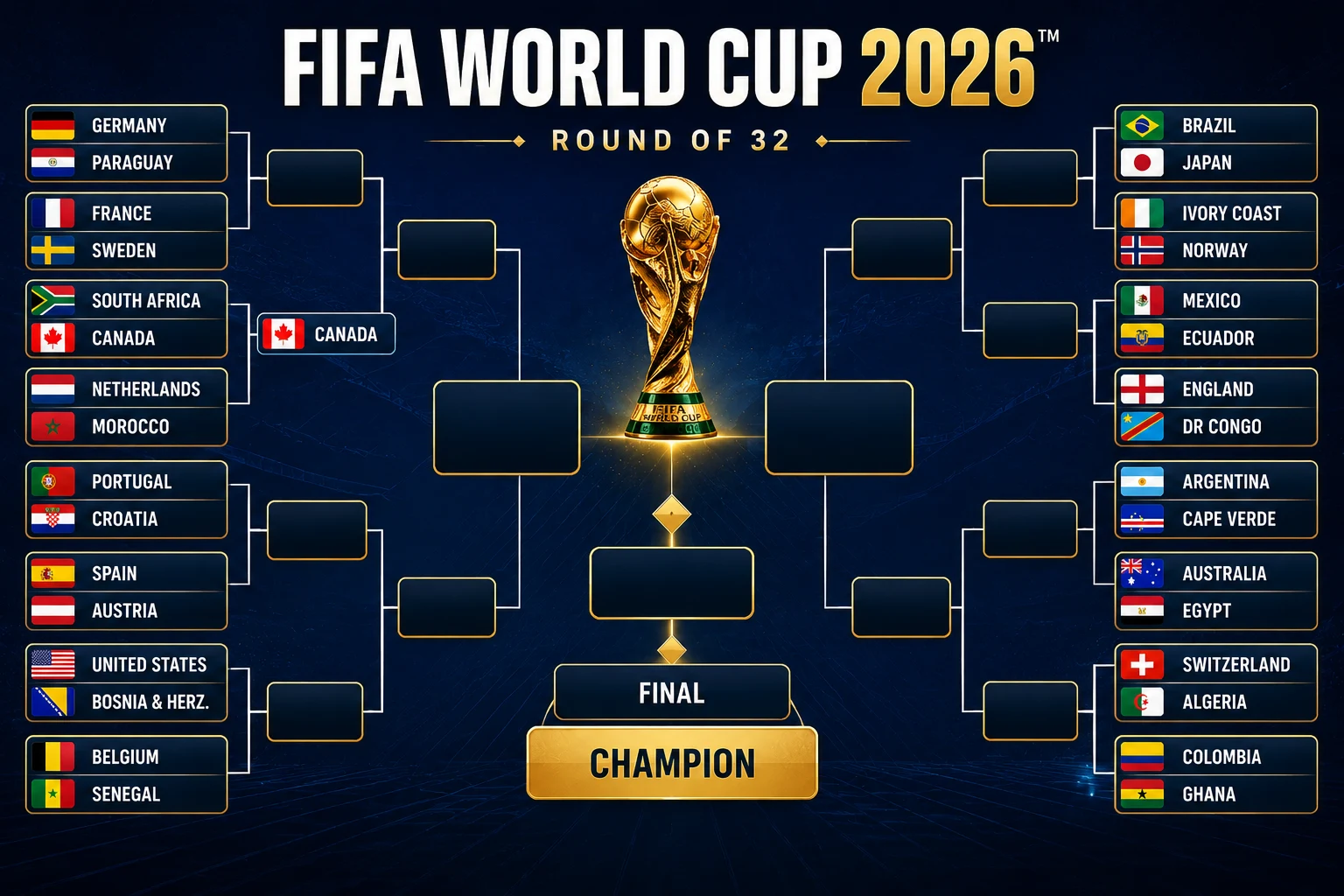
How Does the Round of 32 Bracket Work?
The Round of 32 bracket is not random. FIFA uses a fixed knockout bracket system based on group positions.
The bracket includes:
- Group winners
- Group runners-up
- Eight best third-placed teams
A group winner may face a third-placed team, while runners-up can be paired against other runners-up depending on the bracket position. FIFA also uses pre-set combinations to decide where the qualified third-placed teams fit into the bracket.
One important rule is that teams from the same group cannot meet again in the Round of 32. This prevents an immediate rematch between teams that already played each other in the group stage.
Because only eight of the 12 third-placed teams qualify, FIFA’s regulations include many possible combinations for how those third-placed teams can be placed into the Round of 32 bracket.
Round of 32 Format at a Glance
| Feature | FIFA World Cup 2026 Round of 32 |
| Stage type | Knockout round |
| Number of teams | 32 |
| Number of matches | 16 |
| Qualification | Top two from each group + eight best third-placed teams |
| Match result | Winner advances, loser eliminated |
| Draw possible? | No |
| Extra time | Yes, if level after normal time |
| Penalties | Yes, if still level after extra time |
| Next stage | Round of 16 |
What Happens If a Round of 32 Match Ends in a Draw?
A Round of 32 match cannot finish as a draw because it is a knockout match.
If the score is level after 90 minutes, the match goes to extra time. Extra time has two periods of 15 minutes each.
If the teams are still level after extra time, the winner is decided by a penalty shootout.
So the knockout rule is simple:
90 minutes → Extra time → Penalties → Winner advances
This format applies throughout the knockout stage, including the Round of 32, Round of 16, quarter-finals, semi-finals, third-place match, and final.
What Comes After the Round of 32?
After the Round of 32, the 16 winning teams move into the Round of 16. From there, the tournament continues in a traditional knockout format.
| Stage | Number of Teams | Number of Matches |
| Round of 32 | 32 | 16 |
| Round of 16 | 16 | 8 |
| Quarter-finals | 8 | 4 |
| Semi-finals | 4 | 2 |
| Third-place match | 2 | 1 |
| Final | 2 | 1 |
Every round reduces the number of teams until only two teams remain for the final.
Why the Round of 32 Matters More in 2026
The Round of 32 makes the 2026 World Cup more competitive because more teams can reach the knockout stage. It also creates more high-pressure matches for fans.
For smaller or lower-ranked football nations, the new format offers a better chance to reach the knockout rounds. For stronger teams, it adds one more must-win match on the road to the final.
This also means the eventual World Cup champion will need to survive more knockout pressure than in past 32-team editions.
In the 2022 World Cup, a team had to win four knockout matches to become champion: Round of 16, quarter-final, semi-final, and final. In 2026, the champion must win five knockout matches: Round of 32, Round of 16, quarter-final, semi-final, and final.
Simple Example: Team Path to the Final
Here is how a team can move through the FIFA World Cup 2026 knockout stage:
| Round | What the Team Must Do |
| Group stage | Finish 1st, 2nd, or as one of the best third-placed teams |
| Round of 32 | Win one knockout match |
| Round of 16 | Win again |
| Quarter-final | Reach the final four |
| Semi-final | Win to enter the final |
| Final | Win to become world champion |
This longer knockout path makes consistency, squad depth, and fitness even more important in the 2026 World Cup.
Key Difference Between 2022 and 2026 World Cup Format
| Feature | FIFA World Cup 2022 | FIFA World Cup 2026 |
| Total teams | 32 | 48 |
| Groups | 8 groups | 12 groups |
| Teams per group | 4 | 4 |
| First knockout round | Round of 16 | Round of 32 |
| Teams in knockout stage | 16 | 32 |
| Knockout wins needed to become champion | 4 | 5 |
The biggest change is that the 2026 World Cup gives 32 teams a place in the knockout rounds instead of 16.
FAQs
1. How many teams play in the FIFA World Cup 2026 Round of 32?
A total of 32 teams play in the FIFA World Cup 2026 Round of 32. These include 12 group winners, 12 group runners-up, and the eight best third-placed teams.
2. How many teams qualify from each group?
The top two teams from each group qualify automatically. A third-placed team can also qualify if it ranks among the eight best third-placed teams across all 12 groups.
3. Can a third-placed team qualify for the Round of 32?
Yes. Eight third-placed teams qualify for the Round of 32 in the FIFA World Cup 2026. They are selected by comparing all 12 third-placed teams using points, goal difference, goals scored, team conduct score, and FIFA ranking if needed.
4. Is the Round of 32 a knockout round?
Yes. The Round of 32 is a knockout round. The winner advances to the Round of 16, while the losing team is eliminated from the tournament.
5. Can a Round of 32 match end in a draw?
No. A Round of 32 match cannot end in a draw. If the score is level after 90 minutes, the match goes to extra time. If it is still level after extra time, penalties decide the winner.
6. Why is there a Round of 32 in the 2026 World Cup?
There is a Round of 32 because the 2026 World Cup has expanded to 48 teams. With more teams in the tournament, FIFA added an extra knockout round after the group stage.
Final Thoughts
The FIFA World Cup 2026 Round of 32 is one of the biggest changes in modern World Cup history. With 48 teams, 12 groups, and eight best third-placed qualifiers, the tournamemant gives more countries a chance to reach the knockout stage.
For fans, the rule is simple: after the group stage, 32 teams enter the knockout rounds, and every match becomes win-or-go-home. The Round of 32 adds more drama, more storylines, and more pressure on every team chasing the World Cup trophy.