
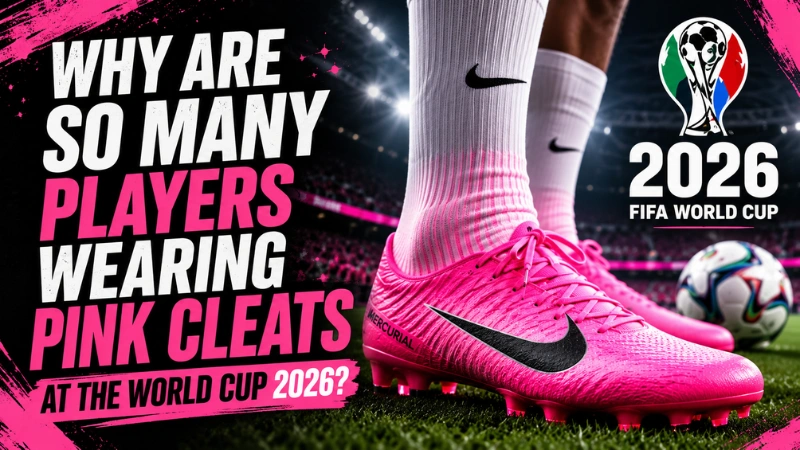
Players are wearing pink cleats at the FIFA World Cup 2026 because pink is one of the easiest colors to see on a green soccer field. It pops on grass, looks sharp on TV, survives tiny mobile-screen highlights, and rarely clashes with national team uniforms.
That is the quick answer.
But the better answer is much more interesting: this is what happens when Nike, Adidas, Puma, New Balance, Skechers and other brands all solve the same marketing problem using the same data.
They all wanted one thing: visibility.
They all looked at the same green pitch. They all saw the same 2026 color trend. They all reached the same conclusion.
And now, almost everyone looks the same.
The World Cup pink cleats trend is not just a fashion moment. It is a perfect sports marketing case study about color science, trend forecasting, brand sameness, and the weird comedy(tragedy) of billion-dollar companies accidentally joining the same group chat.
The simple reason pink cleats work on a soccer field
A soccer field is a giant green canvas. That is important.
When a player is sprinting, turning, shooting, or sliding, the cleats are small and moving fast. For a brand, that creates a problem. How do you make a tiny product visible in a match full of bodies, grass, shadows, camera cuts, and motion blur?
You choose a color that fights the background.
Pink does that extremely well.
FOX Sports reported that pink cleats stand out strongly against the green pitch and are highly visible for fans watching in stadiums, on TV, and on mobile screens. The same report also noted another useful detail: no participating World Cup country has a primarily pink uniform, so the cleats do not usually disappear into the kit.
That makes pink both practical and commercial. It is not just “pretty.” It is engineered attention.
This matters because modern soccer is watched everywhere. A World Cup goal is not only seen live. It becomes a replay, a TikTok clip, an Instagram reel, a thumbnail, a meme, a boot review, and a screenshot. A cleat color has to work across all those formats.
Pink works because it is loud even when the screen is small.
Why pink cleats became the World Cup’s unofficial uniform
The funny part is that pink was supposed to create difference.
Instead, it created sameness.
Adidas, Nike, Puma, New Balance, and Skechers all released pink-themed cleats for the 2026 World Cup, with different brand names and slightly different shades. Adidas had “Solar Turbo.” Puma had “Poison Pink.” Other brands had their own versions too.
On a product page, those cleats may look different. A boot nerd can identify the soleplate, the upper, the logo placement, the texture, the silhouette, the athlete association.
But on a wide broadcast angle?
Most people just see pink.
That is the problem. The color made the footwear visible, but it made the brands harder to separate. Page Six reported that sneaker observers saw the trend as a possible branding backfire because so many companies released similar pink-toned cleats at the same time, making individual brands less distinct.
In other words, the brands won the visibility battle together.
And because they won it together, no one clearly won it alone.
Pink Cleats Are Actually A Trend Forecasting.
The pink cleats did not appear randomly.
World Cup products are planned years in advance. Brands have to design the cleats, test them, sign off with athletes, manufacture them, prepare campaigns, ship them to retailers, and launch them at the perfect moment. Nike and U.S. Soccer executives have publicly discussed how World Cup preparation can involve years of planning, including four years of tournament prep and a six-year jersey design process.
So the color decisions for many 2026 World Cup products were likely made long before fans saw the cleats on the field.
This is where WGSN and Coloro enter the story.
WGSN and Coloro identified “Electric Fuchsia” as one of the key colors for Spring/Summer 2026. WGSN described it as a vivid neon shade between pink and purple, with a kinetic and digital quality.
That description almost sounds designed for World Cup cleats.
Bright. Digital. Youthful. Energetic. Perfect for screens. Perfect for clips. Perfect for a tournament built around global attention.
The Guardian also connected hot pink’s World Cup dominance to WGSN’s earlier forecast that bright pink, described as electric fuchsia, would be popular in 2026.
So no, Nike, Adidas, and Puma probably did not sit in a secret room and decide, “Let us all make the same pink cleats.”
The more likely explanation is funnier.
They all read the same signals.
The self-fulfilling prophecy of pink cleats
Trend forecasting is often treated like prediction. But in industries this big, it can become something closer to instruction.
Here is how the loop works.
A major trend agency says electric fuchsia will be important in 2026. Big brands build collections around electric fuchsia. Retailers stock electric fuchsia. Athletes wear electric fuchsia. Fans see electric fuchsia everywhere. Then everyone says, “Wow, electric fuchsia is really trending.”
But did the trend happen naturally?
Or did the industry build the trend because everyone believed the forecast?
That is the fascinating part.
The pink cleats trend feels like a self-fulfilling prophecy. The forecast did not merely describe the future. It helped manufacture it.
And because many brands subscribe to similar trend intelligence, they often move in similar directions at similar times. The result is not always innovation. Sometimes it is synchronized sameness.
That is exactly what seems to have happened here.
The brands were trying to stand out, but they were all using the same map.
Why this is such a strange branding failure
The whole point of a World Cup cleat pack is differentiation.
A brand wants you to see a player score and instantly think: Nike. Adidas. Puma. New Balance. Skechers.
It wants the boot to carry identity.
But if too many brands use the same color family, that identity gets blurry.
The 2026 World Cup’s wave of pink boots sparked debate among fans, with many feeling the tournament lacked the variety and distinct brand identities typically showcased in major boot collections.
SoccerBible previewed the World Cup boot packs and referred to the expected visual effect as a “sea of pink,” while noting that there were still custom and nostalgic designs for fans willing to look beyond the obvious.
That phrase is perfect: sea of pink.
A single pink cleat is a signal. A sea of pink is camouflage.
That is the contradiction at the heart of this trend. Pink was selected because it was visually loud. But when everyone becomes loud in the same way, loudness becomes background noise.
Pink cleats used to be shocking. Now they are normal.
To understand why this is so strange, you have to remember that soccer cleat colors used to be conservative.
For decades, black and dark leather boots were the default. A player wearing white, red, gold, or pink was making a statement.
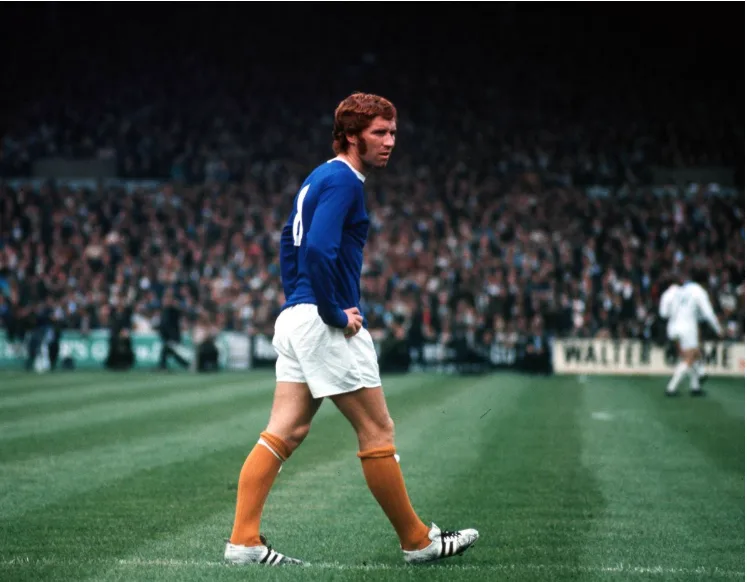
Alan Ball’s white boots in 1970 were treated as genuinely unusual. Footy-Boots has documented how Ball’s white Hummel boots drew attention on TV and helped turn colored football boots into a commercial opportunity.
Pink arrived much later as an even louder disruption. Nike released its first pink football boots in 2008, with Nicklas Bendtner becoming the first player to wear them. At the time, pink boots were headline material because they were still unusual in football culture.
That is what makes 2026 so different.
Pink is no longer rebellion. Pink is the mainstream.
A color that once said “look how different I am” now says “I am part of the tournament trend.”
That is not bad. It just shows how quickly visual codes change in sports.
Why players actually like bold pink cleats
The brands are not the only ones driving this.
Players also want cleats that feel bold, confident, and expressive.
The Associated Press reported that major brands including Nike, Adidas, Puma, Skechers, and New Balance came out with pink boots for the World Cup. It also quoted Nike’s Odinga Nimako saying athletes associate bold pink with confidence and standing out.
That matters because elite players are not only athletes now. They are also personal brands.
A modern soccer player exists in match footage, campaign shoots, Instagram posts, tunnel fits, boot launches, YouTube edits, and fan pages. Their cleats are part of the visual identity.
The product has to perform on grass. But it also has to perform as content.
Pink does that well. It looks fast. It looks modern. It looks made for a screen.
That is why the color took over so easily.
Why Messi’s non-pink cleats stood out more
Here is the best irony of the whole story.
Once pink became common, not wearing pink became more interesting.
Lionel Messi is the cleanest example. Instead of blending into the pink wave, Messi wore Adidas cleats inspired by Argentina’s colors. Adidas described the F50 Messi Elite firm ground soccer cleats as being painted in Argentina’s iconic colors and worn by Messi at the FIFA World Cup 26.
Messi and Christian Pulisic are examples of players who chose more personal or patriotic cleat designs instead of simply following the pink trend.
That is powerful because Messi’s cleats are not just visible.
They mean something.
Pink says: “Notice me.”
Messi’s cleats say: “Argentina. Legacy. Last dance. Memory.”
That is the difference between attention and meaning.
Attention makes people look. Meaning makes people remember.
And at a World Cup, meaning usually wins.
The marketing lesson from the World Cup pink cleats trend
The pink cleats trend is a warning for every marketer.
Data is useful. Research is useful. Trend forecasting is useful. But if every competitor has access to the same insight and reacts in the same way, the insight stops being an advantage.
The problem was not that pink was wrong.
Pink was very right. That is why everyone picked it.
The problem was that brands confused visibility with distinctiveness.
A brand can be visible and still forgettable. A cleat can be bright and still anonymous. A product can be everywhere and still fail to own a clear idea in the consumer’s mind.
That is what happened here.
The brands did not disappear because nobody saw them. They disappeared because everyone saw the same thing.
So, why are players wearing pink cleats at the World Cup?
Players are wearing pink cleats at the World Cup 2026 because pink is highly visible against green grass, performs well on TV and mobile screens, fits the electric fuchsia color trend, and gives players a bold, confident look.
But the bigger story is that too many brands followed the same logic at the same time.
Nike, Adidas, Puma, New Balance, Skechers, and others all tried to create the most noticeable cleats of the tournament. Instead, they created one of the best branding case studies in modern soccer.
Pink did exactly what it was supposed to do. It stood out.
Then it stood out so much, and so often, that it stopped standing out.
And that is why the most memorable cleats at this World Cup may not be the pink ones at all.
They may be the ones brave enough to mean something else.
Frequently Asked Questions (FAQs)
- Why are so many players wearing pink cleats at the World Cup 2026?
Players are wearing pink cleats because pink contrasts strongly with green grass and remains highly visible on TV, mobile screens, and social media clips. - Are they called cleats or football boots?
In the United States and Canada, people usually say “soccer cleats” or simply “cleats.” In the UK and many other football markets, people usually say “football boots.” - Which brands made pink cleats for the World Cup?
Adidas, Nike, Puma, New Balance, and Skechers have all released pink-themed or pink-heavy cleats for the 2026 World Cup. - Did the brands plan the pink cleats trend together?
There is no clear evidence that the brands coordinated together. The stronger explanation is that they followed similar color forecasting, visibility logic, and consumer trend data. WGSN and Coloro had already identified Electric Fuchsia as a key Spring/Summer 2026 color. - Why do non-pink cleats now stand out more?
Because pink became so common that it lost some uniqueness. Custom or national-color designs, like Messi’s Argentina-inspired cleats, feel more personal and easier to remember.